When you watch a modern NFL or college game, the chess match between a quarterback and the secondary is the main attraction. You’ll hear announcers debate whether the defense is “sitting in a soft zone” or “locking up in man-to-man.” It feels like these two philosophies have existed since the first pigskin was inflated.
But if you had to guess which one came first, what would you say? Most people assume man-to-man is the original form—it’s intuitive, after all. “I’ve got this guy, you’ve got that guy.” However, according to football historian Timothy B. Brown, the answer is actually the exact opposite.
The Pre-Forward Pass Era
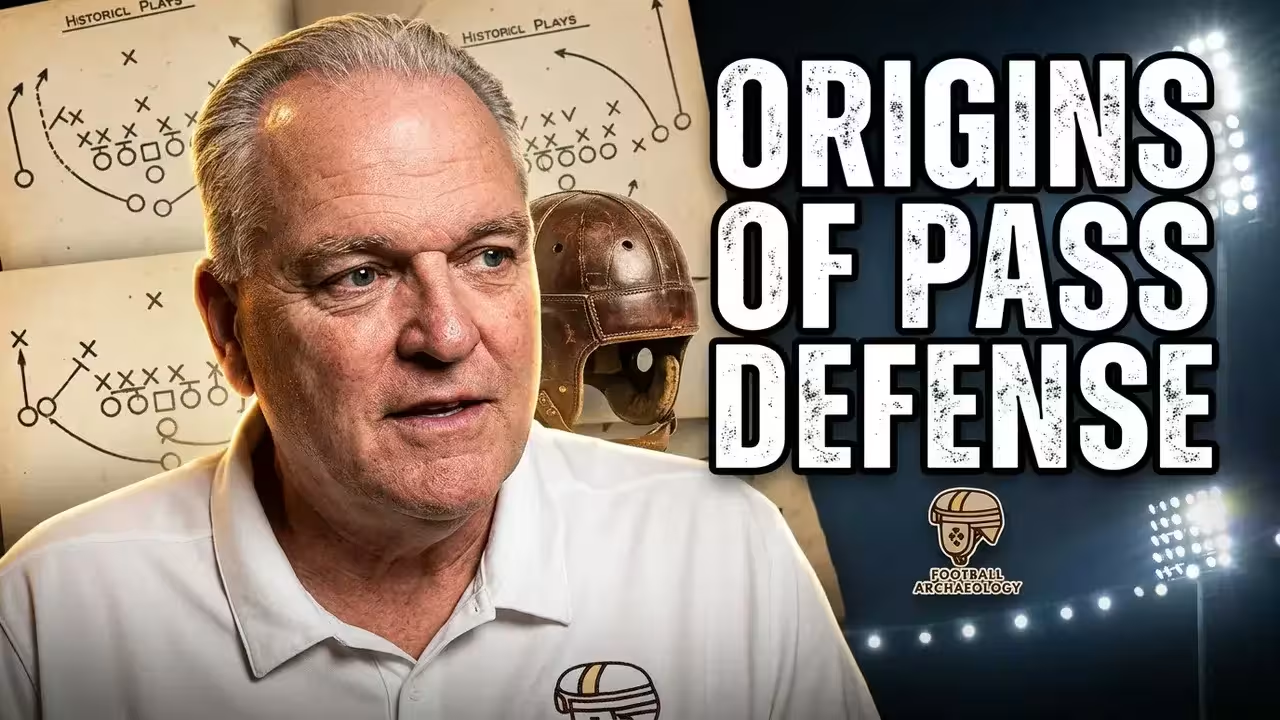
In a recent conversation with Darin Hayes on the Football Archaeology segment, Brown explained that to understand pass defense, you have to look at the game before 1906—when the forward pass didn’t even exist.
Back then, football was a game of pure “cloud of dust” rushing. Defenses focused on the line of scrimmage, typically utilizing:
- The Diamond (1-2-1): Four backs positioned to stop the run.
- The Box (2-2): A tighter formation designed to stifle sweeps and outside runs.
The Surprising Birth of Zone
When the forward pass was legalized in 1906, it was heavily restricted. Passers had to be five yards to the left or right of the center, and most teams only sent one or two receivers out.
Because the passing game was so clunky and inaccurate, defenders simply stayed in their “territories.” This was the earliest form of zone defense. Players weren’t assigned to a specific person; they were simply responsible for whatever eligible receiver entered their patch of grass.
Why the Shift to Man-to-Man?
So, how did we get to the tight, jersey-grabbing man-to-man coverage we see today? It was a matter of necessity. As the rules evolved, so did the strategy:
- 1910 Rule Change: The requirement to be five yards left or right of the center was scrapped. Now, quarterbacks could snap the ball and throw anywhere—right, left, or over the middle.
- Flooding the Zone: Offenses started sending four receivers out at once. If a defense stayed in a static zone, the offense would simply put two receivers in one defender’s “territory,” forcing him to choose one and leave the other open.
- The “Spy” and Star Power: By the 1920s, legends like Red Grange forced defenses to change. Teams like Ohio State would put two dedicated defenders on Grange wherever he went. This specialized “spy” tactic was one of the first major shifts toward man-to-man principles.
The Modern Mix
As Darin Hayes noted during the discussion, zone defense can be a disaster if not executed perfectly—just ask any high school coach. Yet, it remains the foundation of the game because of how the forward pass began. It wasn’t until the 1950s, with the advent of “two-platoon” football and full-time assistant coaches, that we saw the sophisticated “Umbrella” defenses and hybrid schemes we recognize today.
The next time you see a cornerback “on an island,” remember: he isn’t playing the oldest version of the game. He’s playing the evolved version.
What do you think is harder to execute: a perfect zone or lockdown man-to-man?