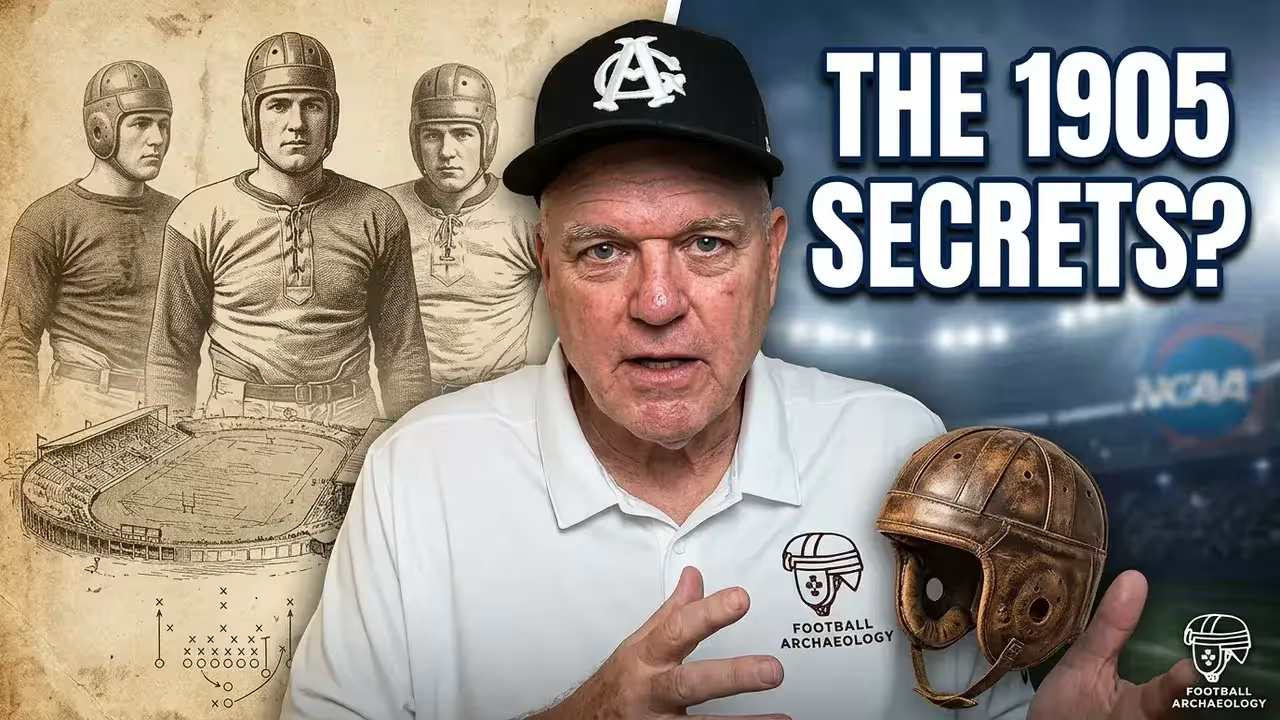
The Army-Navy rivalry is one of the most storied traditions in American sports. Every year, millions of fans tune in to watch the Midshipmen and the Black Knights battle for service academy bragging rights. However, few realize that a logistical crisis surrounding the 1905 Army-Navy game fundamentally shifted how college football stadiums were built and laid the groundwork for the modern NCAA.
In a recent episode of the Pigskin Dispatch podcast, host Darin Hayes sat down with Tim Brown of Football Archaeology to unearth this fascinating piece of gridiron history. The story centers on two young military figures who would later become prominent historical titans: William “Bull” Halsey and Palmer E. Pierce. Today’s conversation stems from one of Tim’s Tidbits titled: Bull Halsey, Palmer E. Pierce, and the 1905 Army-Navy Game.
The Ticket Crisis at Penn’s Franklin Field
By the early 1900s, the Army-Navy game had grown into a massive national spectacle. Politicians, military officials, and wealthy alumni swarmed the gates. At the time, the game was hosted at the University of Pennsylvania’s Franklin Field—then one of the largest stadiums in the United States.
Under the existing agreement, ticket distribution was split evenly: one-third each to Army, Navy, and Penn. Because Penn used its ticket allocation for its own students, donors, and influential local figures, the academies found themselves facing an intense ticket shortage. Powerful congressmen even threatened to cut academy funding if they didn’t get their seats.
Tasked with resolving this high-stakes deadlock were Navy’s athletic representative, “Bull” Halsey (who would go on to become a legendary World War II Fleet Admiral), and Army’s representative, Palmer E. Pierce. When Penn refused to give up their share of the tickets, Halsey and Pierce walked away from the negotiating table, pulling the 1905 game out of Philadelphia and moving it to Princeton.
The Princeton Disaster and a New Stadium Philosophy
While Princeton possessed a fine stadium, the town itself lacked the infrastructure to handle a massive influx of out-of-town travelers. Special trains choked the small station, and there weren’t enough hotels or restaurants to accommodate the crowd. The event was a logistical nightmare, forcing Halsey and Pierce to return to Penn with their tails between their legs.
A new compromise was struck for 1906: Penn built temporary stands behind the goal line, giving all those extra seats to the academies while preserving their own allocation.
As Tim Brown pointed out, this era reflected a completely different mindset regarding sports architecture. Today, stadiums are built to maximize consistent weekly attendance. Back then, massive venues like the Yale Bowl or Harvard Stadium were constructed primarily to accommodate the peak capacity of a single, highly anticipated annual game—often sitting mostly empty for the rest of the season. Army and Navy took a different path, choosing never to build massive permanent stadiums, opting instead to lease major neutral sites like Philadelphia’s Franklin Field, and later, Lincoln Financial Field.
The Birth of the NCAA
The 1905 season wasn’t just critical for stadium logistics; it was also the year of college football’s infamous “safety crisis,” during which brutal on-field play led to widespread calls to ban the sport entirely.
Palmer E. Pierce stepped up as West Point’s representative to a coalition initiated by New York University (NYU) to reform the game. While some schools wanted to abolish football, Pierce advocated for working alongside existing rule-makers to reform the sport safely. His leadership united conflicting factions, resulting in the creation of a new rulemaking body that officially became the NCAA in 1910. Pierce served as its very first president until 1913, cementing his legacy as a savior of American football.
The next time you watch the Black Knights and Midshipmen clash on the gridiron, remember that this historic rivalry did much more than produce great games—it shaped the administrative and architectural landscape of college football as we know it today.