From the 1874 Harvard-McGill showdown that birthed American football to the birthdays of gridiron legends Emmitt Smith and Ray Lewis, May 15th marks a cornerstone of football history. On this day, the “Harvard Rules” met the “Rugby All-Canada Code,” shifting the sport from soccer to the tactical, hard-hitting game we know. Whether you care about the evolution of safety gear or legendary Heisman winners and MVPs, May 15th delivers a masterclass in football’s enduring spirit.
May 15 American Football History Timeline
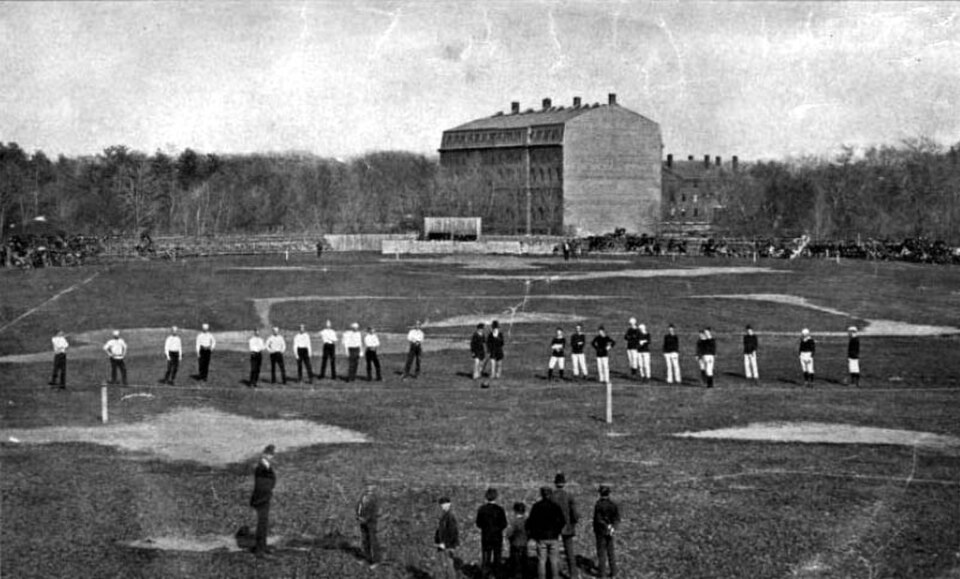
- May 15, 1874 – Harvard versus McGill game #2
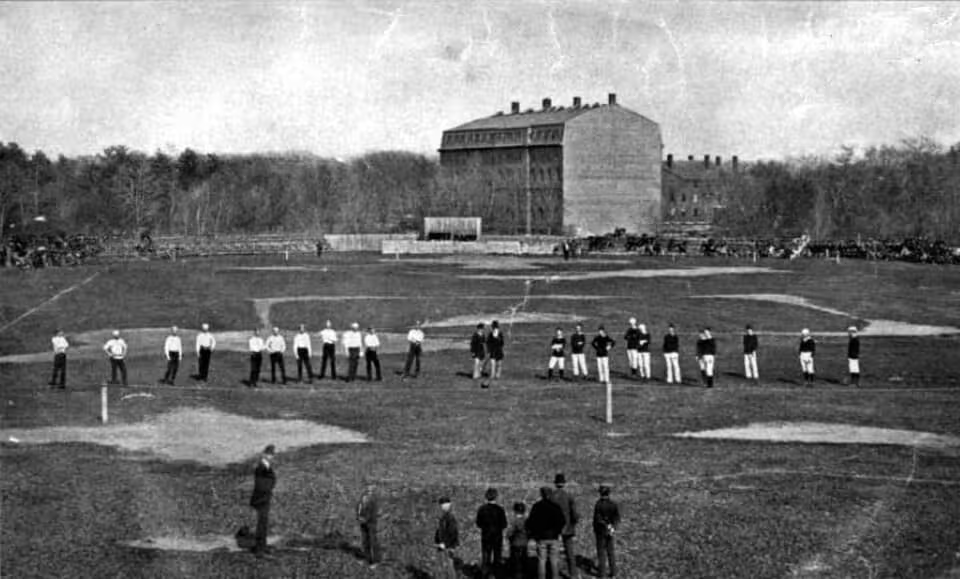
The May 16, 1874, edition of the Boston Post featured an excerpt titled “Foot-Ball.” The last football game between Harvard and McGill University was played yesterday afternoon at Jarvis Field. As yesterday’s first day’s play was under the Harvard rules, those of McGill were adopted. Three games of half an hour each were played, time being called at the expiration of each, without either club having been able to force the ball over the opposite goal. There was a large crowd and much enthusiasm.
Parke H. Davis, in his book from 1911 title, Football: The Intercollegiate Game, states that McGill University’s captain in 1874 was a player by the name of David Rodger and that it was he who sent the invitation for the game to Harvar.d. The first was suggested to be played during this May 1874 time period in Cambridge, Massachusetts, under the Rugby All-Canada code rules, and a second game was proposed to be played in Montreal that fall under the Harvard rules, thus introducing each school’s style of play to the fans of the host school. These proposed plans, of course, morphed into something even better. There was a lot of enthusiasm on both sides, and Harvard accepted the challenge.
The American Heritage website explains that two games were played: May 14 under Harvard rules (Harvard won 3-0) and May 15 under McGill’s rules (a scoreless tie). After a rematch in Montreal that October, Harvard ultimately adopted McGill’s version permanently.
In June 1875, Tufts defeated Harvard in the first football game between American teams. Later that fall, Harvard and Yale met for the first time, playing under “concessionary rules” that blended both teams’ games but leaned toward Harvard’s version. The following year, Harvard, Rutgers, Princeton, Columbia, and Yale came together to create the first standard set of college football rules, abandoning soccer entirely in favor of the Harvard-McGill game. So, the ultra-American sport of football turns out to have been invented in Canada—Quebec, yet.
- May 15, 1917 – H. Goldsmith submitted his idea for Football Pants With Protectors for US Patent 1225799.
May 15 Football Hall of Fame Birthdays
Happy Birthday to these legendary figures! Since today is May 15, we celebrate a lineup of icons who defined their eras with toughness, speed, and versatility.
Here is the list of gridiron greats born on this day, in order of birth:
- Eddie Talboom [1921]Nicknamed “Boom Boom,” this versatile Wyoming halfback was a WWII veteran who became the school’s first All-American in 1950. A triple-threat star in the single-wing offense, he was responsible for every point in Wyoming’s 1950 Gator Bowl victory and left college with an elite career average of 10.2 points per game.
- George Brown [1923]A standout guard and linebacker, Brown’s career spanned the US Naval Academy and San Diego State, with a notable interruption for heroic WWII service on the USS Indianapolis. He was an AP All-American in 1943 and later became a legendary “honorary captain” for the Aztecs, earning his place in the College Football Hall of Fame in 1985.
- Ron Simmons [1958]A two-time consensus All-American at Florida State, Simmons was a defensive tackle so dominant he finished ninth in the 1979 Heisman voting. After setting numerous school tackle records, he transitioned into a world-famous professional wrestling career, becoming the first African American WCW World Heavyweight Champion.
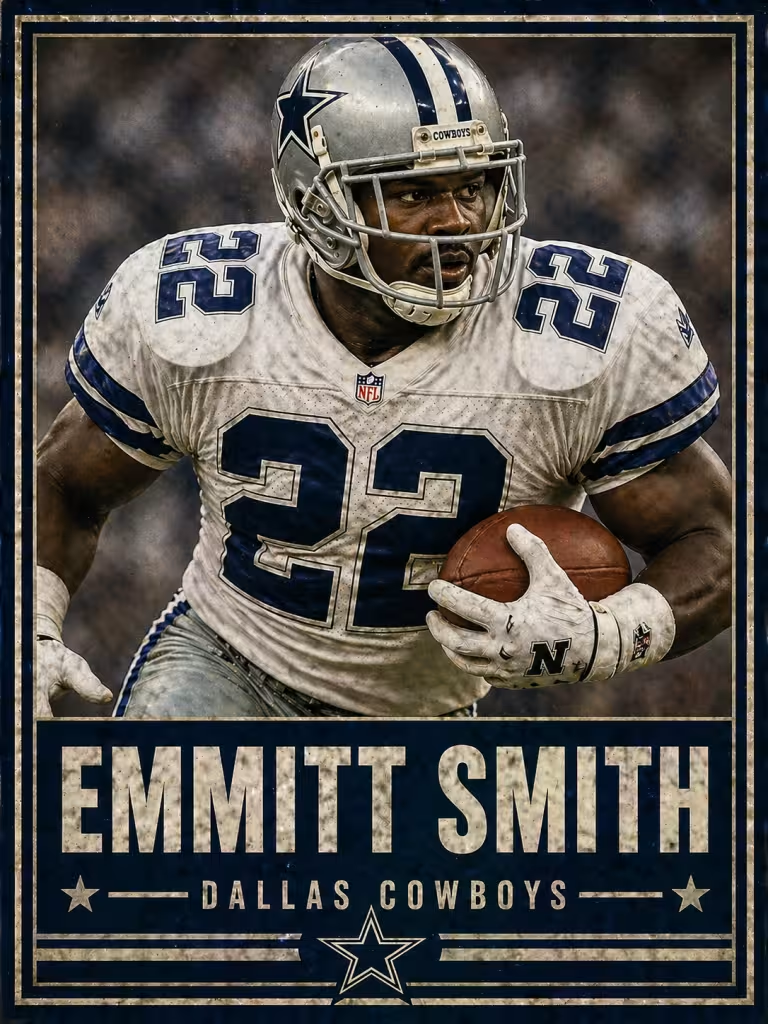
- Emmitt Smith [1969]A University of Florida sensation who set 58 school records in just three years, Smith went on to become the NFL’s all-time leading rusher with 18,355 yards. The Dallas Cowboys legend won three Super Bowls, a league MVP, and a Super Bowl MVP, cementing his status as one of the most durable and productive backs in football history.
EMMITT SMITH
1990–2002
- Desmond Howard [1970]The 1991 Heisman Trophy winner at Michigan, Howard was a dynamic wide receiver and return specialist who helped the Wolverines to three Big Ten titles. He famously translated that return magic to the pros, earning Super Bowl XXXI MVP honors after recording 244 total return yards and a 99-yard touchdown for the Green Bay Packers.
- Rod Smith [1970]An undrafted gem from Missouri Southern State, Smith defied the odds to become the Denver Broncos’ all-time leader in receptions, yards, and touchdowns. A key figure in Denver’s back-to-back Super Bowl titles (XXXII and XXXIII), he remains the most prolific undrafted wide receiver in NFL history.
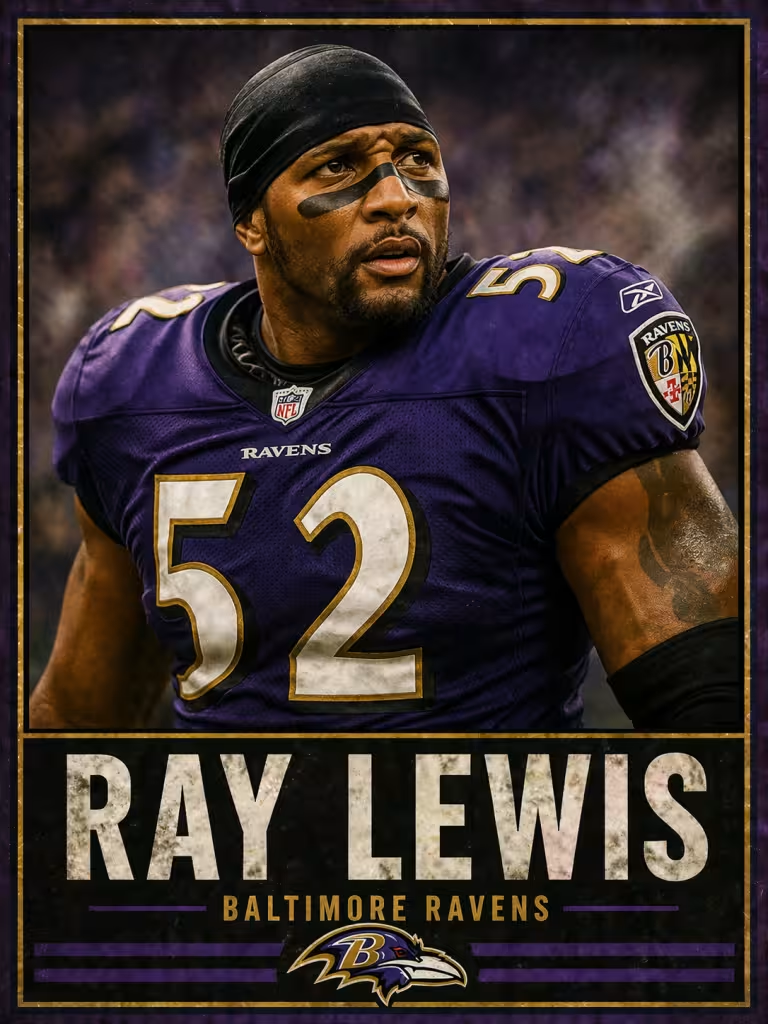
- Ray Lewis [1975] A ferocious linebacker out of the University of Miami, Lewis spent his entire 17-year career with the Baltimore Ravens, becoming the face of their dominant defense. He is one of the few players to win both the NFL Defensive Player of the Year and Super Bowl MVP in the same season, retiring with two Super Bowl rings and a reputation as the greatest middle linebacker of his generation.
RAY LEWIS
1996–2012
Conclusion
May 15th serves as a bridge between football’s humble beginnings on a field in Cambridge and its modern status as a cultural phenomenon. The legacy of this day is carried forward by the icons born upon it—from Emmitt Smith’s relentless rushing and Desmond Howard’s electric returns to Ray Lewis’s defensive dominance. These pioneers and players didn’t just participate in the game; they evolved it. As we look back on nearly 150 years of milestones, from the first “no-score” tie to the Hall of Fame busts in Canton, we see a sport that is constantly reinventing itself while honoring its legendary roots.