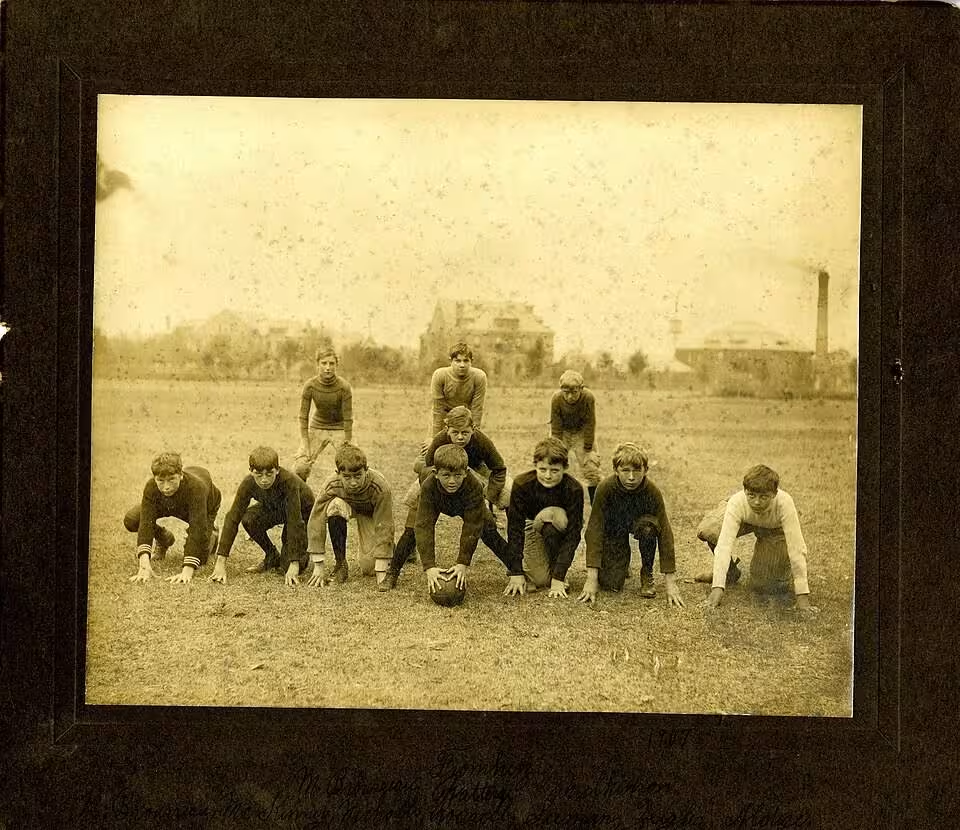
The 1907 American football season was a pivotal year as the sport evolved from its brutal, rugby-style roots. It was the second season after the landmark 1906 rule changes, most notably the legalization of the forward pass. These changes aimed to reduce on-field fatalities and injuries.
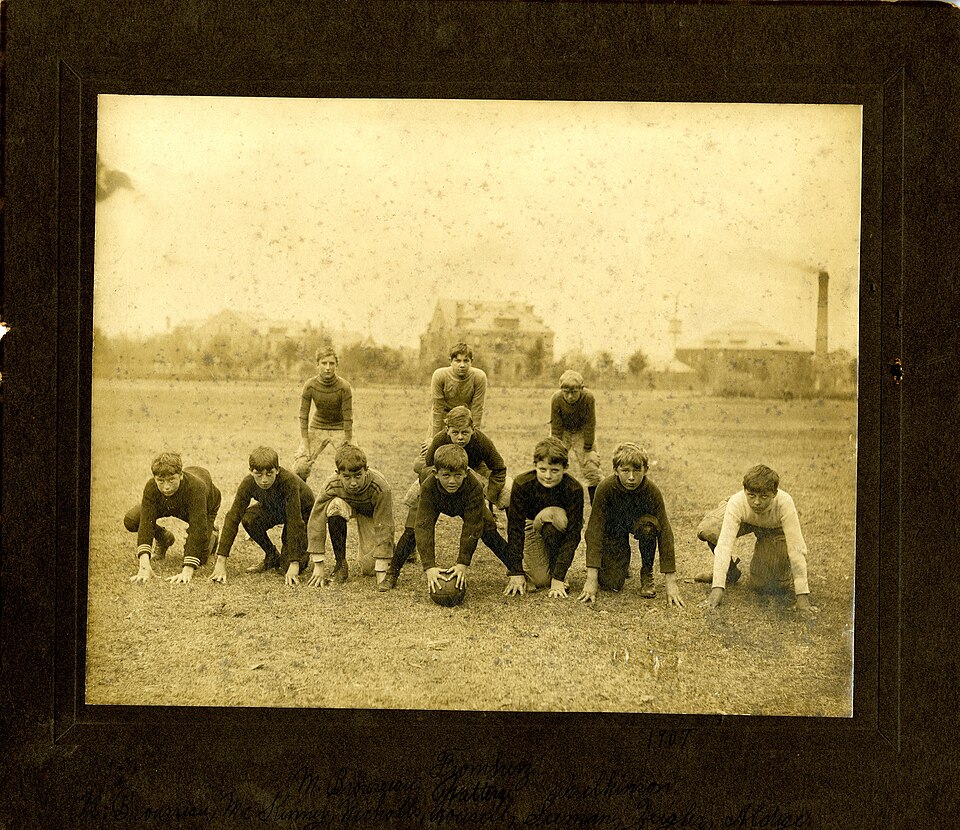
The Powerhouses and the National Title
The season was dominated by the “Big Three” (Yale, Princeton, and Harvard) and the rising stars of the West (now the Midwest).
- Yale University: Generally recognized as the national champion, Yale finished with a perfect 9–0–0 record. They were a defensive juggernaut, outscoring their opponents 186-10.
- Princeton: Had a strong year but fell to Yale 12–10 in a classic season finale that decided the undisputed king of the East.
The past few editions of this series have focused on the very important reforms made to the game in early 1906 by the group of football minds that would eventually become known as the NCAA. The changes were necessary because the game itself was at risk of extinction, as many sought to ban the dangerous athletic spectacle.
Some changes previously discussed included adopting a rudimentary forward pass, reducing regulation game times to two 30-minute halves, and countless other small changes in officiating duties and the like. We failed to mention in our last edition that Mr. John Heisman helped initiate the idea of the forward pass after he had seen it run illegally about a decade earlier.
One of the most important changes to help tame the mass grouping plays that seemed to cause most of the injuries came from our hero, Walter Camp.
Camp identified the problem.
Walter Camp, as we have seen, was not only a great player and coach but also an innovator in football. Ironically, one of Camp’s earlier innovations created the most likely contributor to the game’s unacceptably brutal nature: the mass momentum play.
Camp recognized that when he promoted reform in the 1800’s to create a system in which the offense needed to go at least 5 yards on 3 plays to prevent boring ball-control games, he had created another problematic flaw in the game. Teams could simply ramrod runners into a heavily defended line by pounding a mass of humanity against another. Injuries and ill feelings resulted from this style of play, as five yards was probably too short a distance to make it a challenge to obtain.
Camp earlier tried to persuade the five-yard line to be moved farther back, to no avail, particularly because rivals Princeton and Harvard used mass momentum plays as their main offensive strategy, and an increase in yardage to gain a first down was not in their best interest.
When Camp and other members of the old Intercollegiate Football Rules Committee were invited to join the other schools across the country in a joint session, Camp was faced with either being lost as a little fish in a big pond or great acceptance by the broader, larger population of rules makers who had a thirst for reform.
Camp knew that the meetings he would attend would be essentially an attack and a harsh scrutiny of the game he had developed. Walter Camp must have been a rare person because, rather than go into the arena of rule reform in a defensive mode, he entered the meetings with the mindset of tweaking the rules of the game to create an even better game that could stand the test of time. He wanted football to be a game of strategy, where those with knowledge and integrity could overcome a larger, more physical opponent through intellect.
Camp’s proposal of the increase of the yard to gain ten yards in four attempts or downs was widely accepted, and Camp fully expected the brutal runs up the middle to become a dinosaur of football plays, and that the exciting end runs would replace it. What eventually happened was that the forward pass nullified Camp’s dream because the threat of a pass forced the defensive backs to back off a little further to defend it, thereby reducing the reinforcement potential the backs used to stuff the run. To Camp’s delight, though, the passing game provided for even more strategy by using alternate ways to attack a defense.
Mass momentum plays did not disappear, though, as many thought. Running off tackle with blocking backs became a very popular way to gain good yardage, as the defensive backs retreated to defend the pass. This would lead to another serious threat: mass momentum plays ruining the game of football by causing widespread injury across the country. We will talk about this in more detail in a future article, including how the issue was overcome.
Football, though, in 1906 and 1907 was a very interesting game as the coaches around the game used their newly adopted rules to try and gain advantages over opponents. One interesting example of this was the rule that stated that when a forward pass went incomplete out of bounds, it became the defense’s ball at the point it went out of bounds. Many teams started using this play and its incompletion as an alternative to punting the ball away.
A Deep Dive into 1907 Football History and Highlights
- October 26, 1907 – The Western University of Pennsylvania (now Pitt) players wore numbers for the first time during a game against Bucknell. Many claim this might be the first time in history that jersey numbers were used in a game. Thanks for this fact from historian and author Dave Finoli of 21-66Books.com. Check out what may be an even earlier event of this occurring in 1905.
- November 2, 1907 – The undefeated Carlisle Indian School team, just days after beating Penn, faced the Princeton Tigers at the Polo Grounds in New York City. Thousands jammed into the stadium to watch the Tigers win 16-0.
- November 9, 1907 – Carlisle, a team of Native Americans led by Pop Warner and Jim Thorpe, outclassed the scholars of mighty Harvard.
- November 16, 1907 – Princeton fell to Yale in New Haven, 10-12, to assure Yale recognition as the nation’s top team.
- November 16, 1907 – Birmingham, Alabama – The 12th Iron Bowl is played as Auburn and Alabama finish in a 6-6 tie. According to rolltide.com, the name “Crimson Tide” was allegedly first used by Birmingham Age-Herald sports editor Hugh Roberts to describe this game, as reported by the American Football Database.