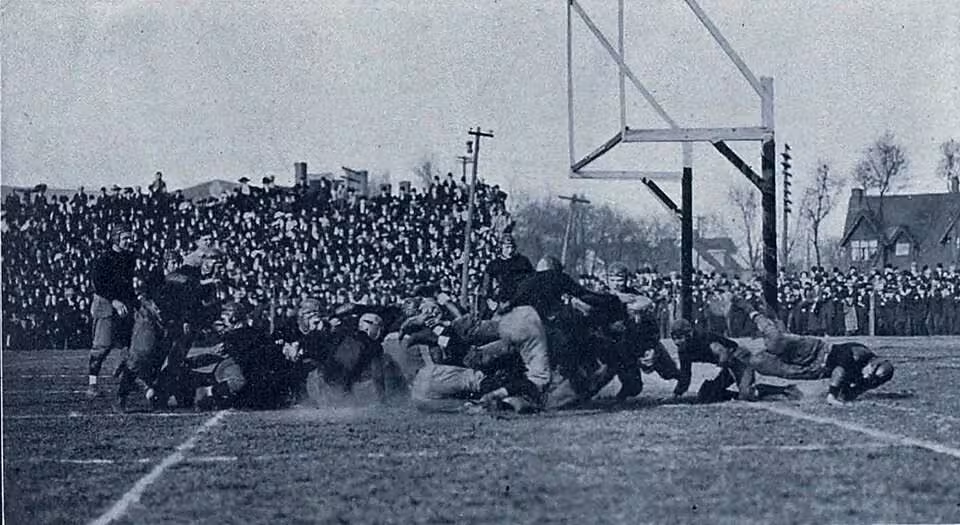
The 1909 American football season marked a pivotal moment, bridging the brutal “mass-momentum” era of the late 19th century with the evolving modern game. Although the forward pass had been legalized three years earlier, it was during 1909 that teams began refining its use. At the same time, the sport remains centered on relentless ground play and defensive battles, highlighting an ongoing transition in its style.
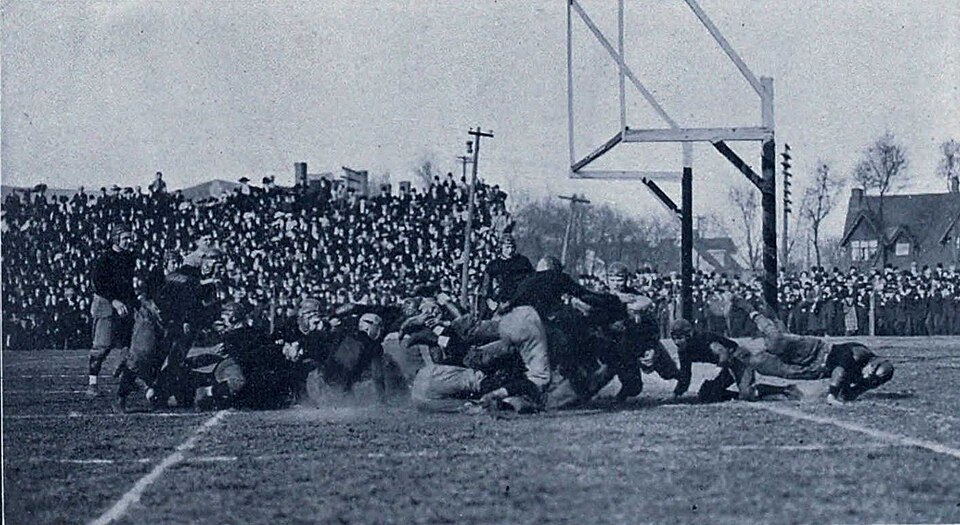
Key Highlights of the Season
- Yale was the consensus national champion, finishing a perfect 10–0. Their dominant defense ended the season unbeaten, untied, and unscored upon.
- The Field Goal Revolution: A significant rule change came into effect prior to the 1909 season. The value of a field goal, which had been four points, was reduced to three. This scoring change, adopted that year, remains the standard today.
- Safety Concerns: Despite reforms introduced in 1906 to improve safety, the 1909 season still saw troubling on-field fatalities and injuries. These events led to extensive rules committee meetings after the season ended. By the 1910 offseason, new regulations—including requiring seven players on the line of scrimmage and abolishing the “flying tackle”—were adopted to address ongoing concerns.
- Besides Yale, strong programs like Lafayette (also undefeated) and Harvard ranked highly, but Yale’s defensive shutouts set it apart.
27 March 1909 Football Rules Convention
This convention must have been fairly short and sweet, since few changes resulted from it. For the first time, a goal from the field was worth three points at this meeting. Also, the inadvertent whistle was first mentioned by football rules makers. A new rule which stated that the Referee should never blow his whistle to indicate a foul, and if he did so inadvertently, then the ball would become dead and play would stop.
Another concept of designating a player as either a lineman or a backfield player was instituted. The rule stated that a player who is more than one foot back of the scrimmage line but less than a yard back from it was not eligible to receive a forward pass.
There was also a lengthy discussion and a diagram created regarding players’ positions and the names of each position. This diagram and naming were incorporated into the rules.
The season itself in 1909 was less productive than the sessions held by the rule makers. In fact, one could say it was counterproductive. Many teams went back to the old strategy of unwinding coil-like blocking schemes. These strategies focused on the defensive tackle positions and really created a large number of injuries in the 1909 season.
Once again, there was public outcry against football, and talk of the sport’s abolition was heard from citizens and politicians across the country. Walter Camp and those who sided with him pointed out that the mass momentum, interlocked blocking, and the offside interference stunts were the main culprits that made the game extremely dangerous. The Committee created by Chancellor McCracken for the first time assembled under the name of the National Collegiate Athletic Association, or N.C.A.A. The organization put the burden of remedying the ailing game on its Rules Committee. The Rules Committee responded by convening numerous tedious sessions to fix the game, making those meetings the most strenuous in the game’s history.
The Committee decided to create a new code and make significant changes to the game. Although not everyone supported this approach, it was seen as the only realistic way to preserve the game at this stage. Previously, the public accepted a few changes to keep the game on campuses, but now, small adjustments are insufficient. The game needed a major overhaul to address specific public concerns and ensure its survival.
A Deep Dive into 1909 Football History and Highlights
- March 27, 1909 – The Football Rules Committee met and established that officials should NOT blow the whistle when a foul occurred, and that if they did, the inadvertent whistle rule would apply. Also, offensive players were established before the snap, either on the line or in the backfield.
- November 25, 1909 – Baylor hosted a game that many recognize as the world’s first “Home-Coming” game on Thanksgiving Day, which included a concert, parade, and bonfire. Timothy Brown of Football Archaeology states that there were many other contests prior to this, noted as Homecoming, but that this game against TCU is the first designed to bring alumni “home.” Baylor won the game 6-3 at Carroll Field in Waco, TX. The next time Baylor held the event was in 1915, according to Tim. Check out our 1911 Homecoming Post for the first annual event.
- December 4, 1909 – The University of Toronto Blues defeated the Toronto Parkdale Canoe Club 26-6 at Rosedale Field in Toronto, securing the first-ever Grey Cup and completing an undefeated season.