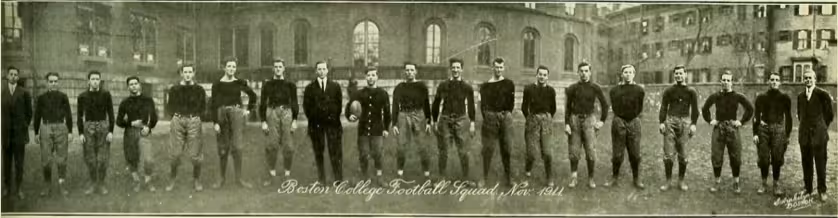
The 1911 American football season was a transformative year that bridged the gap between the brutal, “mass-play” era of the early 1900s and the modern strategic game we recognize today. It was a season defined by defensive dominance, the rise of legendary coaching figures, and a scoring system that was still in flux.
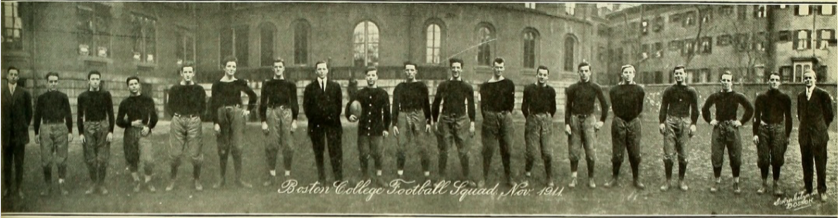
Season Highlights & Trends
The Powerhouses
The “Big Three”—Princeton, Yale, and Harvard—continued to dominate the national landscape.
- Princeton claimed the split national championship with an 8-0-2 record, spearheaded by their stifling defense that allowed only 15 points all season.
- Penn State also finished undefeated (8-0-1), staking their own claim to the national title and signaling the rise of programs outside the traditional Ivy League circle.
The Football History Rewind series, in its last few editions, has just journeyed through one of the most radical rule-revision periods in the game’s history, 1910. The Game of 1910 is much different because of these rule changes from the way it was a few years earlier. From our twentieth-century perspective, the rules more closely resemble those of football in 1910, whereas the rules of 1900 would lead one to believe it was a different sport altogether. The truth be told, it was a different game!
Items such as the forward pass, seven men on the line of scrimmage before the snap, and tackling rules took the game from a brutal battering ram of humanity thrust into a wall of flesh to a strategic game where individuals could make a difference, but the concept of working as a team was still prevalent. The years after the year of great revision would see coaches and players exploring the new rules and concepts, opening the door to new strategies and philosophies on the gridiron. The rule makers would tweak the new rules, experiment to make the game safer for participants, keep the playing field level for both sides of the ball, and keep fans interested in the spectacle of the sport.
New strategies?
The 1910 rules revisions must have been somewhat of a shock to the coaches that first year, for there was only one truly new concept introduced in that season. The University of Minnesota and its coach, H.L. Williams (a Yale product), were the only ones brave enough to venture into the unknown waters of change. All other teams stayed with what they knew and had performed before, but many had to adapt their old standards to comply with the rules.
Minnesota’s Williams tried a new concept where he would not show the look of his formation until just before the snap. Under this strategy, Minnesota’s offense would gather around the line of scrimmage but not be in any certain positions or formations. Then, just before the snap, the players would leap into their proper positions, creating a legal formation, and snap the ball. Defenses never knew what they were going to get coming at them until the ball was snapped! The defenders never had a chance to shift to match the offensive formations because they were masked. The new concept was fondly called the Minnesota Shift.
Results of change
What was really important to those inside and outside football’s inner ring was whether the players’ safety increased due to the rule changes, or was it still the same bloody game it had been before? The 1910 season statistics showed that injuries in football were drastically reduced, and the new rules were the factor that caused this decrease! The public outcry against the game’s brutality had been quieted.
At the same time, the critics within football who opposed change because they felt the game would become dull and uninteresting to spectators were silenced, as the games remained very interesting and entertaining to the masses. The rule makers could not have hoped for better results! They and their innovations had probably saved the game!
In 1911, the tweaking begins.
The men who met and made the rules did not sit on their hands, though, in the next year. On the contrary, they kept at the drawing board, revising the rules further and enhancing the game to new heights. The biggest change to the rules in 1911 concerned the forward pass in the sport.
The forward pass was still only a few years old at this point, and it was not widely used due to the risk-versus-reward trade-off. The risk was that a pass not caught would be ruled a fumble and almost always result in a turnover. Coaches were afraid to use the pass as a regular play in their game plans because of the risk of losing possession. The forward pass was what we would today call a gadget play. It was mainly used by offenses as a surprise tactic or as a last resort.
The rule makers decided to change this characteristic of the forward pass because most wanted to see it become a standard weapon in an offense’s arsenal. The “fumble” aspect of the dropped passes also provided roughness, which the rules committee wanted removed from the game. At the spring meetings of 1911, the rule committee changed the rules so that a dropped or incomplete forward pass that hit the ground was treated as a dead ball. The incomplete pass was born!
A Deep Dive into 1911 Football History and Highlights
- November 11, 1911 – Cambridge, Massachusetts -The Carlisle Indian School of Carlisle, Pa., led by Jim Thorpe, upset the nationally ranked Harvard University football squad by the score of 18-15, with 25,000 in attendance looking on. Thorpe scored every single point for Carlisle in that Game, punching in a touchdown, kicking an extra point, and hitting four field goals. Pop Warner coached the Indians in his 10th year as head coach. Carlisle compiled an 11–1 record in the season, outscoring opponents 298-49. Walter Camp easily selected Jim Thorpe as a first-team All-American.
- November 25, 1911 – Columbia, Missouri – The football game between Missouri and Kansas is considered the first annual homecoming game. The St. Louis Post-Dispatch covered the day’s festivities, stating that Coach Chester Brewer invited alumni to “come home” for the game, which included parades, bands, and more. There were homecoming games prior to this, but never annual events for alumni to return. Also, check out our 1909 Homecoming entry.
- November 25, 1911 – Varsity Stadium, Toronto – The 3rd Grey Cup was played, with the Toronto Varsity Blues winning their third consecutive title by defeating the Toronto Argonauts 14-7, per the CanadianFootball.fandom website.
The forward-passing rules still had some work to do, and more progress would be made in 1912 in that regard. Please look back for the next edition of Football History Rewind, when we will examine how the 1912 revisions would make their mark on the game we love.