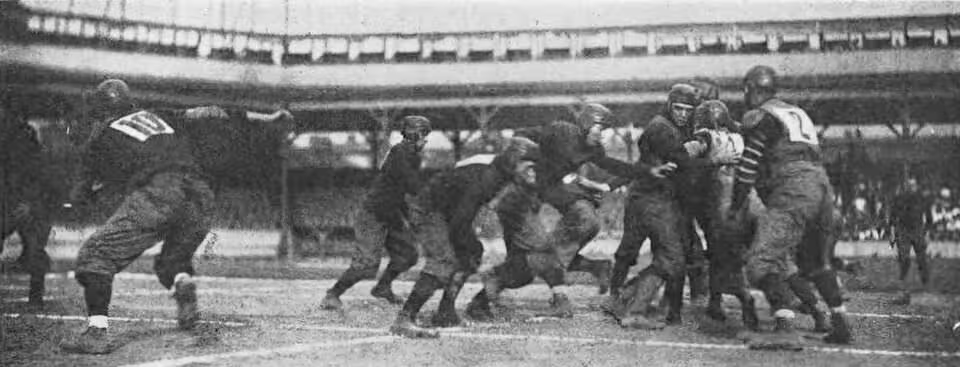
The 1908 American football season was a landmark year in which the sport struggled to balance its inherent brutality with its burgeoning national popularity. It was a season defined by the dominance of the “Big Three” and a controversial debate over how the game should be played.
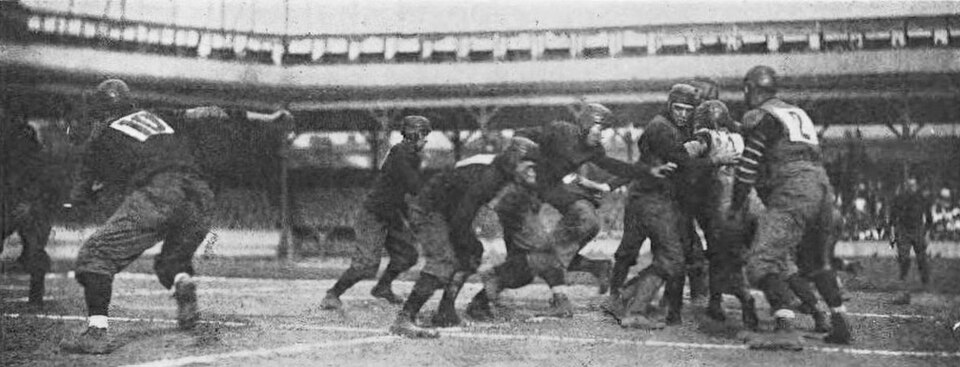
The Powerhouses
Following the fierce competition among top teams, the season quickly became a two-horse race for the national championship between Penn and Harvard.
- Penn (11–0–1): Led by legendary coach Sol Metzger, the Quakers were a defensive juggernaut. They allowed only 12 points across 12 games. They were widely recognized as national champions by various selectors.
- Harvard (9–0–1): Under Percy Haughton, the Crimson also finished undefeated. Their season was highlighted by a decisive 4–0 victory over archrival Yale, effectively ending Yale’s streak of dominance.
- LSU (10–0): In the South, LSU posted a perfect record. They claimed a national title, but their championship was disputed. The dispute arose over allegations of professionalism among their players, a common controversy at the time.
The 1906 and 1907 seasons saw only a few teams trying the newly incorporated forward pass in their offensive schemes. The risks in those days almost always outweighed the rewards, as an incomplete pass was a turnover by rule.
The rule-makers of the Intercollegiate and Conference Committees of 1908 and 1909 set out to make the forward pass more user-friendly to encourage its more frequent use. There were still opponents of the forward pass who also lobbied for rules that deterred teams from passing.
The March 1908 Convention
The first passing rule revision also incorporated any loose ball when it touched an official. The rule change made the ball become dead the instant it struck an official, and the down would be replayed.
Another rule adopted in 1908 concerning the pass was that only the first receiver to touch the ball after a forward pass was entitled to catch it legally, unless it was then touched by an opponent. Another revision from this session on passing deemed that any forward pass that crossed the goal line on the fly, or one that struck the goal post (remember, these were on the goal line at that time) before it touched a player, would be a touchback, and the opposition would gain control of the ball. This meant that a receiver had to catch a pass in the field of play and then cross the goal line to score, and throws to the end zone were merely turnovers.
Other revisions of 1908 that were not pass-related were that the score of a forfeited game would be 1 to 0 and that a half-time intermission should be fifteen minutes in length. The referee would notify both teams when 3 minutes remained in the intermission and would also blow his whistle from midfield when the intermission period expired. Should a team not be on the field within two minutes after this whistle blow, then the ball would be put in play by the offended team at their own thirty-yard line.
A Deep Dive into 1908 Football History and Highlights
- March 1908 – The I.A.A.U. The Rules Committee convened to revise the football rules to make forward passing less restrictive. One of the more important rule revisions was to prevent defenders from interfering with a potential receiver’s right to catch the pass, via Football Archaeology.
- April 13, 1908 – Groundbreaking on Philadelphia’s Shibe Park, home of the A’s & Phillies, as well as the Eagles and Steagles.
- September 19, 1908 – Washington and Jefferson players wear numbers on their jerseys for the first time in a game against Dennison. Thanks for this fact from historian and author Dave Finoli of 21-66Books.com. Check out what may be an even earlier event of this occurring in 1905.
- October 24, 1908 – Penn and Carlisle played to a six-all tie at Franklin Field in Philadelphia.
- November 21, 1908 – At Yale Field, Harvard, under Coach Percy Haughton, registered a 4-0 victory over archrival Yale, effectively ending Yale’s streak of dominance.