By the end of 1905, football faced heavy criticism for its dangers. The President of the United States called for rule reforms.
Theodore Roosevelt summoned college athletics leaders to Washington, D.C., for two such conferences in the White House to encourage safety reform. In early December 1905, Chancellor Henry M. MacCracken of New York University convened a meeting of 13 college leaders to initiate changes in football playing rules. At a subsequent meeting on December 28, 1905, in New York City, the Intercollegiate Athletic Association of the United States (IAAUS) was founded by 62 members.
The IAAUS was officially incorporated on March 31, 1906, and in 1910 changed its name to something a little more recognizable to us today: the NCAA. For several years, the NCAA was a discussion group and rules-making body, but in 1921, the first NCAA national championship was held.
The IAAUS formed a special committee to review football rules and implement changes to make the game safer for participants. This first consortium was called the American Football Rules Committee, and it was headed by none other than our hero Walter Camp. This was a very monumental feat. It can best be described by the following statement on the Walter Camp History Page (www.waltercamp.org)
“The year 1906 was one of the most momentous in the history of football. The game was under heavy fire for the brutality of its close-order, mass, momentous play, in which physical force was all-important and skill and science had little part. As the leader of the American Football Rules Committee, Camp played a leading role in the adoption of far-reaching changes that opened up the game, including the introduction of the forward pass, which brought about a revolutionary change in the pattern of play that was to add immensely to its popularity, and so saved the game.
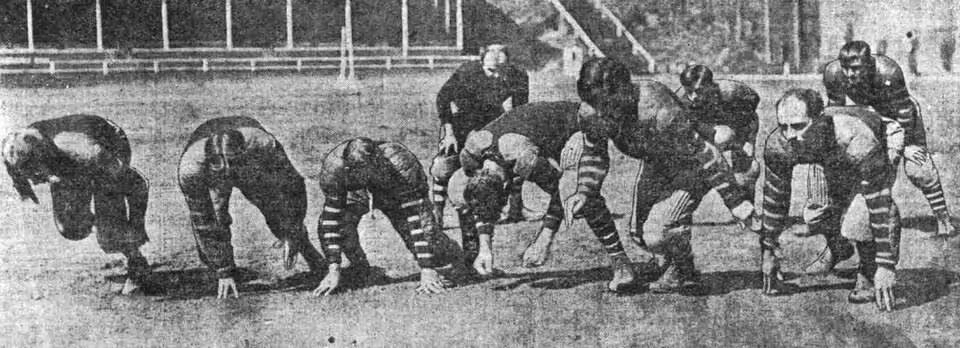
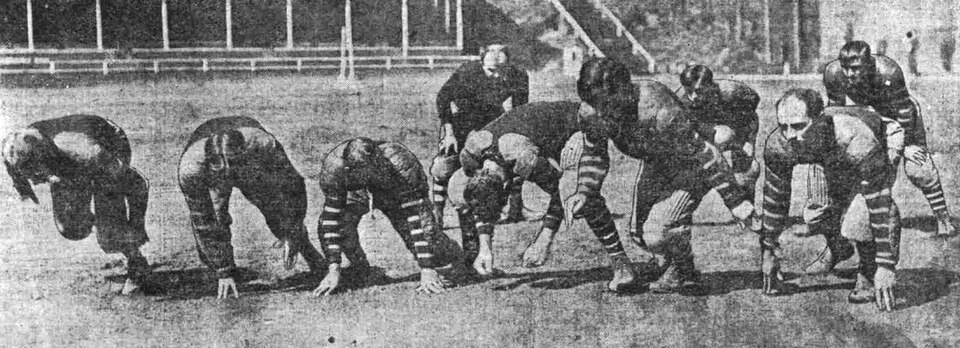
Yes, the forward pass was seemingly the rule adoption that saved football in 1906, but it wasn’t the only thing. Rules forbidding interlocked blocking and requiring a minimum number of men on the offensive line also followed, in an effort to make the flying wedge system a thing of the past.
12 January 1906
It was pure genius how the I.A.A.U. got the missing schools to participate. The meeting title of this 12 January conference seemed to do the trick, as it was called the Joint Session of the Intercollegiate and Conference Committees. The old committee of football rule-makers was invited as a valid and recognized body to participate with the newly established board in reforming the rules of the game. The important thing is that it worked; men such as Alonzo Stagg of the University of Chicago, Walter Camp of Yale, and Paul J. Dashiell of Navy were now sitting at the same table with men such as C. D. Daly of the Army, J. T. Lees of Nebraska, and J. A. Babbitt of Haverford. The amendments to the rules at this joint session would have little impact on the game itself, but they did unify all of football under a single set of rules. The amendments played a significant role in shaping the game into what we recognize in today’s rulebooks.
1)The officials during the game would be the Referee, Two Umpires, and a linesman. It was noted, though, that one of the Umpires could be eliminated in a contest by mutual agreement of the two participating teams.
2)The games would consist of two halves with a duration of thirty minutes each. A ten-minute intermission would separate the two halves. This excluded another rule that allowed the captain of each side to request up to three timeouts per half (sound familiar?).
3)A scrimmage was defined as when the holder of the ball places it flat on the ground with its long axis at right angles to the line of scrimmage and puts it in play by either kicking it forward or snapping it backward. The line of scrimmage was established as an imaginary line parallel to the goal lines and passing through the point of the ball closest to the side in possession.
4)A fair catch was determined as a player who, during a kick, raised his hand clearly above his head as a signal of his intention to catch the ball and not to advance in order to receive protection of going uncontacted. He was permitted to take no more than two steps after this catch.
5) A player would be considered “down” when any portion of his body other than his feet or hands touched the ground while he was being touched by an opponent.
6) Tripping was illegal, and it was defined as when any player obstructed an opponent by contacting him in any way below the knee.
7)Protection was afforded the snapper-back from contact until the ball was actually in play.
8)The ordinary five men of the offensive line (center, guards, and tackles) could not drop back into the backfield unless they went five yards deep behind the line of scrimmage and were replaced at their line position by a player normally in the backfield.
9) Holding was defined as: grasping and opposing with the hands or arms, placing the hands or arms on an opponent to push him away, or circling an opponent’s body with the arms.
These rule changes did not meaningfully alter the game at this meeting; however, subsequent meetings soon followed. At one of these, a proposal by John C. Bell of Pennsylvania and Paul J. Dashiell of the Navy paved the way for what was likely football’s most transformative change: the forward pass. Since space is limited in this segment, we will continue this discussion in our next installment of Fathers of Football.
The 12 January 1906 meeting’s proposals shifted the brutal fist-to-cuff style to a more open style of play. That meeting and those that followed laid the foundation for today’s game by introducing the forward pass.
The saying “the more things change, the more they stay the same” aptly describes the introduction of the forward pass to American football. It was also the most important aspect of the ancient Spartan game harpaston, which we earlier discussed as one of football’s predecessors. Parke H. Davis notes in his book Football: The American Intercollegiate Game that the very word harpaston was derived from the long forward pass that opened every game.
The Forward Pass
Earlier in this series, it was mentioned that John C. Bell of Pennsylvania and Paul J. Dashiell of the Navy proposed the forward pass at the 1906 rules conference. However, while Dashiell supported the change in the meetings, the actual sponsor was Dr. Harry Williams of Minnesota.
Many opposed the introduction of the forward pass, including Walter Camp. Nonetheless, supporters outnumbered critics and the revision “passed” (pardon the cheesy phrasing). Its legality did not bring immediate, widespread change to the game. Harford Powell, Jr. likely best captures football experts’ mindset in his biography of Walter Camp: “The forward pass was lightly regarded by football tacticians, who thought of it as a last desperate resort – a sort of ‘shoestring’ play that was more likely than not to give the ball to one’s opponents.”
Interestingly, the following season saw fewer forward passes attempted, with none having any impact until the final game. Interestingly, the first coach to use the forward pass was Walter Camp, one of the men who opposed it at the reform meetings. A wise tactician, Camp knew the rules (having helped innovate many) and played them to their potential. The forward pass was no different now that it was legal.
The forward pass play that Camp developed was not a haphazard or “shoestring” type of play, as many thought this concept was, but a methodical tactic designed to exploit an opponent’s weakness.
The first forward pass in American football?
Let us set the stage for the final game of the 1906 season. Entering the second-to-last week, Princeton, Harvard, and Yale were all undefeated. The Princeton-Yale and Yale-Harvard games would determine the champions. The Princeton-Yale game ended in a scoreless tie, so the Harvard-Yale matchup became the de facto championship, drawing the full attention of the football world.
Late in the scoreless game, Yale broke free for a thirty-yard run, advancing the ball to just inside Harvard’s twenty-five-yard line. It was time for Camp’s play. Quarterback P. L. Veeder took the snap and began an end run. (At that time, only players who received the snap at least five yards from the snap point could advance, making quarterback end runs rare.) Veeder sprinted, then stopped abruptly in the backfield and threw a forward pass to C.F. Alcott, who brought it to the Harvard four. The defense responded exactly as Camp planned, focusing on the end run and leaving receivers open downfield. Yale soon scored from the four, winning 6-0 and sharing the championship with Princeton. At least, this is what historian Parke H. Davis stated may be the first pass, but later historians found evidence to the contrary.
Some have said that September 5 is the date of the first legal pass with Bradbury Robinson, but our longtime friend Timothy Brown of Football Archaeology has proven that this contest between St. Louis University and Carroll College was actually played on September 25, 1906 (Not September 5). Brown also uncovered multiple reports that the University of New Hampshire threw a legal pass a few days earlier, on September 22, against Maine. It was incomplete, but it is the first documented toss forward.
Interest in the forward pass had now begun, as all teams started exploring its possibilities for the next season. The rules regulating the pass were even tweaked a bit more during the off-season as forward pass mania swept throughout the nation.
A Deep Dive into 1906 Football History and Highlights
- January 12, 1906 – The I.A.A.U. and the old guard of football rule-makers listened to President Roosevelt and held a Joint Session of the Intercollegiate and Conference Committees, where the factions would unify all of American football under a single set of rules.
- March 31, 1906 – The Intercollegiate Athletic Association of the United States (IAAUS) was officially incorporated.
- September 22, 1906 – 1st forward pass? – During the University of New Hampshire’s visit to Maine for a game, New Hampshire threw one incomplete forward pass during the game, which resulted in a turnover based on the 1906 rules, per Football Archaeology. Maine won the game 7-0.
- September 25, 1906 – For years, many believed the game between St. Louis University and Carroll College was the first collegiate game with a legal forward pass. Bradbury Robinson of St. Louis University threw the first legal forward pass. Timothy Brown has not only shown that September 5 was erroneously reported as the game date, but also that Robinson might not have been the first in this Football Archaeology segment. It may be the first completed legal forward pass, though.
- October 13, 1906 – Charley Moran threw the first forward pass for the Massillon Tigers against Benwood (West Virginia), per Author Gregg Ficery during a 2021 interview on our Pigskin Dispatch podcast.
- October 27, 1906 – Per the Pro Football Hall of Fame website, the very first documented pass completion in a professional football game came when George (Peggy) Parratt of the Massillon Tigers threw a completion to Dan “Bullet” Riley in a victory over a team that was comprised of a combined mix of Benwood players and Moundsville players.