By 1887, American football had survived its infancy and was entering its “Gilded Age” of expansion. This wasn’t just a year of hard-hitting games; it was the year the sport began to march westward and move indoors, forever changing the geographical and environmental landscape of the gridiron. While powerhouse programs like Yale and Harvard were perfecting their dominance on the East Coast, the rest of the nation was finally waking up to the “football craze.”
In this exploration of 1887 American football history, we’ll uncover:
- The “birth” of a legend: Notre Dame’s learns the game from Michigan players.
- How Chicago hosted the first major indoor football experiment.
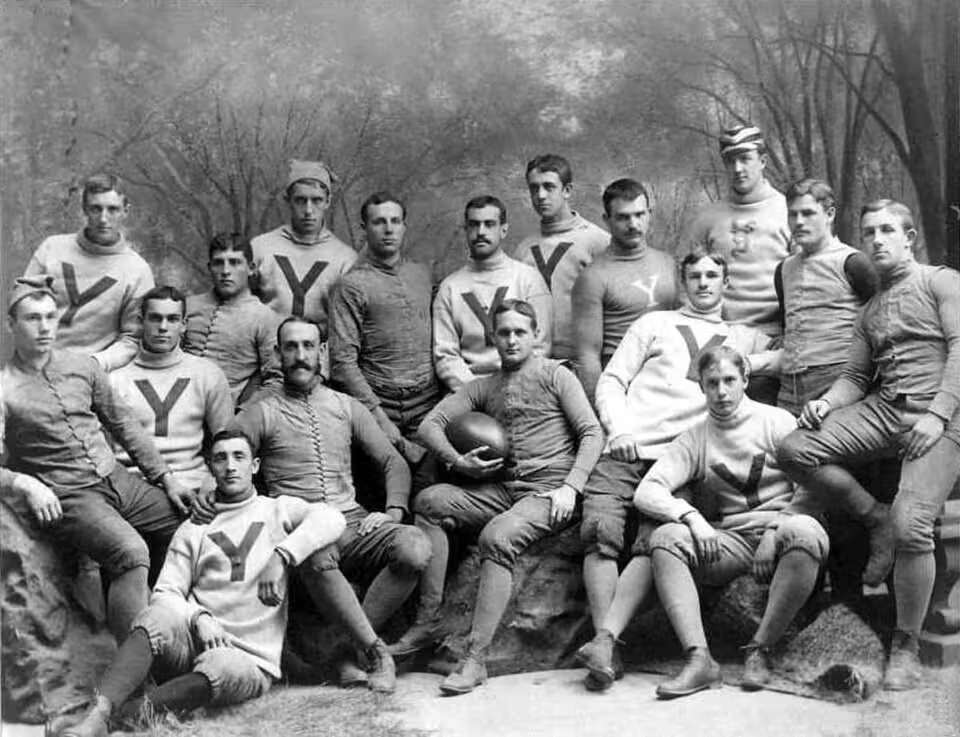
- Yale’s ruthless, undefeated run to the national championship.
A Deep Dive into 1887 Football History and Highlights
- March 26, 1887 – A football rules convention was held where revisions were made to make the referee the ultimate authority on the field, and to adjust wording on a try for goal after a touchdown.
- On November 23, 1887, the University of Notre Dame invited some interested students to visit their campus to teach ND students how to play football. The meeting, widely considered a controlled scrimmage the next morning, was intended to teach Notre Dame students how to play the game.
- November 24, 1887 – On Thanksgiving Day, Yale defeated Harvard 17-8 in a major intersectional college football game.
Significant Events of 1887
While 1887 might seem quiet compared to the “rule-making” years of the early 1880s, it actually featured several major milestones that defined the sport’s future.
March 26, 1887, rules convention
The months leading up to this convention were spent debating who, if anyone, won the 1886 championship game between Yale and Princeton, which was ended before completion.
This convention focused on the rules of the game and empowered the referee with even more clout. A resolution was passed that stated, “rules should be enforced rigidly by referees, and that captains should instruct their men against holding, roughing, and all other objectionable features.” The group even went so far as to have all varsity captains sign a resolution, thereby swearing to coach their respective teams to play fairly and by the rules.
Other major rule changes from this conference included making it mandatory for teams to try for a goal after a touchdown. Previously, the rule simply stated, “Shall try for the goal.” The rule was to prevent a team from deliberately missing the try for a goal to obtain another touchdown, because the ball was not dead under the old rules.
In those days, a touchdown was worth 2 points, and a goal after a touchdown was worth 4 points. The teams had their own reasons for wanting to do this, and it is something that is beyond this writer’s understanding of the game of that time.
1. The Birth of Notre Dame Football
The origins of Notre Dame football can be traced back to two Michigan players, George Winthrop DeHaven Jr. and William Warren Harless, both former students of the South Bend school.
In October 1887, DeHaven reached out to Brother Paul—the head of Notre Dame’s intramural sports—to introduce him to the emerging sport of football. Since Michigan was already scheduled to play in Chicago on Thanksgiving, the three men successfully coordinated a deal between the two universities to hold an inaugural match on Notre Dame’s campus the day before the holiday.
2. Yale’s Defensive Masterclass
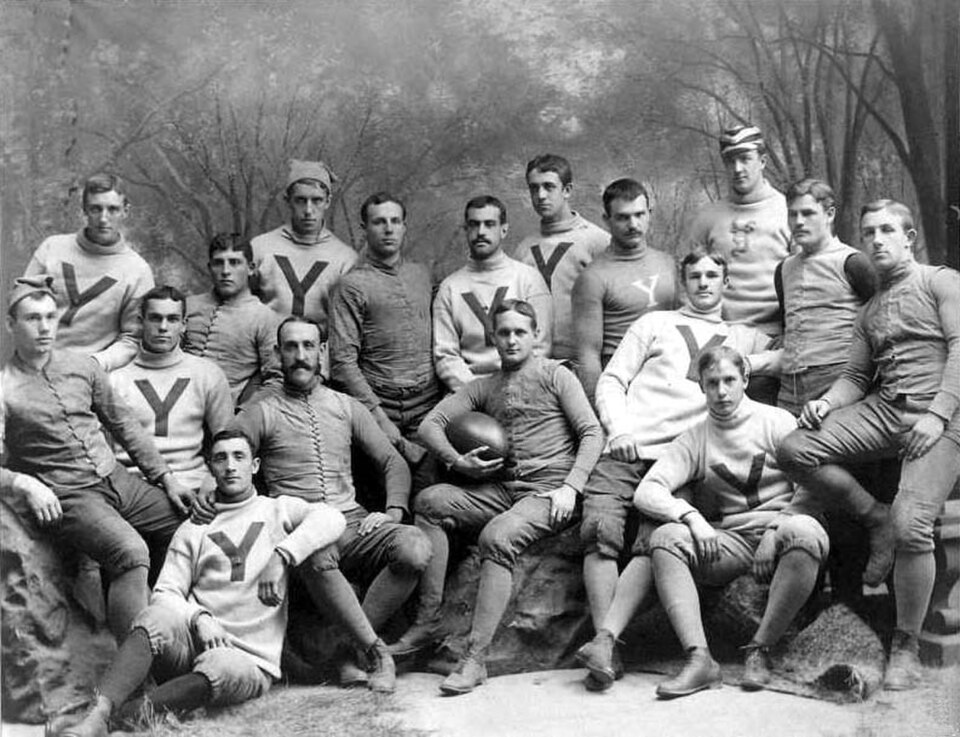
The 1887 Yale Bulldogs are often cited by historians as one of the greatest early teams. Led by captain Pa Corbin, Yale went 9-0, outscoring their opponents 415 to 4. They capped the season with a 17-8 victory over Harvard at the Polo Grounds in New York, securing a consensus National Championship.
3. Expansion in the Midwest and South
1887 saw the “First Organized Game” in various cities and states. For example, the first organized football match in Cleveland, Ohio, took place this year (Central High School vs. Case freshmen). The game was rapidly moving beyond the “Big Three” (Yale, Harvard, Princeton) and becoming a national obsession.
4. Technical Refinement of the “Snap”
While Walter Camp introduced the snap years earlier, 1887 saw the game move further away from the rugby “scrum” as referees became stricter about the line of scrimmage. The transition from a chaotic foot-scuffle to a hand-delivered snap became the standard during this season, allowing for more complex offensive plays to develop.