How are two events, occurring half a world away from each other in the spring of 1888, milestone moments for Notre Dame football? Imagine a single month where the universe essentially conspired to change the gridiron forever. It’s a story of a tutorial, a tassel-capped debut, and a baby born across the Atlantic who would eventually tie it all together.
Football Blossoms in the Spring Air
In our modern era of American football, we often feel that “spring football” emerged only in the last fifty years, but that tradition dates back to the very beginnings of the gridiron game. Some major FBS powerhouses even celebrate their schools’ inaugural games when the trees are starting to blossom, including the University of Notre Dame.
In the 1870s and 1880s, college football was still transitioning from a student-led recreational activity to an organized intercollegiate sport. There was no governing body like the NCAA to dictate a “playing season.” Games were often scheduled whenever one school’s “Football Association” (run by students) challenged another.
On April 20, 1888, the team that would later be known as the Fighting Irish took the field for the first time, facing Michigan, which was experienced and fairly good, having not allowed a point since 1883. In fact, the Michigan players played a part in teaching the Notre Dame group to play the new game of American football.
The Tutorial and the Invitation
The story begins not with a rivalry, but with a lesson. In the fall of 1887, the seasoned veterans from the University of Michigan gave the “boys of Notre Dame” a tutorial on how to actually play this emerging game. By the spring of 1888, the students at South Bend were ready to test their mettle.
- The Formal Gesture: Notre Dame sends an invitation to Michigan for a two-game series in South Bend.
- The Acceptance: Michigan, having several years of experience under its belt, accepts the challenge for April 20 and 21.
- The Announcement: The Scholastic (Notre Dame’s student paper) makes it official in their March 24 issue, setting the stage for what we now know was a date with destiny.
The Birth of a Legend (Voss, Norway)
While the Michigan players were preparing to travel, something “miraculous” was happening thousands of miles away in Voss, Norway.
- March 4, 1888: A child named Knute Larsen Rokne is born.
- The Historical Coincidence: At the exact moment Notre Dame is organizing its very first varsity squad, its future architect is just a month-old infant in a different hemisphere.
- The Unseen Thread: This Norwegian-born boy would eventually take the “humble beginnings” of the 1888 squad and elevate them to national prominence over the next four decades.
April 20, 1888 – The Green Stocking Debut
On a Friday in South Bend, the first football game in Notre Dame history kicks off at a baseball venue called Green Stocking Ballpark. Notre Dame had a reported enrollment of 500-600 students (all male) that year, while Michigan was thought to have a much larger student body.
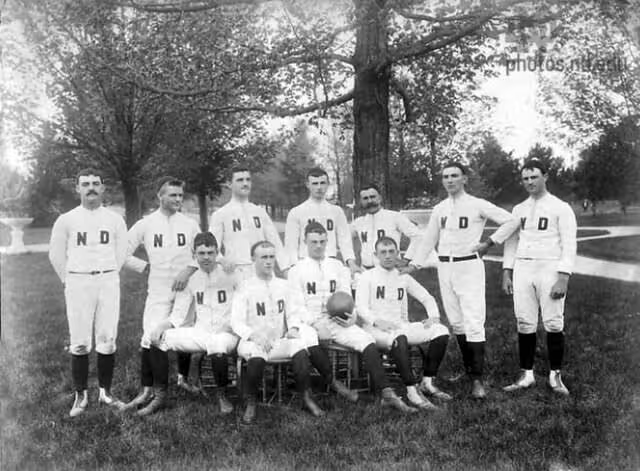
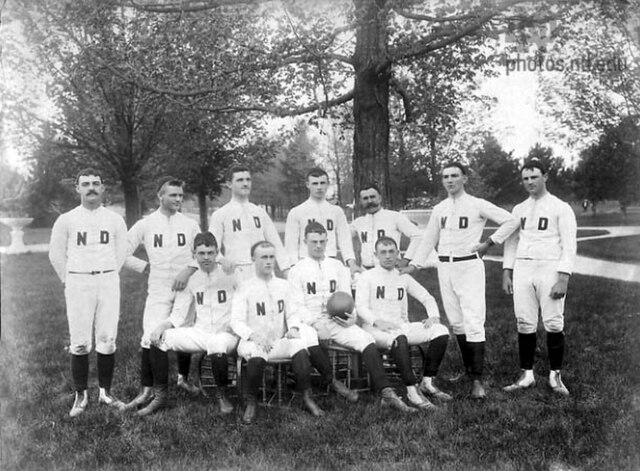
- The Aesthetic: Forget the gold helmets. The team wears baseball-style uniforms, tennis shoes for traction, and tassel caps instead of pads.
- The “Eleven”: Only eleven men appear in the team photo because the university actually owned only eleven uniforms.
- The David vs. Goliath Moment: Michigan hadn’t allowed a single point against them since November 1883.
- The Score: Although Michigan wins 26–6, the “upstart” Notre Dame team does the unthinkable by scoring 6 points against the “seasoned opposition”.
The Legacy and the Artifact
The following day, April 21, Michigan wins again (10–4), but the foundation is laid. Notre Dame managed 10 points in two days against a defense that had been a brick wall for five years.
- The “Connective Tissue”: From these games, only one known program-style handout survives. This modest sheet, explaining the rules of an “unfamiliar game,” is the earliest surviving artifact of the program.
- The Conclusion: The arc comes full circle when that baby from Voss, Norway, eventually arrives in South Bend, turning this “little-known Midwestern Catholic school” into a household name.
It sure is a lot of fun to look back and preserve the history of how these two events—a birth in Norway and a game in South Bend—changed the game we love.
We want to thank Notre Dame Historian and preservationist Andy Nickle and his brilliant site RockneandMore.com for the inspiration and information on this amazing story.