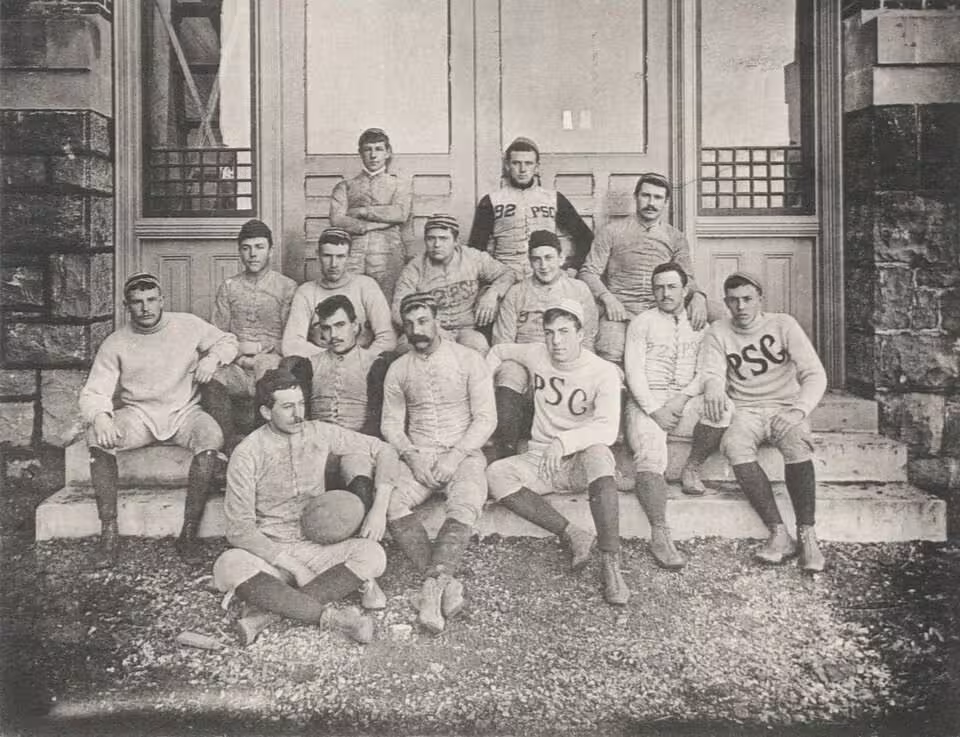
The 1889 season saw several significant events that helped shape the modern game of American football.
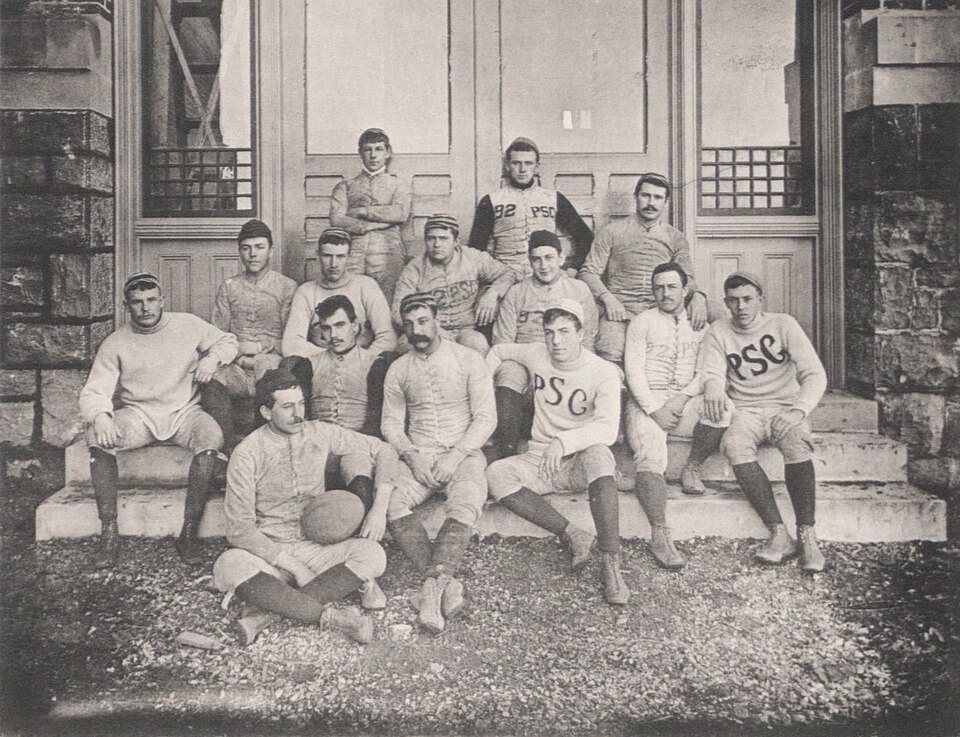
Our story of football history left off as the Graduate Advisory Committee proposed a multitude of rules revisions in March 1889 that the Intercollegiate Association would have to examine at its next convention. The convention to ratify or reject these proposals did not take place in 1889, as turmoil enveloped the fledgling organization of football. One of the group’s major contributors, Harvard, was again threatening to leave the Association. Another, Yale, was rumored to be leaving the fold, too. Could this be the end of the line for the great innovative body that was creating the very foundation of our era of football?
The Committee has spoken!
All research on the 1889 rules revisions indicates that the recommendations of the Graduate Advisory Committee were accepted without a vote of the Association. All changes recommended were incorporated into the following season without a record of a convention in 1889.
There was a heated debate among the member schools of the Intercollegiate Association over player eligibility rules. The bickering seems to have been so intense that it prevented the members from agreeing on much of anything, including setting up a convention for that year!
Walter Camp called the Graduate Advisory Committee together in a special session on 4 November 1889 to review a proposal he had made in ruling on who was eligible to play the games. Camp’s proposal was very detailed but incorporated the following points:
-Players must be bona fide students of the schools they played for.
-Players could not be paid or reimbursed in any way for playing football for the school.
– Other member schools could challenge the eligibility of players in writing, and that player in question could respond with a written affidavit proving he met the criteria to be eligible.
Mr. Duncan Edwards of Princeton offered amendments to Camp’s proposal to limit players’ eligibility to four years. This includes playing for other schools in the Association. Edwards also stated that he believed all players should have undergraduate status as a student at the member school.
Advisor H. C. Leeds of Harvard raised a point of order, which stymied the adoption of the proposals from passing. His point was that the season was still in progress and that the special session of the Advisory Committee was not able to adopt rules at this time, per the Associations’ governing rules, which said the Committee would meet in early May of each year. The point of order was not upheld, but the rule amendments were defeated.
Leeds then filed protests against 15 Princeton players, and Edwards countered with 4 protests of his own against Harvard players. The Committee was at an impasse; it would have to adjourn and meet again in a couple of weeks. A rift was evident in the Association, pitting Harvard and Yale against Princeton, Wesleyan, and Pennsylvania. The other member schools took no clear stance, leaving them on one side or the other.
A Deep Dive into 1889 Football History and Highlights
- March 2, 1889 – The Football Advisory Committee held a rules meeting. One rule brought to fruition was an official’s timeout after a score. Other revisions included a hefty 25-yard penalty for offending teams for illegal tackling and unnecessary roughness.
- March 7, 1889 – Perhaps the first game ever under artificial electric light. The indoor football game between the University of Pennsylvania and the Riverton Club (supplemented by Princeton players) was played. Football Archaeology.com has a tremendous write-up on the contest.
- March 30, 1889 – A second football rules meeting was held to redefine what a touchdown was. Other precepts included allowing the defense to use their hands and arms to block opponents, while offensive players could not use their arms or hands. Referees were given whistles for the first time by rule to signal the stoppage of play.
- November 16, 1889 – The University of Iowa plays its first official varsity football game against Iowa College (now Grinnell College) in Grinnell, Iowa. Iowa College won the game 24-0, making it the first collegiate football game played west of the Mississippi River.
- November 23, 1889 – The Wisconsin Badgers played their first-ever football game in Madison, losing 27–0 to the Calumet Club of Milwaukee. Played on the “lower campus athletic field” (now Library Mall), this marked the start of the program’s history.
- December 14, 1889 – Wofford defeated Furman in the first intercollegiate game played in the state of South Carolina.
- December 1889 – Journalist Caspar Whitney selected the inaugural All-America college football team, which was composed entirely of players from the “Big Three”: Princeton, Yale, and Harvard. Among these legendary honorees, four individuals eventually earned induction into the College Football Hall of Fame: Knowlton Ames (Fullback, Princeton), Hector Cowan (Tackle, Princeton), Pudge Heffelfinger (Guard, Yale), Amos Alonzo Stagg (End, Yale), Edgar Allen Poe (Princeton), among others.
2 March 1889: Committee deals with taking time and roughness
This session of the Advisory Committee recommended that a time-out period be instituted whenever the ball was brought out after a safety or a touchback. Another reform suggested by the Committee was to separate the fouls of illegal tackling and unnecessary roughness. In prior seasons, the two were treated as one and the same foul, with the same penalty: disqualification of the offender. The rule change would continue the disqualification for unnecessary roughness but would reduce the penalty for illegal tackling to a 25-yard penalty against the offending team.
There was a lot of heated debate at this session of the Committee, to the point that they decided to meet again at the end of the same month to continue the talks.
30 March 1889: Round two
The Committee went right to work with suggestions on multiple rule reforms. The first was for the definition of a touchdown. They wanted a new rule to read that “a touchdown is made when the ball is carried, kicked, or passed across the goal-line and they are held either in touch or in goal. “
The Committee further tinkered with the rules regarding the use of hands from the prior year. The suggestion was to allow the defense to use their hands and arms to block opponents, while allowing the offense to use only their bodies, not their arms or hands, to ward off defenders.
Big changes were proposed for officials, too! It was suggested that both the Referee and the Umpire be given whistles to indicate when the play was over. The Ref would carry a stopwatch to keep the game’s official time. It was also decided that the Ref would not stop play when the quarters expired but would wait until the play had ended. It was also a recommendation to call a timeout while the ball is brought out for a try or a kick-out after a score. Other less impactful suggestions were also made at this meeting, but the only other one of real consequence was that of establishing an official ball of the association, the Lillywhite Number J.
The Committee had made its recommendations, and now it was up to the Association members to either adopt or reject the suggestions the Committee had worked on over two meetings. Please look back soon to learn how the Convention attendees treated the new rule proposals in the next leg of this football history trip. Right here on PigskinDispatch.com, your place for the good news about football.
According to Wikipedia, the 1889 Princeton Tigers football team, led by team captain Edgar Allan Poe, compiled a perfect 10–0 record and was recognized as the national champion by the Billingsley Report, Helms Athletic Foundation, Houlgate System, National Championship Foundation, and Parke H. Davis.
We are able to give this in-depth look from so long ago in history through careful research. Using someone who was contemporary to the period is the best source. So, a very special shout-out to our main source of reference for this article: Parke H. Davis, in his 1911 book, Football-The American Intercollegiate Game.