
The late 1880s saw the introduction of many rules that are still essential to today’s football. These building-block years laid the foundation for our game. In this series, we leave “no stone unturned” as we examine football’s yearly progress. We now continue with 1886, and key rules convention highlights from that year.
A Deep Dive into 1886 Football History and Highlights
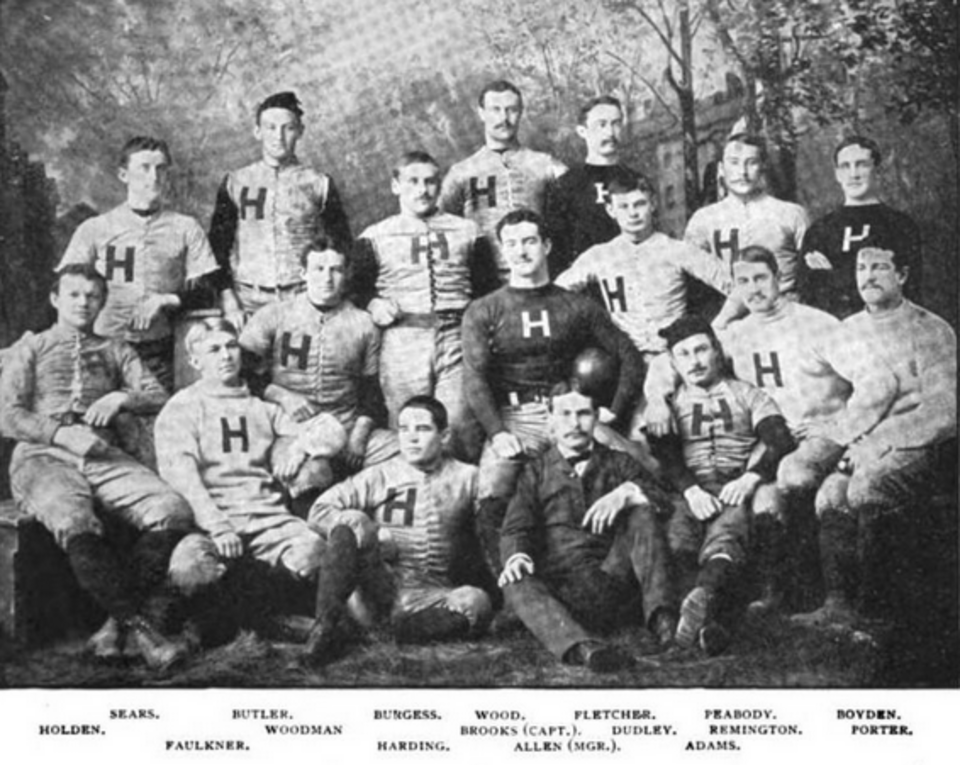
- May 5, 1886 – At the IFA Rules Convention, Harvard was reinstated as a member school after a one-year hiatus. Rules protecting the center were instituted to improve player safety.
- October 9, 1886 – A 2nd IFA Rules Convention for the year took place. The first scheduled championship game is set for Thanksgiving Day. The first time an “official game ball” was recorded by rule, the Lillywhite number “J” was the ball to be used in all games.
- November 25, 1886 – Yale and Princeton played the first ever pre-scheduled championship on Thanksgiving Day, which ended in a scoreless tie.
Convention of May 5, 1886
Once again, the Fifth Avenue Hotel in New York, New York, hosted the convention for the football rules organization. The highlight of this meeting was that Harvard was requesting reinstatement into the organization, as football was once again alive in the Boston school. The game’s growing popularity across the region pressured the faculty at Harvard to reconsider their earlier decision to abolish it on school grounds.
The most important historic development for football, though, was a rules resolution that passed. Princeton representatives C.M. DeCamp and H.S. Savage initiated a very significant proposal to the board. They suggested that something must be done to restrict the rush of the defense so as not to rough up the very vulnerable snapper of the ball. The rule simply stated that the center (yes, correctly spelled) should be “permitted to snap the ball without any interference from opponents.” This is the precursor to the roughing the snapper rules of today.
The October 9, 1886, convention
Milestones of sorts occurred in this meeting that would help shape ideas for football going forward. The first was the board’s decision to play the championship game of that year between Princeton and Yale on Thanksgiving Day. To my knowledge, this is the first of the famous Thanksgiving Day games.
Another big step from this football meeting was adopting a single standard ball. The Lillywhite number “J” was the only ball allowed in match games for teams in the organization.
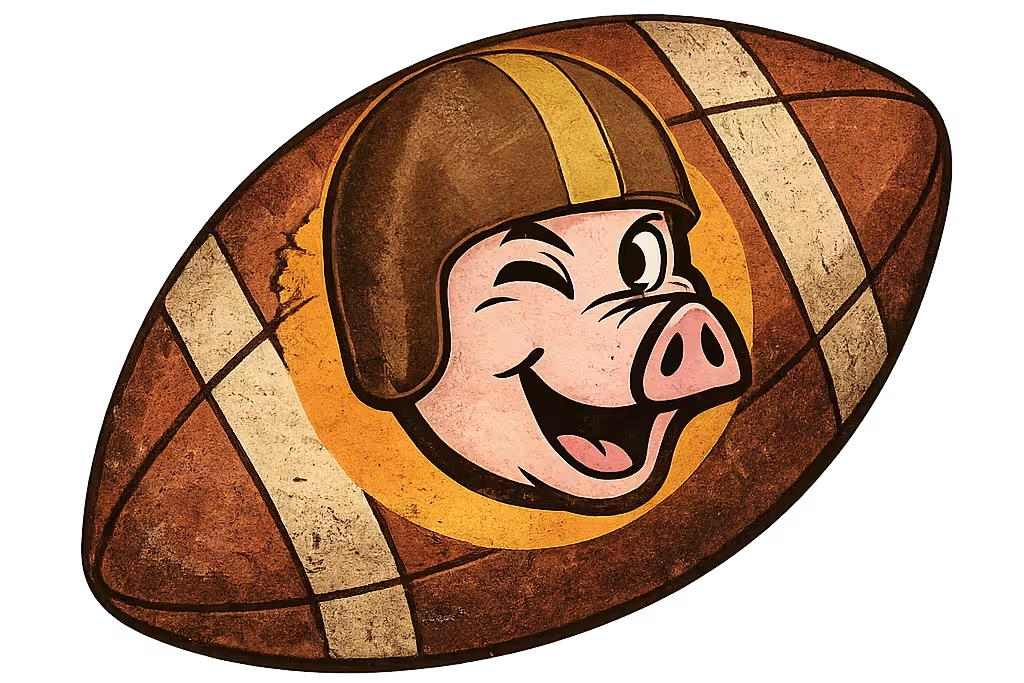
Remember that the history of football up till that time was this. The first football was a pig’s bladder, inflated with human lung power, and knotted at the end like a balloon. Shoemakers then made a leather case for the ball to match the bladder’s shape. This was “plum-shaped”; rounder than today’s ball, but certainly not spherical.
In 1862 came the invention of an India rubber bladder and a pump with which to inflate it. This allowed the production of a round ball, though some manufacturers still used a button at each end to hold the stitching together where the leather panels met. “Buttonless balls” was a prime marketing buzzword for suppliers and manufacturers in the 1880s! Lillywhite was an English rugby ball manufacturer and was the leader of the year in ball production. There was nothing in the early rules about the size of the ball to be used. Some of those used in the early years were enormous by today’s standards. After the tape measure was produced, the law became a ball of average circumference of not less than 27 inches and not more than 28 inches. This rule was extended to encompass all games in 1883.
The conference also changed wording in the rules to allow a defense to start its rush. Previously, the rules stated that the defensive charge could start with an offensive player beginning pre-snap movement, called “motion.” The revised rule now specifies that the defensive rush cannot start until the ball is snapped and officially “in play.”
Yale was retroactively named as the national champion by the Helms Athletic Foundation and National Championship Foundation, and a co-national champion with Princeton by Parke H. Davis.
Conclusion
The 1886 conventions at the Fifth Avenue Hotel show that football’s evolution balances player safety with strategic innovation. By protecting the “center” and standardizing the Lillywhite ball, early pioneers let the game move beyond its rugby-style roots. These small adjustments—like shifting from “motion” to the ball being “in play”—may seem minor now, but they form the DNA of every Saturday and Sunday kickoff. As we leave no stone unturned in our year-by-year history, the lessons of 1886 remind us that fundamentals never go out of style.