Every autumn, thousands of fans gather on the banks of the Hudson River to watch the Army Black Knights play at Michie Stadium. With its breathtaking views of the river and West Point’s historic stone architecture, it is widely considered one of the most picturesque venues in college sports.
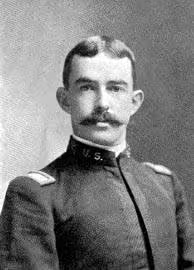
But the stadium’s scenic beauty carries a profound historical weight. It stands as a monument to Dennis Michie, a member of the United States Military Academy (USMA) Class of 1892. Michie was not just the Army’s first football captain; he was the visionary who willed the program into existence, and a hero who laid down his life for his country.
The Birth of a Program: A Bold Definition
Born at West Point in 1870, Dennis Michie was the son of Peter Smith Michie, a distinguished Civil War veteran and longtime professor at the Academy. Growing up on campus, young Dennis developed a deep love for both the military life and the emerging sport of American football.
By 1890, football was spreading like wildfire across East Coast universities, but West Point had no team. The Academy’s leadership was notoriously strict, viewing the sport as a dangerous distraction from the rigorous training required of future officers.
Michie refused to accept that line of thinking. Believing that the physical grit, tactical strategy, and intense teamwork of football were perfectly aligned with military leadership, he set out to organize a program.
The turning point came when the United States Naval Academy challenged West Point to a game. The Navy had been playing organized football since 1879 and held a massive advantage. Seizing the opportunity, Michie secured the Academy Superintendent’s official permission to accept the challenge—on one condition: all funding, training, and organization fell squarely on the cadets.
Michie took on the monumental task. He served as the team’s organizer, head coach, and its first team captain.
The First Army-Navy Game (1890)
On November 29, 1890, the historic rivalry was born on “The Plain” at West Point. The cadets, wearing improvised uniforms with little formal training, faced a seasoned Midshipmen squad.
Predictably, the Navy’s experience won out. The Midshipmen shut out Army in a 24-0 victory. Despite the stinging defeat, Michie’s experiment proved a massive success in spirit. The game captured the imagination of the Corps of Cadets, and the administration realized that football brought an unmatched level of camaraderie and morale to the Academy.
The Taste of Vengeance (1891)
Dennis Michie wasn’t a man to accept a shutout lightly. Determined to avenge the loss, he spent the next year refining the team’s tactics and conditioning. He even hired the team’s first official coach, Henry S. Williams, to help prepare the squad.
On November 28, 1891, Army traveled to Annapolis for the rematch. Driven by Michie’s leadership on the gridiron, the Cadets flipped the script entirely, shocking the Midshipmen on their home turf with a decisive 32-16 victory. Having successfully established the program and balanced the ledger against the Navy, Michie graduated the following spring as a pioneering legend of West Point lore.
The Ultimate Sacrifice
After graduating in 1892, Michie was commissioned into the U.S. Army. Six years later, the Spanish-American War broke out.
Serving as a First Lieutenant with the 6th U.S. Infantry, Michie was deployed to Cuba. On July 1, 1898, during the bloody assault on San Juan Heights near Santiago, Lieutenant Michie was killed in action while leading his men under heavy fire. He was only 28 years old.
When West Point opened its new, state-of-the-art football stadium in 1924, there was no debate over what it should be called. It was dedicated as Michie Stadium, ensuring that every generation of cadets would remember the man who gave the Academy its football team and gave his country his life.