How did a 245-pound center from Fort Wayne change the geometry of the football field forever? Before the modern era of complex defensive schemes, Germany Schulz was a one-man revolution for Fielding Yost’s “Point-a-Minute” Michigan Wolverines. A physical marvel who worked in steel mills to fund his education, Schulz didn’t just play the game—he re-engineered it. From inventing the spiral snap to becoming the sport’s first roving linebacker, Schulz was the “human bulwark” that defined the transition from rugby-style grit to modern strategic football.
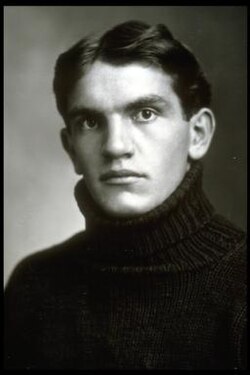
Football Bio
April 19, 1883 – Fort Wayne, Indiana – Germany Schulz, a top-notch University of Michigan center from 1904 to 1908, was born.
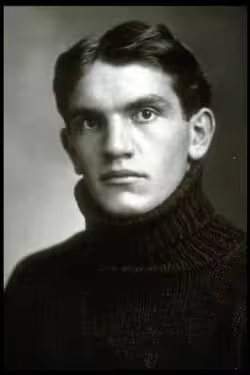
The National Football Foundation shares that Schulz, who stood 6’-4’ tall and weighed in at 245 pounds, unfortunately had to miss the 1906 season as he had dropped out of school because of financial reasons. But the passion he had for both his education and football drove Germany to work hard in a Fort Wayne steel mill to raise funds to pay for his final two years of tuition at the University. This drive to succeed was seen on the gridiron as well, as he is credited with two innovations at his position.
Schulz invented the spiral snap; previously, long snappers always sent the ball end-over-end to the awaiting backs, who really had to pay attention to the oncoming ball to field it cleanly, thus taking an extra moment off their reaction time to start their momentum. His other major contribution was that, before Schulz, centers always played along the line on defense, but the innovative German dropped back to become a roving center, thereby creating football’s first linebacker!
The colorful newspaper journalist, Grantland Rice, painted a great picture of Germany Schulz when he proclaimed in 1928: “Schulz stands as the fastest giant who ever played football, a human bulwark fast enough to tackle at either end, as he brought down his man after the manner of a hawk snaring a quail.” The College Football Hall of Fame proudly displayed a tribute to Germany Schulz in its legendary museum in 1951. After Schulz played his last collegiate down, he served as assistant coach at Michigan, Wisconsin, Tulane, and Kansas State, and in 1923 as head coach for one season at Detroit University.
Conclusion
Germany Schulz remains arguably the most influential lineman in the history of college football. By stepping back from the line of scrimmage on defense, he created a new dimension of play that every modern defense relies on today. His “spiral snap” revolutionized offensive timing, turning the center from a mere ball-shover into a precision passer. Recognized by Grantland Rice and Casper Whitney as the greatest center of all time, Schulz’s legacy isn’t just in the Hall of Fame; it’s in every linebacker who ranges from sideline to sideline and every snap that spirals perfectly into a quarterback’s hands.
Accolades and Football Accomplishments
- College Football Hall of Fame: Inducted in 1951 (Inaugural Class).
- Consensus All-American: 1907.
- All-Time All-American Team: Named by Casper Whitney as the greatest center to ever play (1920s).
- Inventor of the Linebacker: First player to “rove” behind the defensive line.
- Inventor of the Spiral Snap: Replaced the end-over-end “tumbled” snap.
- Michigan Football Legend: Key member of Fielding Yost’s “Point-a-Minute” era.
- Coaching Career: Served as head coach at the University of Detroit (1923) and assistant at Michigan, Wisconsin, and Tulane.
- NCAA 50th Anniversary Team: Selected as the all-time center in 1951.