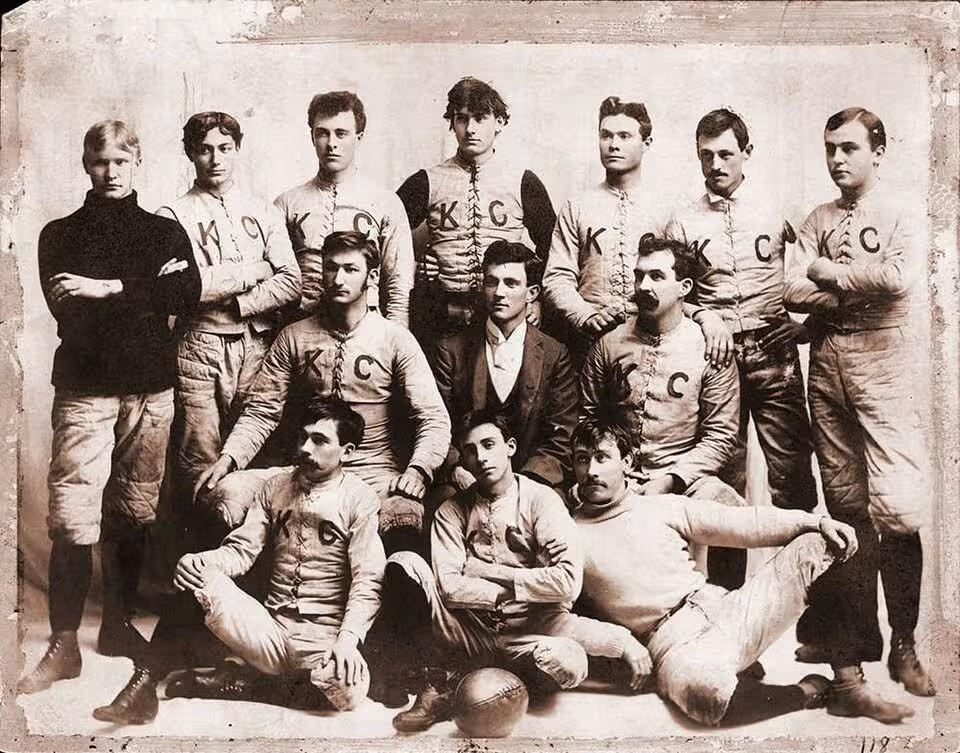
The 1892 season opened with promise, as the Graduate Advisory Committee suggested tweaks to the rules, while teams like Harvard looked to push the rules to their limits.
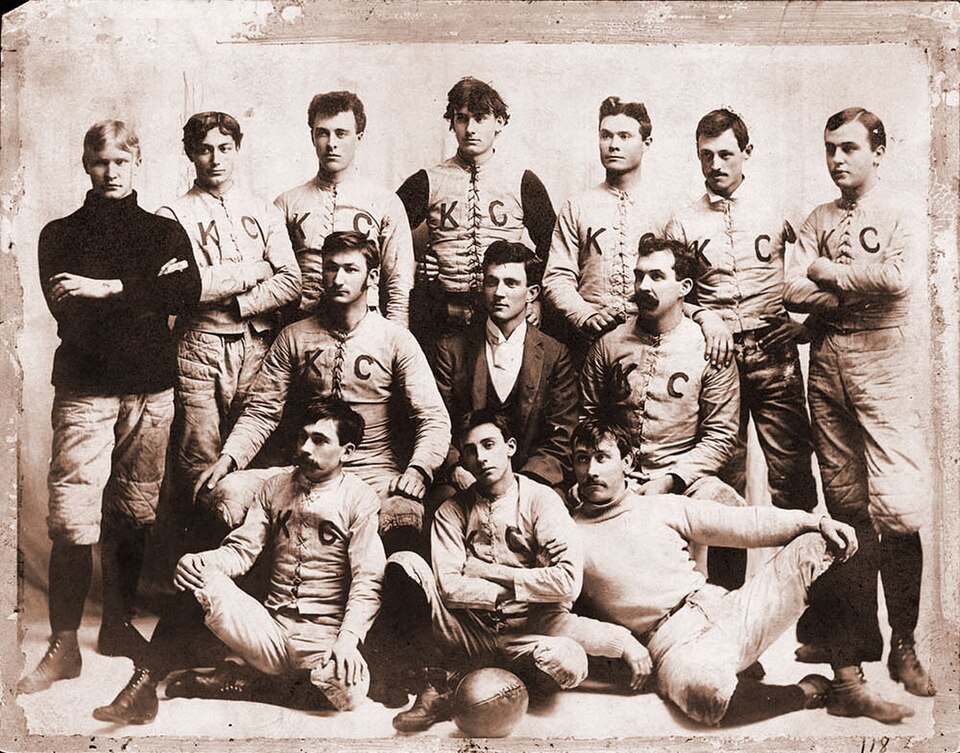
Kalamazoo College’s first football team, 1892. First row, left to right: Remington, Stripp, Shelvin. Second row: Weeler, McWilliams, Magill. Third row: Agbast, J. Westnedge, Gregg, Cole, Kinnane, Shutts, Lineau. Absent: R. Westnedge. The J. Westnedge is Colonel Joseph Westnedge, for whom Westnedge Avenue in Kalamazoo is named. Although he began college coursework in about 1895, the 1892-1893 College Catalog lists him as enrolled in Electives. Perhaps he enrolled in one class in order to play on the football team. The photographer is unknown
Session of Graduate Advisory Committee: 21 March, 1892
The Committee was back and had considered some rule changes to recommend during their hiatus. The group’s suggestions for change totaled three in this session.
- If the ball was fumbled on a “punt-out,” it would be re-kicked. Should it be fumbled a second time, the opponents would start a possession at the center of the field.
- If a “bona fide” attempt at a goal is tried and missed, the ball will go to the opponents at the center of the field.
- Any person who is not a player and attempts to “coach” will be warned; a second offense will result in removal from the field enclosure.
These changes could significantly impact play style, as punt-outs and kicks for goal were common. The Committee recommended penalties for missed kicks, encouraging teams to avoid careless attempts. However, these were only suggestions, as the Association still needed to hold a convention for members to vote on and approve them before they became rules.
Convention of 12 May 1892
All three Graduate Advisory Committee recommendations were accepted with slight modifications. Their wording was revised to be more concise and pertinent.
- Rule 34 read, “If a punt-out from a touchdown is missed or is not fairly caught, the ball shall be taken to the center of the field and given to the defenders of that goal.”
- Rule 32 was added and stated, “If the try for goal following a touchdown is missed, the ball shall be brought to the center of the field and be given to the defenders of that goal.”
- Another new rule stated, “The Umpire shall warn any person coaching from the sidelines. Upon a second offense, the person shall be ordered behind the ropes or fence.”
As officials in today’s era, we are probably all asking ourselves if this third rule revision from 1892 could be reinstated in our rules. It seems that coaching can only be done on the field by the on-field captains. There were no coaches as the captains were in charge of the teams.
Strategy achievements in 1892
Most schools had adopted Princeton’s V-formation due to its effectiveness. Harvard, however, tweaked it to surprise Yale in their November 1892 match. Yale opened the first half running the Princeton V, also known as the V-trick. Harvard settled into the common defense and formed its own V-shaped formation. At the start of the second half, Harvard sprung its surprise. Yale, expecting the V to reappear, as was common at the time to start a period, was stunned when Harvard forwards ran to the 55-yard line (yes, the 55-yard line). One Harvard player, B.W. Trafford, remained at midfield, holding the ball at Harvard’s 45-yard line. The other ten Crimson players retreated to their own 25-yard line and divided into two groups of five, each near a sideline. This happened before the ball was put into play. After a short pause, Trafford waved his arm without putting the ball into play, signaling the two groups, locked together, to rush forward with tremendous momentum. Yale players watched as Trafford disappeared into the crowd. Nearly too late, Yale reacted and finally tackled Trafford at their own 25-yard line.
Harvard’s Lorin F. Deland devised a formation remembered as the “Flying Wedge.” Formations like this took football to new strategic and inventive levels. Strategies such as these shaped the game and its rules. See more details in our next edition of this football history timeline, coming soon on the Dispatch. Find it all right here on PigskinDispatch.com—your place for good football news.
A Deep Dive into 1892 Football History and Highlights
- March 21, 1892 – The Graduate Rules Committee convened to propose changes to the rules on a “punt-out,” missed field goal attempts would result in loss of possession, and a 2 and your gone policy for violators who coached from the sideline.
- May 12, 1892 – The Rules Convention was held, which approved the Graduate Advisory Committee recommendations from March 21. The rules were officially adopted.
- May 25, 1892 – Investigators discovered a boat with deep fingernail scratches, which directly linked it to events from days before. They presumed the wreckage belonged to a vessel carrying high school football players and host fishermen who had gone missing in the Atlantic Ocean off the coast of Melbourne, Florida, on May 21. They further presumed that fourteen players and their teenage companion had drowned.(Source)
- September 28, 1892 – The very first night football game was played in Mansfield, Pennsylvania, between Mansfield State Normal and Wyoming Seminary.
- November 12, 1892 – Pudge Heffelfinger became the first known paid American football player, who was handed $500 by the Allegheny Athletic Association when they played the Pittsburgh Athletic Club at Exhibition Park on the North Shore of Pittsburgh.
- November 19, 1892 – During the season-ending Yale vs Harvard game, the Crimson unveiled their surprise new tactic, a variation of the “Princeton V”, which they called the “V-Trick.” Yale learned about the tactic days before and prepared, defeating Harvard 6-0, in front of 20,000 fans at Hamden Park in Springfield, MA.
We can provide this in-depth look into history from so long ago through careful research. Using someone who was contemporary to the period is the best source. So, a very special shout-out to our main source of reference for this article: Parke H. Davis, in his 1911 book, Football-The American Intercollegiate Game.