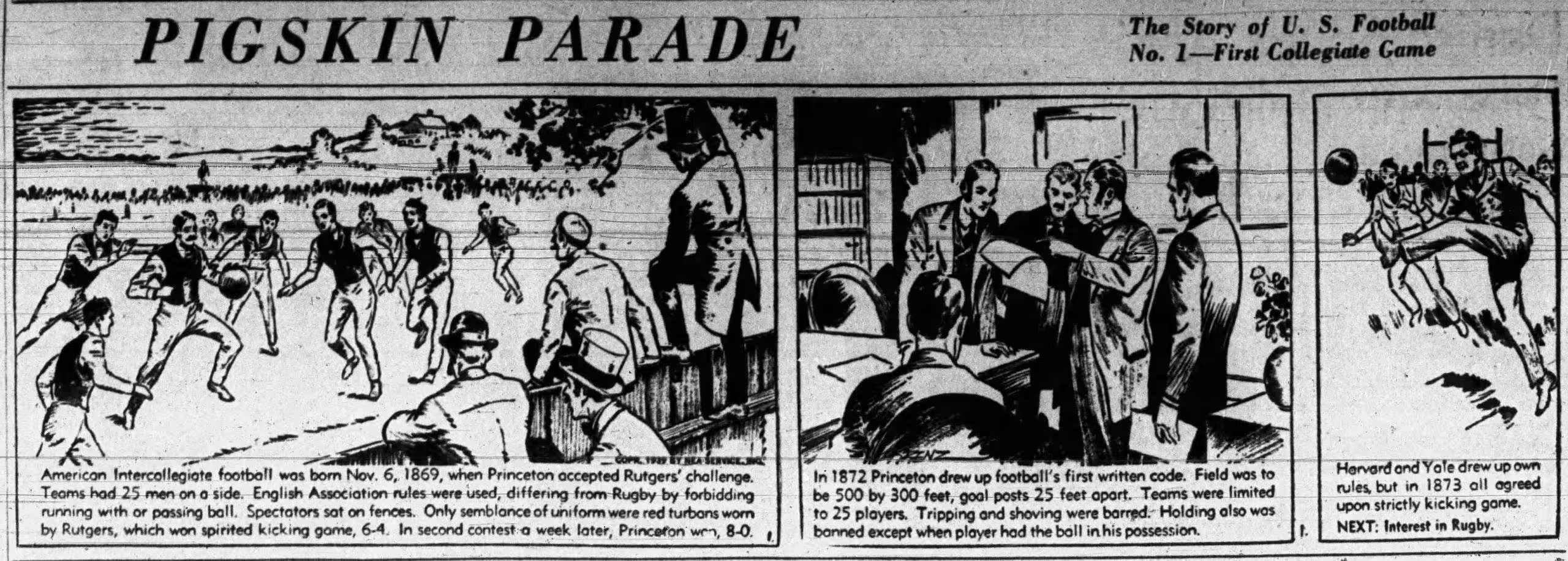
Pigskin Dispatch’s Part 4 in the Series on American Football History
Having explored football’s Ancient European roots, let’s recap before moving forward.
When we last visited this series, a new game called rugby was shipped from England to America. Rugby was a brutal game, and many schools in England decided not to play it and instead chose association football, or soccer. The soccer name obviously stayed here in the States, but in Great Britain and much of the world, soccer is called football.
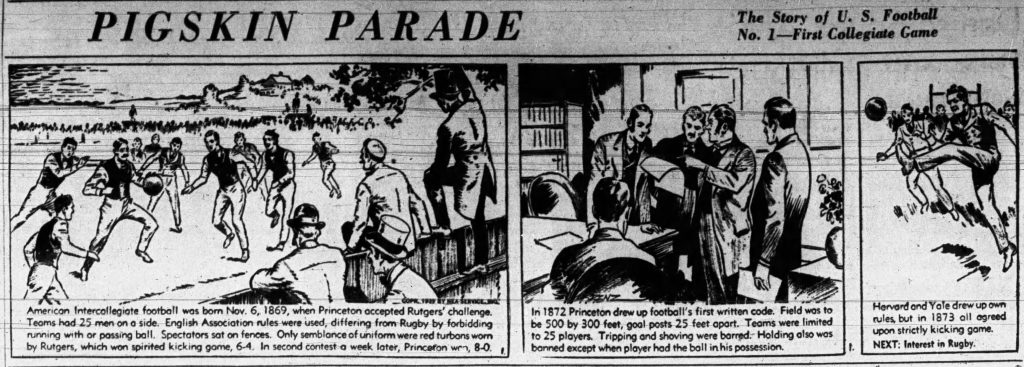
For more on the Pigskin Parade comics, join us here.
A Deep Dive into 1869 Football History and Highlights
America Takes Part in the Game
Rugby, though, seems to have become popular early in America. By 1860, the game was abolished in many American schools due to its rough nature. It was revived in 1862 by Gerritt Smith Hiller, who organized a group of Yale students to play again, using rules that were a reasonably close imitation of soccer. Still, the game was often more an excuse to beat up freshmen in a hazing activity than anything else. The game stuck around and became popular at the eastern colleges.
- November 6, 1869, an inter-collegiate game was played between Princeton and Rutgers. The game played this day was very similar to soccer, with hints of rugby, with 25 players on the field for each team. Many call this the First American football game. We call that idea Hogwash. Check out our 1876 and 1880 posts for a better idea of when American football first started.
- November 13, 1869 – Princeton hosted Rutgers in Princeton, NJ, winning 8-0. Again, not really American football, but an intercollegiate sporting event for sure.
Rules: The games were largely based on soccer rules (using a round ball), with 25 players per team and no running with the ball or passing. A “free kick” was awarded for catching a ball on the fly, which Princeton used heavily in the second game.
Co-Champions: Both teams were later recognized as national co-champions for the 1869 season.
We provide this in-depth historical look through careful research. The best sources are people from the period. Our main reference for this article is Parke H. Davis’s 1911 book, Football—The American Intercollegiate Game.