As of the 2026 season, the Alabama Crimson Tide football program has 18 national championships, making it one of college football’s most decorated programs. From the legacies of the Wade, Bryant, and Saban eras to stars like Johnny Mack Brown, Ken Stabler, Derrick Henry, Joe Namath, and Bart Starr, the Tide has rolled through gridiron history with swagger. In this post, we want to study the origin of the Tuscaloosa-based program and how this legacy connects to the modern-day people and events of ‘Bama football.
In The Beginning of Alabama Football
The University of Alabama’s football program originated in the autumn of 1892, sparked by a grief-stricken student returning home from New England.
William G. Little, a native of Livingston, Alabama, had attended Phillips Academy in Andover, Massachusetts, during the 1891–92 school term. While up north, Little immersed himself in the emerging, brutal game of American rugby-like football, which had captivated Ivy League campuses. Little had intended to enroll at Yale, but when his brother died unexpectedly, he decided to return south to stay closer to his family. In early 1892, Little enrolled at the University of Alabama in Tuscaloosa. Packed inside his canvas bag was an oddity to his southern fellow students: an oblong leather football, a heavy canvas uniform, and a passion for the gridiron.
Organizing the Cadets
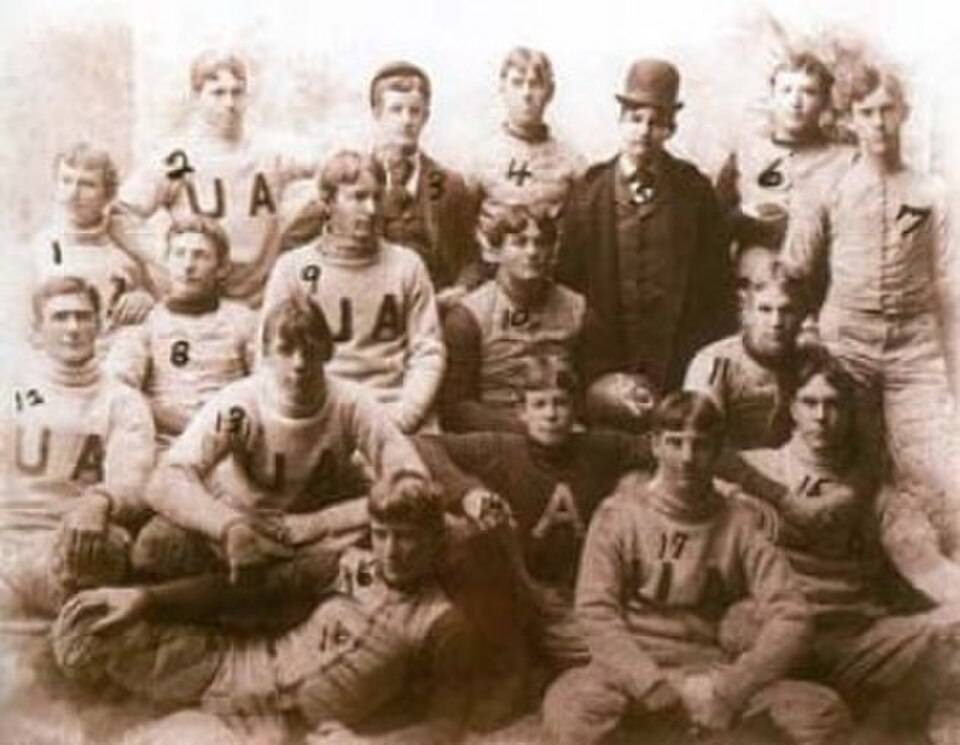
Because the University of Alabama was run under strict military discipline at the time, its students were known as the Cadets. The moniker “Crimson Tide” lay fifteen years in the future, first coined by sportswriters in 1907; we will get to that in a moment.
In October 1892, Little began rallying interested classmates on the Tuscaloosa campus open green space, teaching them the fundamentals of football in basic tackling drills, blocking assignments, and how to execute the newly fashionable “flying wedge” formation developed at Harvard. His Bama peer loved the game as much as Little did. Soon after, the student body formed an athletic association, elected Little team captain, and raised funds to hire their first head coach: E. B. Beaumont.
Beaumont’s tenure proved short and a bit controversial. The players quickly realized their coach possessed only an elementary grasp of the rules and strategy. As the 1893 university yearbook (Corolla) bluntly documented: “We were unfortunate in securing a coach. After keeping him for a short time, we found that his knowledge of the game was very limited. We, therefore, ‘got rid of’ him.” Following Beaumont’s unceremonious firing, Little and his teammates took charge of their own training and tactics.
The Inaugural Game
Alabama’s first official contest took place on Friday afternoon, November 11, 1892, at Lakeview Park in Birmingham.
The Cadets faced an all-star squad assembled from Birmingham high schools and Professor Taylor’s academy. The match was primarily arranged as a warm-up exhibition for a high-profile game against the older, heavier Birmingham Athletic Club (B.A.C.) scheduled for the following afternoon.
Before a curious crowd unaccustomed to the collision sport, Alabama dominated from the opening kickoff. Utilizing the flying wedge to batter the line of scrimmage, the Cadets overwhelmed the local prep players, winning 56–0. David Grayson, Dan Smith (who scored twice), G. H. Kyser, T. S. Frazer, and Captain William Little himself scored the first-half touchdowns.
The celebratory mood was short-lived: the next day, playing battered and exhausted against the Birmingham Athletic Club, Alabama suffered its first loss, dropping a 5–4 heartbreaker when B.A.C.’s J. P. Ross drilled a late 63-yard drop kick. (Touchdowns counted as 4 points and field goals as 5 points under 1892 scoring conventions.) Alabama later avenged the defeat in December, shutting out the B.A.C. 14–0 at Lakeview Park.
Early Stars and Pioneering Coaches
The foundation laid in that four-game inaugural season (which finished 2–2 after a February 1893 loss to Auburn in the state’s first Iron Bowl clash) rested entirely on student leadership:
- William G. Little: The acknowledged founding father and star halfback who brought the equipment, organized the roster, and guided the team through its inaugural campaign.
- Eli Abbott: A ferocious starting tackle on the 1892 line who immediately took over as player-coach from 1893 to 1895 (and again in 1902). Abbott served as the technical architect of Alabama’s line play during its earliest interstate matches.
- David Grayson & Dan Smith: Alabama’s first explosive ball-carriers. Grayson scored the program’s first recorded touchdown and later ripped off a 65-yard run in the B.A.C. rematch.
- William B. Bankhead: A reserve on the 1892 squad who earned renown beyond sports and eventually became the 42nd Speaker of the U.S. House of Representatives.
- Otto Wagonhurst (1896) & W. A. Martin (1899): Early professional coaches brought in to stabilize the roster once Southern intercollegiate conferences began to form. Wagonhurst, a former Penn athlete, brought rigorous conditioning techniques that modernized the program’s weekly preparation.
Within a decade of Little carrying his solitary football off the train into Tuscaloosa, the game transformed from an eccentric campus experiment into an institution that would define Alabama collegiate sports for over a century.
How the Crimson Tide Moniker Originated
It is one of the most unique and recognized nicknames in all of sports: the Crimson Tide. How did this name come about, and what does it mean?
On November 16, 1907, in Birmingham, Alabama, the 12th Iron Bowl was played, and Auburn and Alabama tied 6-6. According to rolltide.com, the name “Crimson Tide” was allegedly first used by Birmingham Age-Herald sports editor Hugh Roberts to describe this game, as reported by the American Football Database.
The internet fandom site has a great story about the game. The game was allegedly played on a sloppy, muddy quagmire of a field, and Auburn was the big favorite. But evidently the “Thin Red Line,” as Alabama was often called at the time, played a great game in the reddish mud and held Auburn to a 6-6 tie, thus earning the name “Crimson Tide.” Zipp Newman, former sports editor of the Birmingham News, probably popularized the name more than any other writer. This was the last football contest between the two schools until 1948, when the series was resumed.
Milestone Moment of National Recognition for Tide
Alabama football had a pivotal moment in 1926 that put the program and Southern football on the map. On January 1, 1926, Coach Wallace Wade guided his team to an outstanding season and the prestigious invitation to present all Eastern teams in the Rose Bowl. Alabama traveled across the country to face a juggernaut in the Washington Huskies. It was a tight, hard-fought game, but when the dust settled, Alabama won 20-19.
The victory was slim, yet its historical weight was immense. It was a triumph of resilience and regional pride, proving that the style of football played in the South could compete, and win, on the grandest stage. Wallace Wade’s 1925 team finished their perfect 10-0 season by accomplishing what no Southern team had done before: defeating a respected Western powerhouse in the Rose Bowl.
Conclusion
The 1926 Rose Bowl victory was a foundational moment for Southern football. It was the crucial crack in the ceiling that allowed future programs from the region to gain credibility and national recognition. The stunning 20-19 upset over Washington provided the validation and confidence necessary to establish the legacy that would eventually evolve into the dominance we see today. For Alabama, and for the entire American South, this victory was not merely a title; it was the definitive declaration that they belonged at the pinnacle of the sport.
More Stories of Alabama Crimson Tide Football Legends
- Football History of October 8
- Vaughn Mancha: Alabama Football Legend & Hall of Famer
- Football History of October 4
- Football History of October 2
- Johnny Mack Brown: Alabama Football Legend & Western Star
- Cornelius Bennett: Alabama’s 3-Time All-American Legend
- Gridiron Pioneer: The Remarkable Journey of Riley Smith
- Don Whitmire: Alabama & Navy All-American Hall of Famer
- Woodrow Lowe: Alabama’s Legendary Three-Time All-American
- The Guarantee: The Irrepressible Rise of Broadway Joe
- Lee Roy Jordan: The Relentless Heart of Bear Bryant’s Alabama Defense
- Harry Gilmer: The “Jump-Passing” Wizard of the Crimson Tide
- Pooley Hubert: The General of the “Game That Changed the South”
- The Ultimate Guardian: Why John Hannah is the Greatest Lineman in Football History
- Ozzie Newsome: The “Wizard of Oz” Who Redefined the Tight End Position
- The Italian Stallion: Johnny Musso’s Legendary Run at Alabama
- Billy Neighbors: The Iron Anchor of Bear Bryant’s Crimson Tide
- February 21 Football Fix
- Don Hutson: The Alabama Legend and Green Bay Packers Icon
- Bart Starr: The Legendary Quarterback of the Green Bay Packers Dynasty
- The Chosen Few: Ranking College Football’s Greatest No. 3s
- The Day the South Rose: 1926 Rose Bowl
- Ken ‘The Snake’ Stabler: Unpacking the Legacy of the Raiders’ Super Bowl XI Quarterback
- The Interception That Launched a Dynasty: Alabama’s Game-Winning Pick-Six in the Inaugural SEC Title
- Football History of December 4
- The Fateful Kick: How Danny Wuerffel Snatched the 1994 SEC Championship from Alabama
- Football History of December 2
- The Crumbling of the Berlin Wall: Auburn Stuns No. 2 Alabama in Historic First Home Game
- January 7 Football Fix
- The Night Namath Couldn’t Conquer: Reliving the 1965 Orange Bowl Thriller
- Millard “Dixie” Howell: The Alabama Halfback Who Threw to Hutson and Bryant
- Dwight Stephenson: The Eight-Year Star Center
- Hurri Cain: The Triple-Threat Engine Behind Alabama’s 1930 National Title
- Football History of November 15
- Tide vs. Tigers: The Night Defenses Ruled the “Game of the Century” (2011)
- History Behind The First Iron Bowl Game
- The Bear Bryant 1977 Upset That Launched an Alabama Dynasty
- An Instant Classic: The 1969 Ole Miss vs. Alabama Shootout
- Bart Starr
- Tide Stuns Trojans 1971