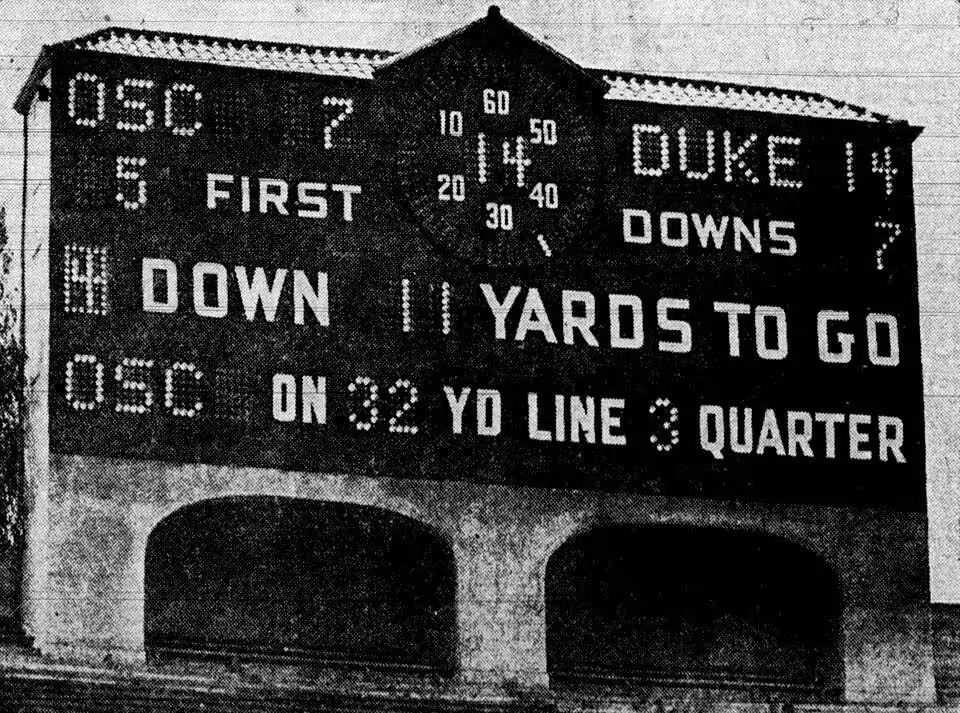
When we go to a football game in today’s modern era, we count on looking at the scoreboard to know the official time of the game. This was not always the case, as alternative means of keeping time were the ones the game actually played to. It’s amazing how far the game clock has advanced in the last century and a half!
Back in 1873, college football players made significant efforts to standardize the game by playing it in two 45-minute halves. Walter Camp of Yale joined Harvard’s legendary coach Loren DeLand in 1894 to write a book titled “Football, How to Watch a Game” , in which they stated that a game would “proceed for 35 minutes of actual play time with time being taken out for delays of any nature.”
After this period of time, a ten-minute intermission would follow, and then the play would resume for another 35 minutes.” So in piecing together these clues, it sounds as if a game started at noon, the first half would end roughly at 12:35 unless delays had “time taken out” which would be added on by the officials, most likely the Referee. One would assume the official game timepiece was a simple pocket watch that the Ref would use to reference the actual time of day.
According to MentalFloss.com, the football rules of the NCAA from the Rule Book publication read Rule 2(a) The length of the game shall be 60 minutes, divided into two halves of 30 minutes each, 8 minutes exclusive of time taken out. There shall be a ten-minute intermission between the two halves.
The FootballZebras.com website shares that up until 1970, the scoreboard at NFL games was not the official time; the official time was kept on a watch by an on-field official known as the line judge. At least it was the line judge from 1965 to 1970; prior to that, the field judge kept the official game time on their watch during the 1950s and early 1960s. Prior to 1950, the Referee himself would carry the game clock. It was the task of whoever was keeping the game clock to notify each sideline and on-field players and officials of the clock’s status and remaining time in the quarter, especially in a tight contest near the end of a half. When the time expired, the official would fire a starter’s pistol into the air.
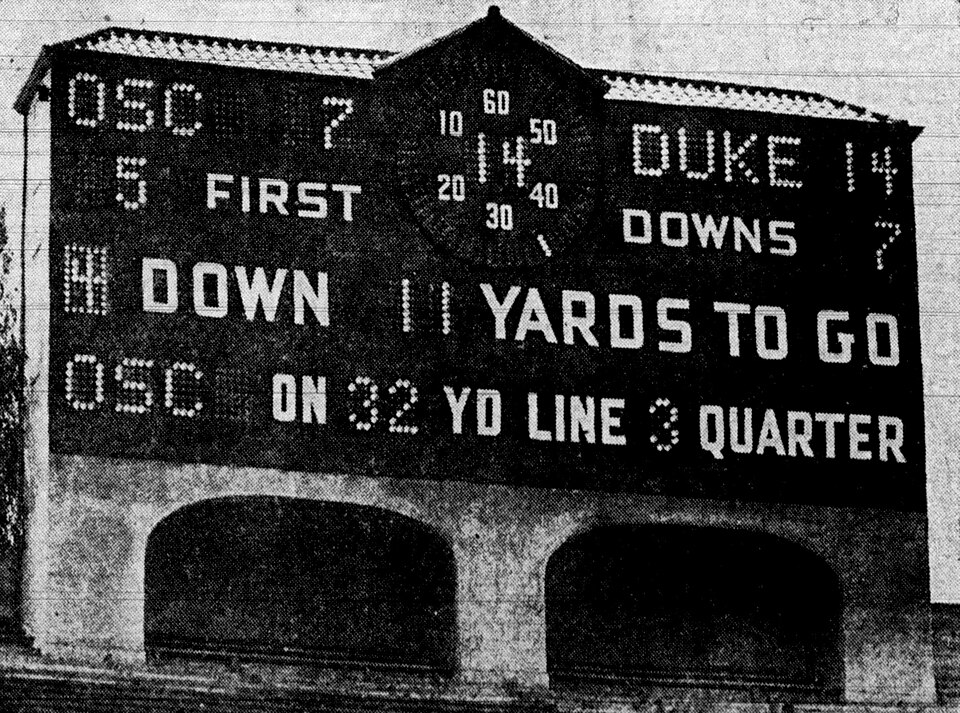
The Football Zebras article goes on to state that, Many times in that era, football was played in baseball parks that had no need for clocks. For instance, Cleveland Municipal Stadium (home of the Rams and Browns) and Yankee Stadium (where the New York Giants played for 18 seasons) had modified analog clocks numbered 0–14. Tiger Stadium posted only the minutes remaining on the scoreboard for Detroit Lions home games.
When stadiums were equipped with clock displays, this timing was unofficial. This led to occasions when the stadium clock still showed time, but the officials declared the game over.
That is where the two-minute warning, still used at the professional level, really had some importance other than just another way for the clock to stop near the end of a half. It was a time when the time-keeping official could officially inform all parties that approximately two minutes remained in the half.