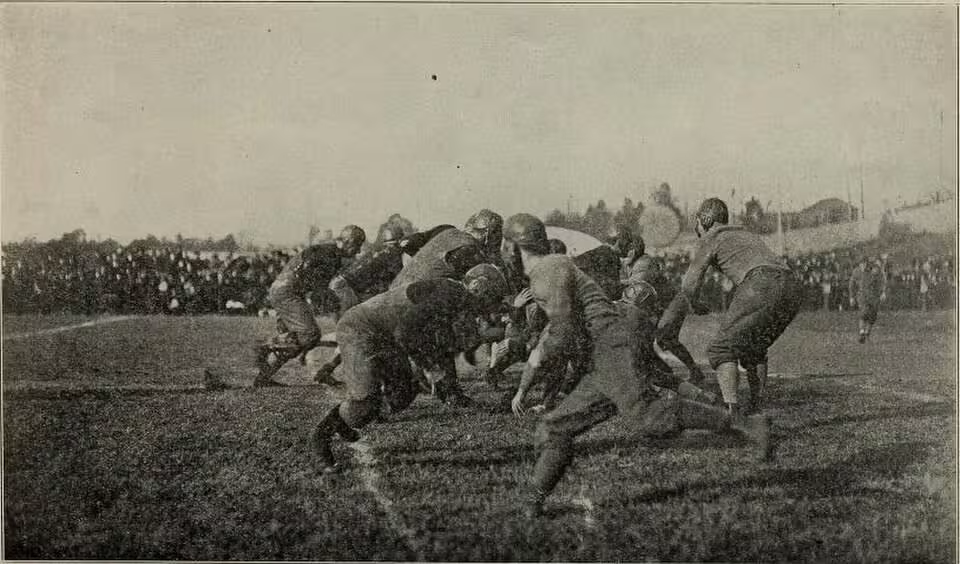
The 1912 American football season was a transformative year that fundamentally altered the sport’s DNA. It was the year the “modern” game truly began to take shape, moving away from its brutal, rugby-style roots toward the high-scoring spectacle we recognize today.
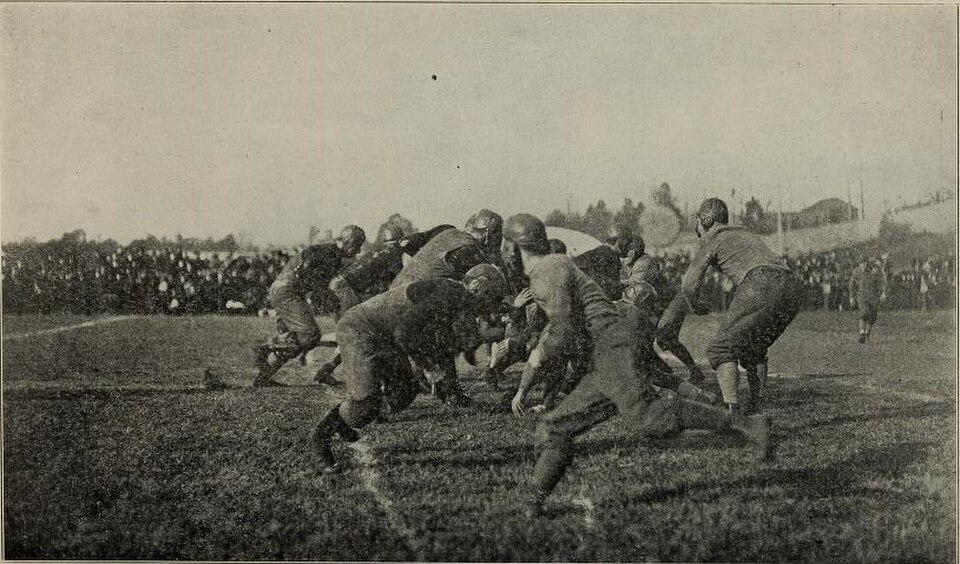
Key Changes and Trends
The rule revisions of 1912 are among the most dramatic shifts in the game’s evolution, transforming American football into what it looks like today. Though the forward pass was legalized in 1906, there was little incentive for offenses to use it because of harsh penalties, such as loss of possession on an incompletion, and other various rules that seem alien to our modern perception of the passing game.
The field size was altered to accommodate gridiron real estate beyond the goal lines in two new areas, which we now call the end zones. The old three-down rule to reach the line of scrimmage to gain was changed to four downs, and the value of a touchdown increased.
- The Point Value Shift: The value of a touchdown was increased from 5 points to 6 points. This shift was designed to incentivize offensive play over field goals, which remained at 3 points.
- Dimensional Changes: The field was shortened from 110 yards to 100 yards, and the 10-yard end zone was officially established. This provided a legal space for catching forward passes, which had previously been restricted.
- Downs and Distance: Teams were now given four downs to gain 10 yards, rather than three. This change enabled more strategic play-calling and reduced reliance on desperate “three-and-out” punting.
- The Rise of the Forward Pass: While the pass was legalized in 1906, the 1912 rules (including the removal of restrictions on pass length) finally allowed teams like Notre Dame and Carlisle to use it as a primary offensive weapon.
Major Teams and Performance
The 1912 season saw the emergence of powerhouse programs and legendary figures:
| Team | Performance Note |
| Harvard | Generally recognized as the national champion, finishing with an undefeated 9-0 record. |
| Penn State | Also finished undefeated (8-0) and claims a share of the national title. |
| Carlisle Indian School | Led by the legendary Jim Thorpe, Carlisle led the nation in scoring with 454 points, showcasing a highly innovative offense. |
| Notre Dame | Finished 7-0, setting the stage for their national explosion the following year. |
A Deep Dive into 1912 Football History and Highlights
- February 3, 1912 – The NCAA’s Football Rules Committee reduced the size of the playing field from 110 yards to 100 yards and added two ten-yard end zones. (Football Archaeology)
- February 3, 1912 – The NCAA Football Rules Committee increased the value of a touchdown from 5 points to 6 points, and a successful kick afterward was worth an additional 1 point. We should note that the one point (PAT) was not clearly identified to the public until the Buffalo Commercial Post Editor asked Walter Camp in a letter.
- February 3, 1912 – New Rules allow a fourth down to reach ten yards for the line to gain.
- February 6, 1912 – Walter Camp responds to a question from the Buffalo Commercial editor on what the value of a Point After Kick Attempt would be worth. Camp responds with: “The touchdown counts as six, and kicking the goal adds one; that is the touchdown and the goal kicked makes 7.”
- July 15, 1912 – Jim Thorpe’s Historic Decathlon Gold – Legendary athlete Jim Thorpe wins the Olympic gold medal for the decathlon at the Summer Games in Stockholm, Sweden. Thorpe sets a new Olympic record for points scored by finishing in the top four of all ten events. Though stripped of his medals in 1913 over minor-league baseball stints, the International Olympic Committee (IOC) officially restored his gold medals posthumously in 1982.
- November 9, 1912 – According to a story on charlotteobserver.com, Worcester Tech coach William F. Carney used the lateral pass as an offensive weapon for the first time. Carney’s team beats Amherst 14-13.
- November 30, 1912 – AAA Grounds, Hamilton. Ontario – The home team, Hamilton Alerts, won their only Canadian title by surviving the Toronto Argonauts, 11-4, in the 4th time the Grey Cup was played per Onthisday.com.
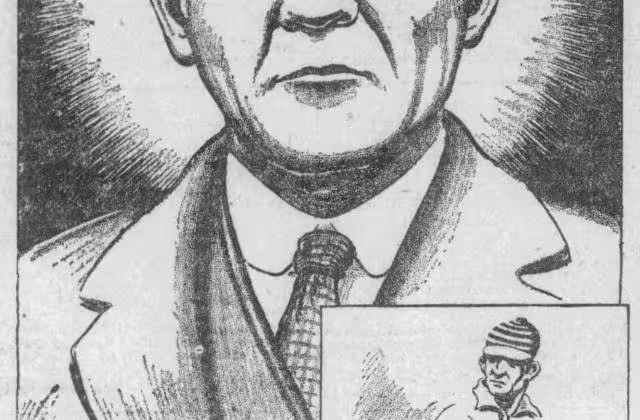
Article from Feb 8, 1912 Buffalo Post (Buffalo, New York) Walter camp
- July 7, 1912 – Olympic track star Jim Thorpe won four of the five events in the 1912 Olympics Decathlon.
- September 21, 1912 – The first legal forward pass caught in the end zone. Football Archaeology has identified that the Maine-Fort McKinley game, which Maine won 38-0, contains the first pass under the new 1912 rule: a Bernheisel-to-Donohue catch in the end zone.
- September 21, 1912 – The new scoring system debuted, with the first six-point touchdowns recorded. This milestone occurred during two notable games: Carlisle’s dominant 50–7 victory over Albright College and Rhode Island’s 7–0 shutout against Massachusetts Agricultural (the present-day University of Massachusetts Amherst). (Source Wikipedia)
- November 2, 1912 – a high-stakes battle of the unbeatens took place as Harvard (5–0–0) hosted Princeton (6–0–0). The game was dominated by Harvard’s Charles Brickley, whose versatile performance secured a 16–6 victory. Brickley thwarted the Princeton offense with two interceptions and contributed heavily to the scoreboard, booting a 47-yard field goal and orchestrating the drive for a Harvard touchdown. (Source Wikipedia)
- November 9, 1912 – Carlisle defeated the mighty Army team 27-6, registering one of the largest upsets in football history and showing what the new rules could do to open the game up for a smaller, faster team. Check out our full story.
- November 9, 1912 – According to a story on charlotteobserver.com, Worcester Tech coach William F. Carney used the lateral pass as an offensive weapon for the first time. Carney’s team beats Amherst 14-13.
- November 30, 1912 – AAA Grounds, Hamilton. Ontario – The home team, Hamilton Alerts, won their only Canadian title by surviving the Toronto Argonauts, 11-4, in the 4th time the Grey Cup was played per Onthisday.com.