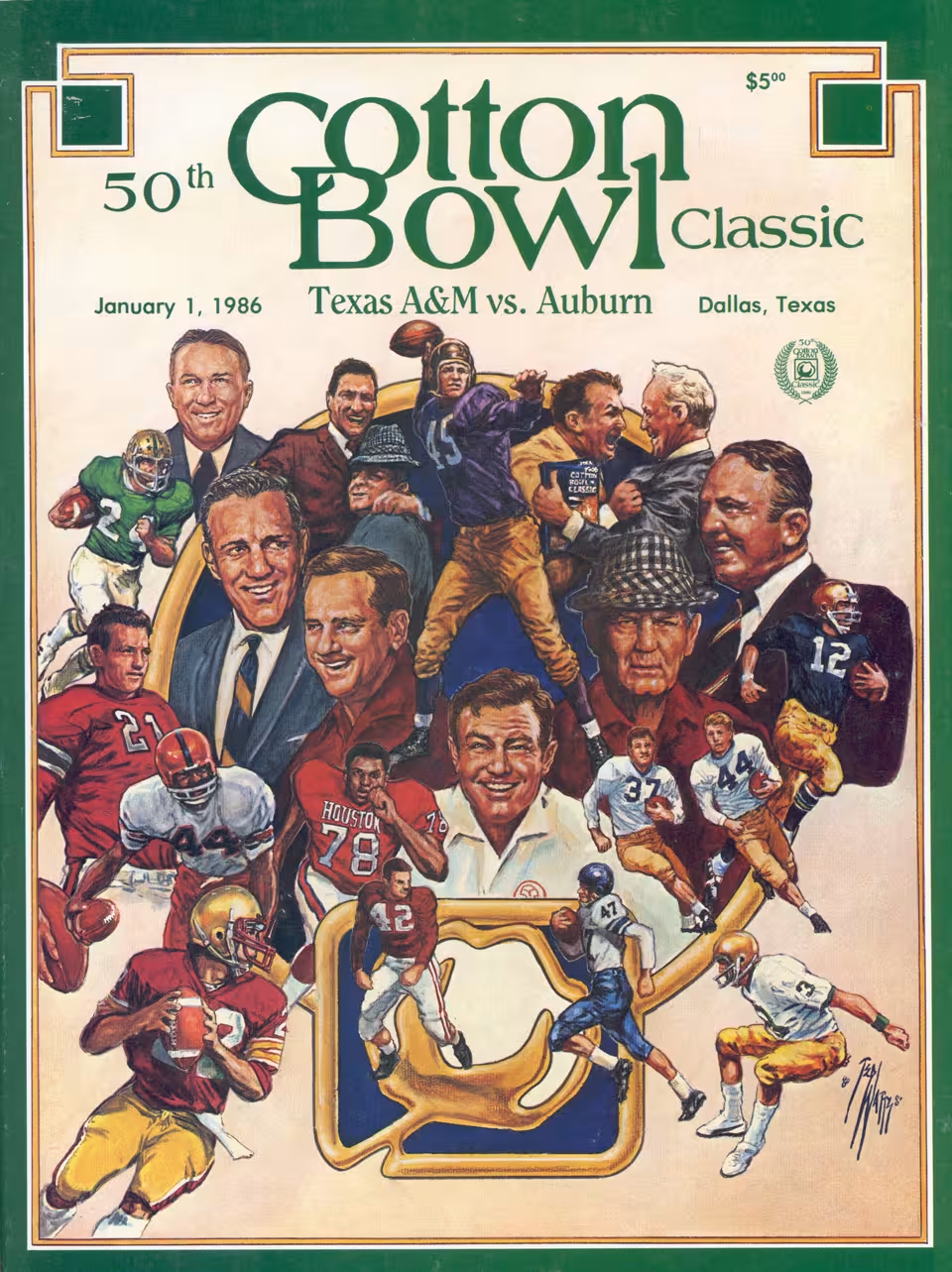
From the rudimentary origins of the fair catch in 1894 to the high-tech wizardry of the virtual yellow first-down line, May 8th is a masterclass in the evolution of the gridiron. Imagine a time when players had to physically dent the turf with their heels to mark a spot, then fast-forward to a billion-dollar industry where 3D field models and digital sensors guide every viewer’s eye. Whether it’s Walter Eckersall crowning the “greatest of all time” in 1910 or the birthdays of defensive juggernauts like Ronnie Lott and Doug Atkins, today’s journey through football history proves that while the technology changes, the legends are timeless.
uploaded to Wikimedia Commons courtesy of Susan Natalie Freeman
May 8 American Football History Timeline
- May 8, 1894- Rules convention at the NYC Athletic Club instituted a rudimentary rule for fair catch interference on a kick play. A portion of this rule required the person fielding and signaling the fair catch to mark the “spot” of the fair catch by marking it with the back of his heel, indenting the turf, after waving one hand over head and catching the untouched kick or punt.
- Turning to another key event, on May 8, 1910, Walter Eckersly writes the Greatest Football Player of All Time article.
https://www.newspapers.com/image/566158784/?terms=Football&match=1
The article begins by establishing Walter Eckersall’s credibility and credentials. Eckersall was selected by Walter Camp three consecutive years as the equivalent of First Team All-America, and even made Camp’s All-Time All-American team as the QB! The brilliant quarterback played, of course, for Coach Amos Alonzo Stagg at the University of Chicago https://pigskindispatch.com/home/Football-History/Football-History-by-month-and-day/June/June-17, and all of this definitely qualified Eckersall for the task of determining the greatest player of all time, for at least the first 30 years of American football.
Eckersall chose Ted Coy from Yale for this honor. Coy, Eckersall exclaims, “possessed superhuman endurance, who more than any other man was responsible for Yale’s football triumphs in the last three years…who by his clean playing and true college sportsmanship on and off the field, which has done much to elevate the popular college sport, belongs the honor of being the greatest football player of all time.” We will examine Mr. Coy’s career more closely in a few weeks, on the May 23 birthday edition of Football History Headlines.
- May 8, 2001- Patent 6,229,550 is granted for Blending a Graphic to create the yellow line on TV for line to gain, the yellow first-down line. Since the late 1990s, the virtual yellow line has quietly enhanced football broadcasts by providing viewers with a live, intuitive guide to the line of gain, even when the sticks are nowhere in view. The graphic is engineered to appear painted on the field, rather than simply plopped on top of the players. The line debuted during a September 27, 1998, game between the Baltimore Ravens and the Cincinnati Bengals. It was developed by Sportvision Inc. and operated by six people in a 48-foot semi-truck parked outside the stadium. ESPN was the only network that immediately agreed to pay the steep price of $25,000 per game. Before long, other companies began offering the yellow line to the other networks, and now you won’t see a football game without it, according to Vox.com.
Sportsvision developed this technology from its failed “blue halo” experiment in NHL Hockey in 1996, called FoxTrax, according to an article on MentalFloss.com. The article goes on to say FoxTrax employed a system of cameras and sensors around a hockey rink to place a little blue halo around the puck. FoxTrax wasn’t a great fit for NHL broadcasts: Hockey purists hated the intrusion into their game, and casual fans didn’t flock to hockey just because the puck was suddenly easier to follow. However, the system inspired producers to explore new ways to integrate computer-generated imagery into live sports broadcasts. The idea of using a line to mark the first down in football was a natural extension, so they rolled it out in that aforementioned Bengals/Ravens game. A rival company, Princeton Video Image, rolled out its Yellow Down Line system during a Steelers-Lions broadcast on CBS later that same season. Sportvision is still operating, but, interestingly, ESPN, Sportvision’s initial partner, acquired all of rival PVI’s intellectual property in December 2010.
Ok, what is the “magic” of this mystery line anyway? Mental Floss again has the answer, stating that, “Long before the game begins, technicians make a digital 3D model of the field, including all of the yard lines. While a football field may look flat to the naked eye, it’s actually subtly curved with a crown in the middle to help rainwater flow away. Each field has its own unique contours, so before the season begins, broadcasters need to get a 3D model of each stadium’s field.” Each broadcast camera is equipped with special sensors that constantly sync its location with the zoom, tilt, and pan of the camera shot to the 3D model of the field’s unique minute landmarks, and voila! A computer-generated line is slipped into any camera view you see. And we enjoy that high-tech digital line without even really thinking about it. (source)
- On May 8, 2010, the last piece of Yankee Stadium fell in the Bronx, New York, marking the end of the two-year demolition process. Almost 88 years to the day from the start of its construction on May 5, 1922, the cycle of the House that Ruth Built has its last remnant removed. It had many baseball memories and historic moments, but as we discussed in the May 5 edition of the Football History Headlines, it was also the venue for some awesome gridiron moments.
- May 8, 2014, South Carolina’s outside linebacker Jadeveon Clowney was the first pick by the Houston Texans in the 2014 NFL Draft. This is really a pretty amazing draft, so much so that we shared the top 16 picks compliments of the Pro Football Reference website. Check out these names of NFL stars.
May 8 Football Hall of Fame Birthdays
Happy Birthday to these gridiron icons! Since today is May 8, we celebrate a trio of Hall of Famers who defined toughness and leadership across multiple eras of football.
Here is the list in order of birth:
- Doug Atkins [1930] A 6’8″ physical marvel who transitioned from basketball to become a National Champion at Tennessee, Atkins was famous for literally leaping over offensive linemen to reach the quarterback. His 17-year NFL career was highlighted by his time with the Chicago Bears, where his devastating pass rush earned him eight Pro Bowl selections and a 1982 induction into the Pro Football Hall of Fame.
DOUG ATKINS
1955–1966
- Bill Cowher [1957] While he played linebacker for the Browns and Eagles, “The Chin” earned his legendary status as the fiery head coach of the Pittsburgh Steelers for 15 seasons. He famously guided the 2005 Steelers to become the first sixth-seeded team to win a Super Bowl and was enshrined in Canton in 2020 for his remarkable 149-90-1 career coaching record.
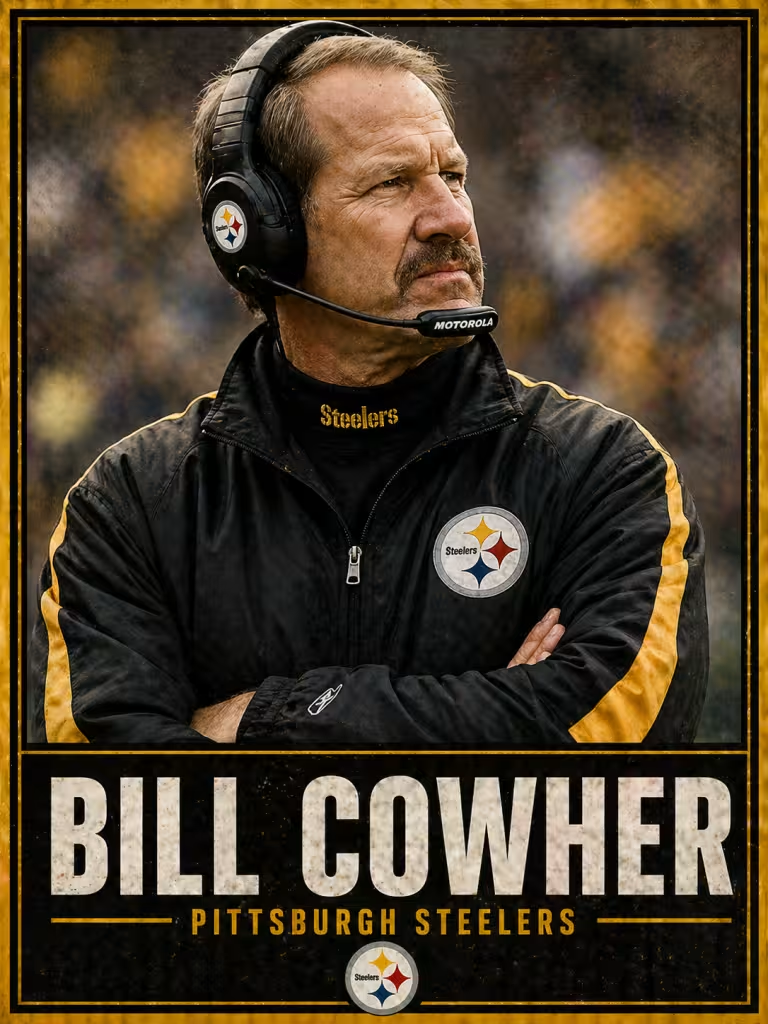
BILL COWHER
1992–2006
- Ronnie Lott [1959] Widely regarded as the most feared hitter in football history, Lott was a National Champion at USC before becoming the defensive heartbeat of the San Francisco 49ers’ dynasty. He achieved the rare feat of earning All-Pro honors at three different positions—cornerback, free safety, and strong safety—and finished his Hall of Fame career with four Super Bowl rings and 63 interceptions.
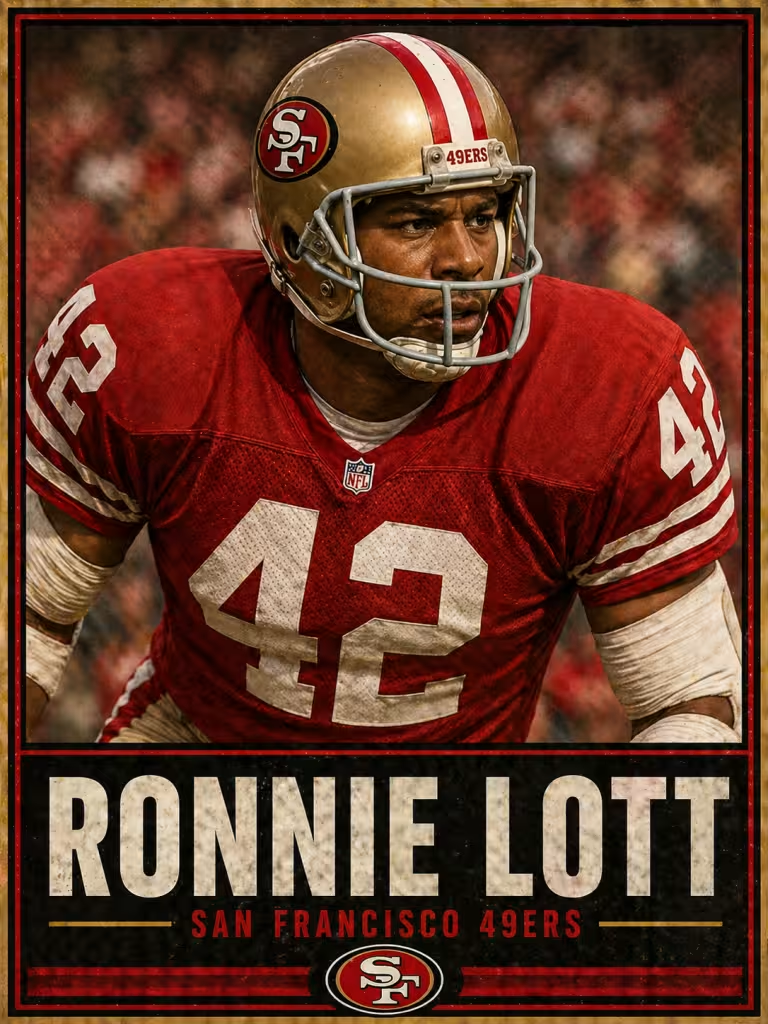
RONNIE LOTT
1981–1990
Conclusion
The legacy of May 8th highlights the bridge between football’s gritty past and its polished, digital future. We see the game’s structural growth in the demolition of the old Yankee Stadium and its technical revolution through the Sportvision yellow line patent. More importantly, we celebrate the human element—the “Chin” of Bill Cowher’s leadership, the terrifying hits of Ronnie Lott, and the leaping pass rush of Doug Atkins. As we look back on these milestones, we are reminded that every innovation, from a heel mark in the dirt to a sensor on a camera, serves the same purpose: honoring the pursuit of gridiron greatness.