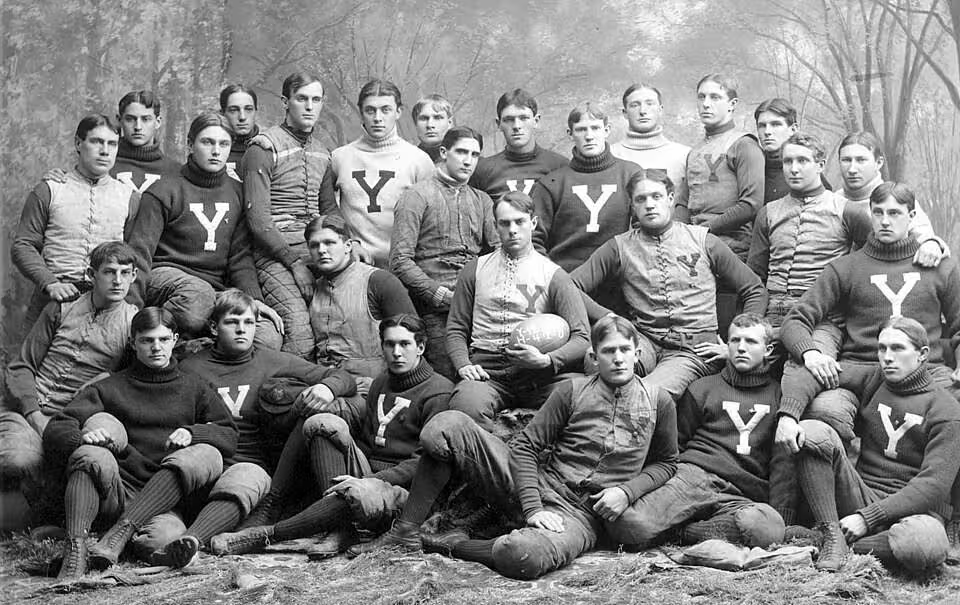
Innovation in football is often celebrated as the mother of invention. However, in 1893, certain innovations, driven by strategists such as Lorin F. DeLand of Harvard and George W. Woodruff of Yale, produced results that may not have been desirable for players. Our 1893 edition reported on how these strategies relied on marshaling a mass of men to overwhelm a single point in the opponent’s defense.
A Deep Dive into 1894 Football History and Highlights
A couple of events impacted football in 1894. Both the Yale Bulldogs (16-0) and the Penn Quakers (12-0) went undefeated. Yale outscored opponents by a staggering 485-13 and was retroactively named the national champion by the Billingsley Report, Helms Athletic Foundation, and National Championship Foundation. Parke Davis said the Bulldogs and Quakers were co-champions.
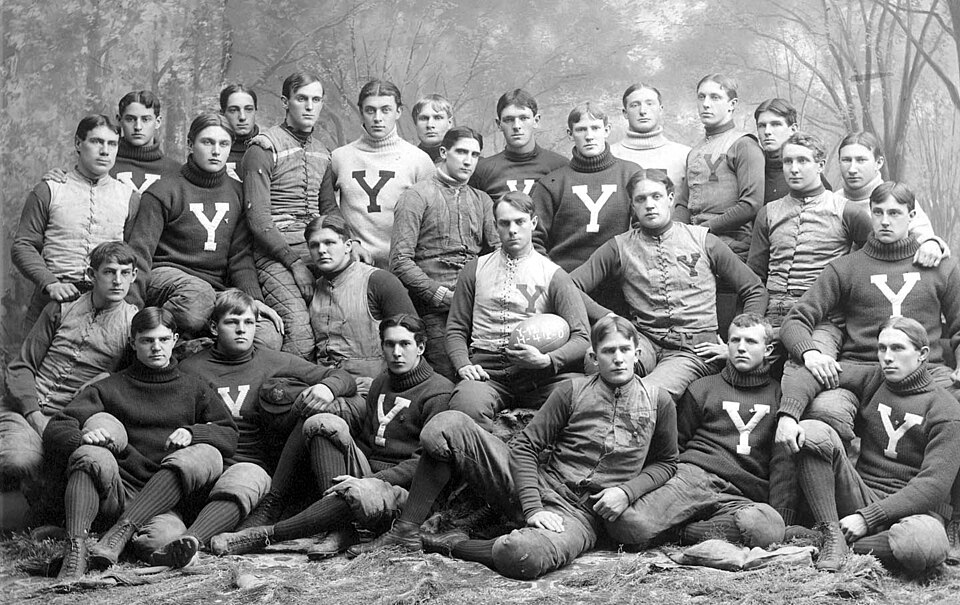
- October 27, 1894 – In its most competitive game of the season, Yale outlasted a tough Army team 12-5.
- November 24, 1894 – A late-season battle of undefeateds. Yale beat Harvard 12-4 at Hamden Park in Springfield, MA, as part of a 16-0 season.
- November 29, 1894 – Harvard suffered a second straight setback in the season finale against undefeated Penn, 18-4.
Football Injury Reports
The game’s formations and strategies led to situations the human body could not physically tolerate. Writer Parke H. Davis, in his 1911 book Football-The American Intercollegiate Game, illustrated the point very explicitly when he wrote: “the generals had devised plays too powerful for their sturdy soldiers to execute and withstand.”
Davis also suggests that some reports of injury may have been exaggerated, especially by the European press. Davis’s book points out one such article in the Münchner Nachrichten (a German periodical) that reported on the November 1893 meeting between Harvard and Yale (see Part XVI of this series) and sounded more like a battle account than a game played by collegians.
The football tournament between Harvard and Yale, recently held in America, ended in disaster. It turned into an awful butchery. Of the twenty-two participants, seven were so severely injured that they had to be carried from the field in a dying condition. One player had his back broken, another lost an eye, and a third lost a leg. Both teams appeared on the field, surrounded by a crowd of ambulances, surgeons, and nurses. Many ladies fainted at the awful cries of the injured players. The indignation of the spectators was powerful, but they were so terrorized that they were afraid to leave the field.”
(Writer’s note: Remember these are the Germans writing this piece, the future instigators of two world wars and a horrific holocaust.
Davis alleges that such articles appeared globally, but he felt they reeked of sensationalism. Nevertheless, they influenced public outcry in the late 1890s and early twentieth century. The Secretary of the Navy and Secretary of War abolished the upcoming Army-Navy series by restricting Academy members to their campuses.
Part of the public’s reaction stemmed from the lack of an authoritative body overseeing football rules. The once-powerful Intercollegiate Association had dwindled to just Princeton and Yale, as other schools left mainly over player eligibility disputes. The game needed saving—someone had to stop the tailspin! Without swift corrections to reduce injuries and unite all under common rules, the game could soon die out, and the public would remain worried.
How to tame the beast that football had become?
The University Athletic Club of New York called for members of Princeton, Pennsylvania, Harvard, and Yale to come together and assume authority over all football rules to try to tame the “beast” it had become. The four schools immediately accepted the assignment and scrambled to elect their representatives to the newly formed body. The representatives selected were W.A. Brooks, J.C. Bell, Alexander Moffat, and Walter Camp. This group of men decided to make it a five-some, inviting the foremost official of the time, Mr. P. J. Dashiell, to join them to gain his perspective and influence on the reformation of the great game.
Before the group had even met, Walter Camp sent out a survey to every known former football player in the United States, asking specific questions about the injury plague that had bitten the game. The former players’ response was overwhelming, and Camp categorized the answers and published them. The results showed that many of the stories were unfounded and very much exaggerated. This report from Camp’s investigation made the accusations of outsiders subside almost to the point of non-existence regarding the horrific injuries.
The group of five then held many meetings in 1894 to develop a plan to change the game so that the injuries that did occur could be greatly reduced. The investigation into Camp found that most former players believed the mass momentum plays, including the “V” and “Flying Wedge” formations, were the main factors in causing injuries. The results of these early sessions saw the group abolish the V-formation and the flying wedge, and restore the concept of the old-style kick-off. They addressed the mass momentum offensive plays by banning player groupings more than 5 yards behind the line, thus reducing the momentum they could generate before they hit the line. The rules revisions were the most radical and widespread changes the game had seen since those of 1882.
The public remained unsatisfied, feeling that football’s troubles went beyond a few formations. We will discuss these events further in the 1895 edition—check back soon here on PigskinDispatch.com, your source for good football news.
We can provide this in-depth look into history from so long ago through careful research. Using someone who was contemporary to the period is the best source. So, a very special shout-out to our main source of reference for this article: Parke H. Davis, in his 1911 book, Football-The American Intercollegiate Game.