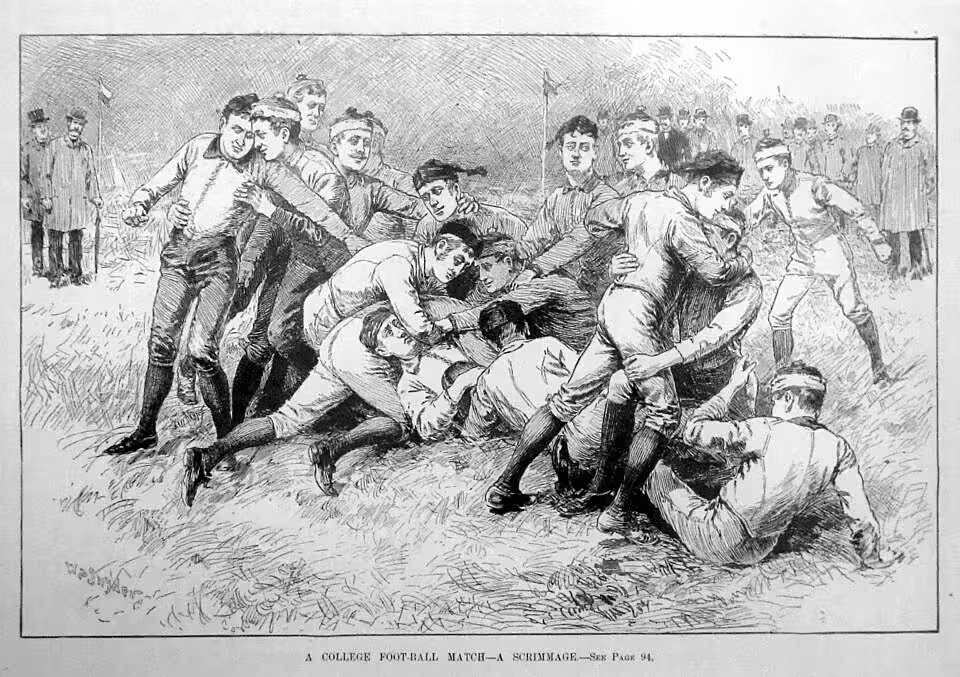
The debate at the specially convened football rules meeting in November 1884 highlighted the need to define the referee’s and the two judges’ authority… This would be the major assignment of the next meeting of the football minds at New York’s Fifth Avenue Hotel on February 7, 1885. At this convention, Harvard was forced to withdraw from the association after the institution abolished the sport at the school’s faculty’s decision. The universities of Pennsylvania and Wesleyan, though, were more than willing to fill the void left by Harvard’s departure as they applied for membership in the association.
Unknown author
Public interest grows
The acceptance of Pennsylvania and Wesleyan into the association, along with public interest, prompted the Harvard resignation to be short-lived. Public interest grew when Yale and Princeton played on college grounds for the first time in the series’ history in 1885. In previous years, the game between these two schools was played in New York City, but this time it was scheduled for New Haven. For the first time, as a result of this site change, football became a social event attended by many ladies. This made attendance figures spike dramatically compared to previous games, because not only were there men who loved to watch the athletic event, but also men who attended to watch members of the fairer sex, as well as the young ladies themselves.
This game in 1885 between Yale and Princeton also had a very dramatic ending, with Princeton snatching victory from their opponents in the last moments on a game-winning run by Henry Lamar. This fantastic finish left an impression on the public, leading them to view football as a very exciting spectator sport.
The Harvard faculty, too, got caught up in the excitement and, by year’s end, decided to revoke their earlier abolition of the sport on campus.
A Deep Dive into 1885 Football History and Highlights
- October 12, 1885, saw the IFA adjust rules to restrict running with the ball after a caught punt, aimed at protecting backs. They also changed the number of officials in games, increasing it to four to better manage the play.
- November 2, 1885 – The University of South Carolina has its first-ever win in its game against Columbia AA (20-0) in Columbia, SC. The very first game for the University of South Carolina football program occurred on December 24, 1892, in a contest against Furman College in Charleston, S.C., where the early Gamecocks were blanked 44-0 by the Paladins. Special thanks to the University of South Carolina’s Athletic Department for furnishing this information to us!
- November 21, 1885 – College football’s first viral moment, as Princeton scored on a game-ending play to defeat rival Yale 6-5. It was also the first contest between these two schools played on one of their campuses rather than a neutral site.
The ref’s role
The October 12, 1885, (more or less Yale and Princeton) meeting established the rule that a referee had the authority to declare a ball down or dead. Other rules in this session stated that the contestants in a championship game had to mutually decide upon the referee for the game, who would have absolute power in all rulings, and they also had to pay him for his services. These referee duties were established in writing. “The referee shall take out time for unnecessary delay. He shall decide disputed points, and shall, for intentionally delaying the game or offside play, give, for the first offense, one point to the opponents, and, for the second offense, one point more to the opponents and dismissal of the offender from the field.” It added that two points would be added to the opponents of teams that “slugged” or intentionally went offside.
The referee was also tasked with declaring a forfeiture of the game should a team refuse to play after the referee ordered them to start play. Another rule stated, “No delay arising from any cause whatsoever shall last longer than five minutes.”
The judges’ position
As previously discussed, the referee was joined on the field by two judges. Over time, the judges developed roles that influenced game rules and gameplay. The 1876 rules assigned a judge to each sideline. This idea came from Rugby, where team captains argued disputed plays. American football innovators instead gave this rule-making authority to on-field special advocates for each team. These advocates, called judges, served as team lawyers on the field. Each team selected its own judge to plead calls to the referee, who had the final say on their claims and disputes.
The judges transformed into selections with strong argumentative and debating skills, as well as deep knowledge of the rules. Many interesting stories emerged from this relationship between officials. This relationship, along with the many delays the arguments caused in the game, led to the demise of the judge positions. The rules of the 1885 conferences pretty much abolished the judge positions and gave all authority of calling the game to the referee.
This was an ironic but sensible transition. The rules became more stringent, yet the number of officials decreased. This made sense because arguments declined as one man, the referee, became the authority in the game.
This led Princeton to a 9-0 campaign and the awarding of a retroactive Championship years later.
Conclusion
Please find the continuation of this story in 1886, of the Dispatch’s football history lesson coming soon, right here on PigskinDispatch.com, your place for the good news about football.
Careful research lets us provide this in-depth historical look. The best sources are contemporaries of the period. Special thanks to our main reference for this article: Parke H. Davis’s 1911 book, Football—The American Intercollegiate Game.