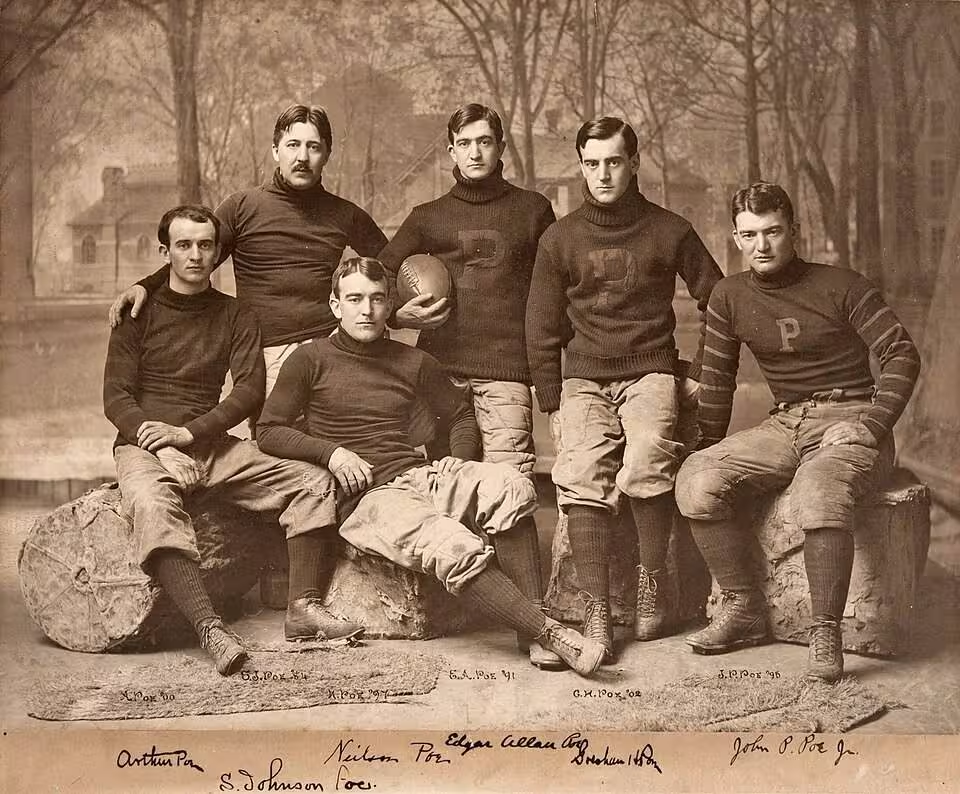
The final season of the 19th century added a couple of tweaks to the rules of American football, propelling it into the next century. Football in this era was a brutal game with 11-player teams, 70-minute matches, and no forward pass. The 1899 Sewanee Tigers famously went 12-0, including five wins in six days by train. Harvard and Princeton were recognized as national champions.
The Rules Committee met on March 17, 1899, and a couple of additional items helped shape the game as the Twentieth Century approached. The first was that a ball that struck an official would no longer be dead. Instead, play was to continue as if it never touched him, and thus the concept of an official being part of the playing field began.
Football in the new century: 1900
Walter Camp was once again thinking in terms of strategy rather than rule revisions to preserve the game he helped transform from rugby. Camp and a small group of men were exploring a novel idea from the Yale coach to exploit a common defensive line strategy of the day. In 1900, defensive “rush-line forwards” commonly charged their opposition low at the snap and drove them backward.
Camp’s idea was to create a play that could use this forward momentum of the rush-line against them by devising a play that would create an opening quickly that could catch the defense off guard and render the front line ineffective because of being unable to re-establish their balance as a runner would shoot past them and their forward momentum. When a defensive forward shot forward, he would have great difficulty covering a hole. The runner could then easily slip through before the defender could regain his position to stop the ball carrier.
This result reincarnated the famous Yale “tackle-back” play, though the team employed a completely new strategy compared to a few years prior.
Despite the success, Yale suffered a couple of low moments in 1899. Princeton defeated Yale with a 35-yard dropkick in the final minute. Columbia defeated Yale 5-0, noted as a major upset.
While Yale was pummeling opponents with their new offensive strategy in the East, Northwestern University had an effective tandem formation of its own in the Midwest.
The Original Wildcat Offense?
Northwestern head coach C. M. Hollister devised what was known at the time as the “Northwestern tandem.” In this formation, there were four men in a direct line behind the center and perpendicular to the line of scrimmage. The first man was the quarterback, and directly behind him was a large blocking back, often called a “heavy forward.” Behind these two men were the half-backs. The offensive advantage was gained by not declaring a strong or weak side of the formation, thus keeping the defense honest by playing one side or the other to its advantage. The offense could then pick on a weak point of a rush-line by pounding two blocking backs through a hole ahead of the runner. The concept and strategy of the “I-formation” was born.
A Deep Dive into 1899 Football History and Highlights
- March 17, 1899 – The Football Rules Committee met and introduced that the officials were now part of the playing field, so that a ball that struck them would no longer be declared dead.
- October 15, 1899 – The Arizona Cardinals NFL franchise played its first game as an organization, the Morgan Athletic Association.
On October 15, 1899, the Cardinals played their very first game! Known then as the Morgan A.A., the club was composed of local teens led by 18 year-old Chris O’Brien (photo). Behind the rushing of Pat O’Brien, the Morgans beat the Shermans 29-0 and finished with a 6-1-1 mark! https://t.co/LlfT0jrjxp
— Joe Ziemba (@cardschicago) October 16, 2026
- October 28, 1899 – Columbia registered perhaps its biggest victory since its inception when the Lions upset Yale 5-0 at Manhattan Field in New York.
- November 11, 1899 – Undefeated Harvard and a one-loss Yale battled to a scoreless tie at Soldier Field in Cambridge, Mass., in front of 50,000 onlookers.
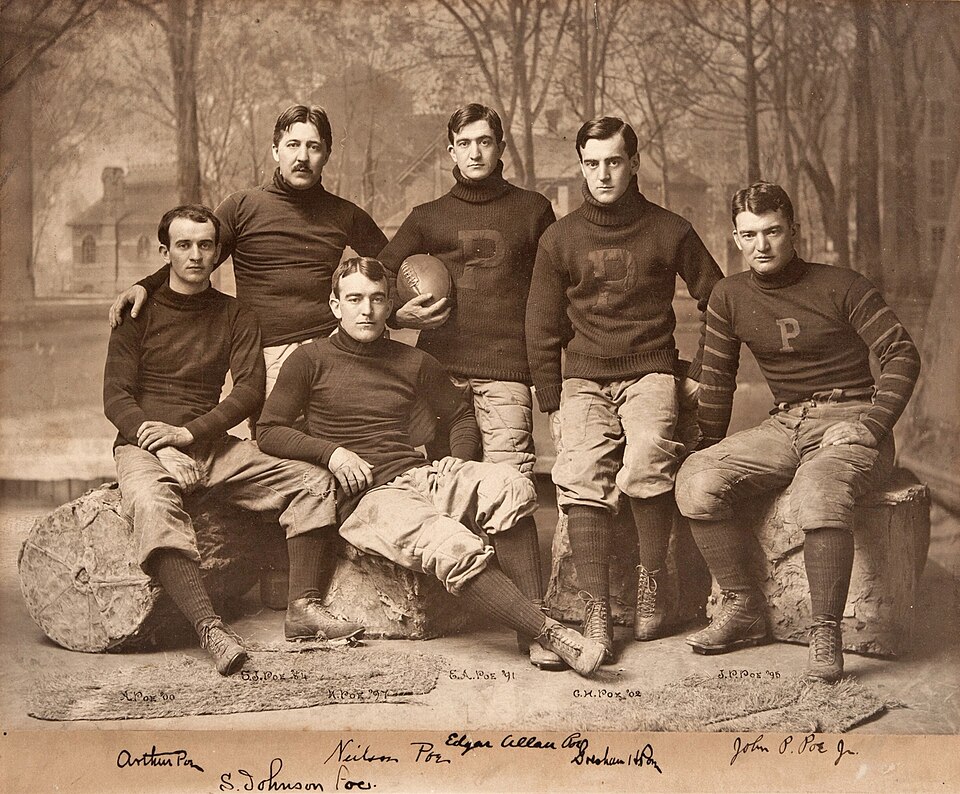
- November 25, 1899 – Princeton’s Art Poe, one of the famous Poe Brothers, drop- kicked a 35-yard field goal in the final seconds to beat Yale 11-10 in front of 15,000 fans atYale Field.
Football was taking shape as the 1900’s began, but there was a lot more changeto come into the new century. The post on 1900 of this series will continue the football history journey, right here on PigskinDispatch.com, your place for the good news about football.
We are able to provide this in-depth look into history from so long ago through careful research. Using someone who was contemporary to the period is the best source. So, a very special shout-out to our main source of reference for this article: Parke H. Davis, in his 1911 book, Football-The American Intercollegiate Game.