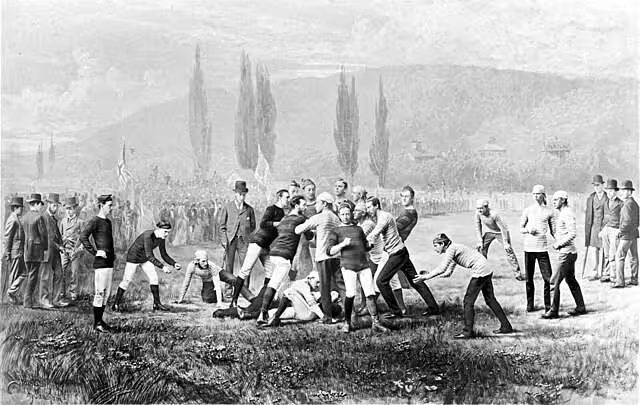
Before the NFL, the Super Bowl, or even the forward pass, there was 1874—the year American football survived its first identity crisis.
While most sports historians point to 1869 as the “birth” of the game, it was the legendary Harvard vs. McGill series that truly changed everything. This wasn’t just a game; it was a cultural collision between English rugby and early American “Boston Game” rules. By introducing the oval ball, the tackle, and the concept of downs, these 1874 matches laid the foundational DNA for the gridiron spectacle we obsess over today.
In this deep dive into 1874 American football history, we’ll explore:
- How a $0.50 gate fee saved the sport.
- The pivotal transition from “soccer-style” kicking to rugby-style carrying.
- Why the Harvard-McGill rivalry remains the most important weekend in collegiate sports history.
Step back in time to see how a few matches in Cambridge, Massachusetts, evolved into a multi-billion-dollar American empire.
A Deep Dive into 1874 Football History and Highlights
Harvard players still had a strong desire to play other schools, so in 1874, Harvard challenged Yale to a game under the Boston rules. Yale declined the challenge due to rule differences; under IFA rules, the game it played was more similar to soccer. Harvard’s team captain, Henry Grant, was still not discouraged. He was anxious for his football team to compete and had heard that a similar game was played just over the Canadian border at McGill University.
- April, 1874: Harvard Captain, Henry Grant, got in touch with the captain of the McGill University team, David Roger, and invited them to play two games in Cambridge, Massachusetts, on May 13 and 14, 1874.
Harvard, until this time, was still playing the Boston game, and the rules also resembled soccer more than today’s game of American football. The Boston rules differed from the IFA version, though, because in the IFA, a player could never pick up the ball and run with it. Boston rules allowed him to pick it up and tuck it only when he was being chased by an opponent. Harvard players were in for a surprise when the McGill squad came to Cambridge a few days early and practiced in front of them. The McGill players kicked the ball and subsequently ran with it under their arms. Harvard’s Grant pointed out politely that this violated a basic rule of American football. The McGill captain replied that it did not violate any rule of the Canadian game. When the Harvard captain asked the McGill leader, “What game do you play?” David Roger replied, “Rugby.” They then agreed to play the forthcoming games under half-Canadian, half-American rules. Harvard normally played with 15 players to a side, but McGill could only bring 11 to the contests, so both sides used an 11-on-11 format.
The Harvard University newspaper printed the following excerpt the next day: “The McGill University Football Club will meet the Harvard Football Club on Wednesday and Thursday, May 13th and 14th. The game will probably be called at 3 o’clock. Admittance 50 cents. The proceeds will be donated to the entertainment of our visitors from Montreal.”
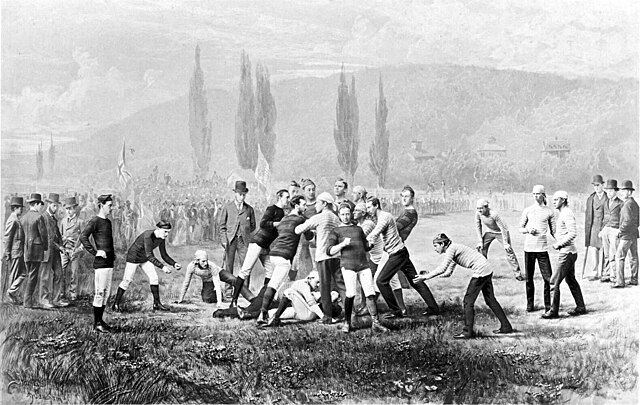
- The May 13, 1874, contest began under Canadian colleges’ rules and was scheduled for the second half to use Boston rules. The Harvard players enjoyed the Montreal version so much that they asked their opponents to play the remainder of the game according to the rules McGill had brought. Harvard won the first game 3-0.
- The following day’s game on May 14, 1874, ended in a scoreless tie between Harvard and McGill. Harvard went on to adopt many elements from the game their Canadian friends had shown them, including tackling, downs, and field goals.
- October 23, 1874 (Rematch): Harvard traveled to Montreal and defeated McGill 3 tries to 0.
These changes to Harvard’s football rules were setting the table for something much bigger and better, though. When we resume in part 6 of this series, we will introduce the true mastermind and founder of American football, Walter Camp, and his gang over at the Yale campus in “A New Authoritative Organizational Body and Leader for Football.” Right here on PigskinDispatch.com, your place for the good news about football.