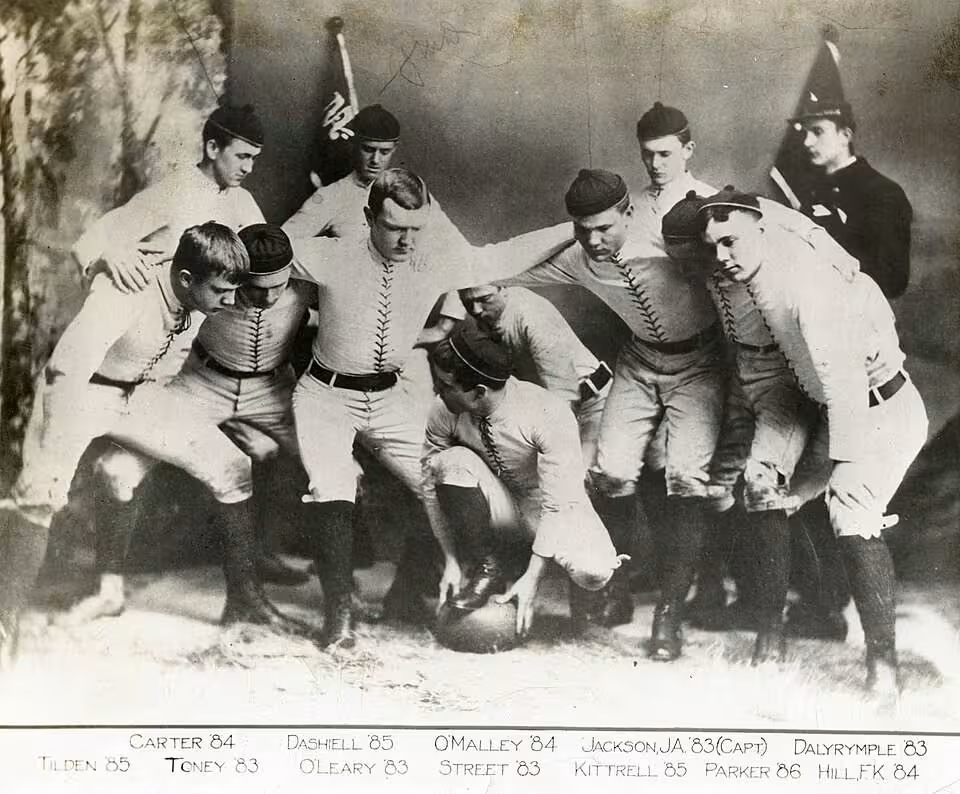
If 1876 was the birth of American football, 1882 was the year it grew up. This was the pivotal moment the sport officially divorced itself from its rugby roots to become the tactical “game of inches” we recognize today. Driven by the visionary Walter Camp, the 1882 season introduced the system of downs and the distance requirement, forever changing the geometry and pace of the field.
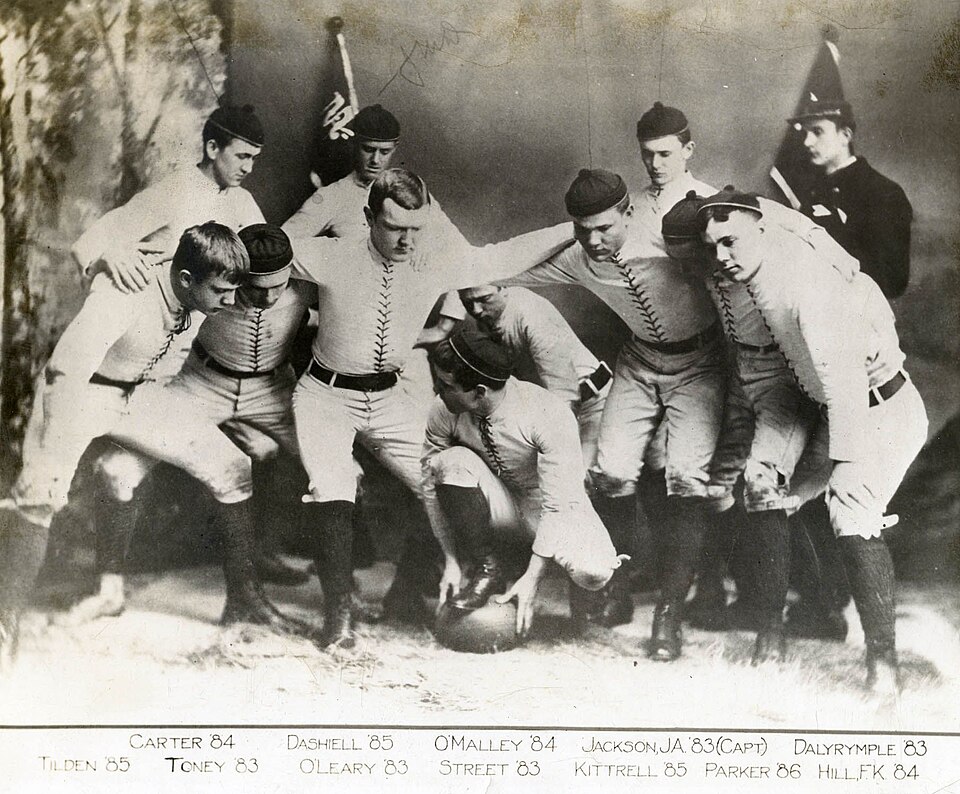
Without the rule changes of 1882, football might have remained a stagnant game of possession. Instead, it became a battle for territory.
A Deep Dive into 1882 Football History and Highlights
There was a steep transformation in 1882 that marked the evolution of American football from its European ancestors, Rugby and soccer.
- September 29, 1882 – The Minnesota Golden Gophers played their first football game. It was a successful outing as Minnesota defeated Hamline University of St. Paul in a 4-0 victory. A couple of weeks later, the two teams met again, and Hamline downed Minnesota 2-0.
- October 1882 – Fordham University (then St. John’s College ) played its first football game, defeating Seton Hall University in its first varsity football game on its way to a 6-1, 1882 campaign..
- November 30, 1882 – In the “game of the year,” Yale and Princeton squared off in a contest famously dubbed “The Block Game.” The matchup earned this moniker because Princeton held possession for the entire first half without ever attempting to score; Yale then seized the ball in the second half and effectively repeated the same strategy. This defensive stalemate directly inspired a landmark rule change: the offensive team had to gain at least 5 yards in 3 downs, or they would forfeit possession of the ball. Yale did win 2-1. This game prompted Walter Camp to suggest an impactful rules change for a series of downs.
- December 1, 1882 – The College Rules body, IFA, upon the recommendation of Walter Camp, introduced a rule to incorporate a series of downs, three to gain five yards.
- December 25, 1882 – Colorado College played its first organized football game, defeating the local Sigafus Hose Company 10–8 in Colorado Springs. It was the first known game in the Rockies.
Significant Events of 1882
The year 1882 is arguably the most important year in the evolution of American football rules. There are three verified, landmark events that occurred this year:
1. The Introduction of Downs and Yards
Before 1882, a team could hold onto the ball indefinitely without moving forward, leading to “block game” tactics where teams simply sat on the ball to preserve a tie. To fix this, Walter Camp proposed the Three-Down Rule:
- Teams were required to gain 5 yards in 3 downs (this later evolved into our modern 10 yards in 4 downs).
- This forced teams to actually run plays rather than just stalling.
2. The Creation of the “Gridiron”
To help referees and players track the 5-yard requirement, the field was marked with horizontal lines every five yards. This gave the field its iconic “gridiron” appearance.
Note: Originally, the field also had longitudinal lines, making it look like a literal checkerboard or grid.
3. Standardized Scoring Changes
While scoring was still being refined, 1882 saw a major shift toward emphasizing the Touchdown. Previously, kicking a “goal” after a touchdown was the primary way to score. In 1882, the value system began to shift to reward the act of carrying the ball into the endzone more heavily, moving the game further away from soccer and rugby traditions.
4. The First Intersectional Game?
While most play was confined to the “Big Three” (Yale, Harvard, and Princeton), 1882 saw increased activity in the Midwest, including the early development of programs like the University of Michigan, which began to challenge the Eastern dominance that had defined the sport’s first decade.
1882 Statistics at a Glance
| Feature | Rule Change |
| Yards Required | 5 Yards |
| Number of Downs | 3 Downs |
| Field Markings | 5-yard horizontal lines introduced |
| Key Influencer | Walter Camp (Yale) |
How do you think the modern game would change if we still only had to gain five yards for a first down?