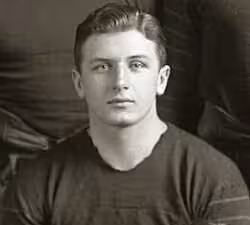
What does it take for the “Father of Football” and a legendary coach like Fielding Yost to call you the best in the game? For Ernie Vick, it was a combination of surgical precision and immovable power. As the anchor of the University of Michigan line during the transition into the modern era, Vick transformed the center position into an art form. From his flawless “snapping” accuracy to his status as a multi-sport professional, Vick’s journey from Toledo to the College Football Hall of Fame is a testament to the “steadiness and consistency” that defined early 20th-century gridiron dominance.
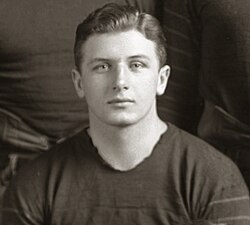
Football Bio
July 2, 1900 – Toledo, Ohio – Michigan four-year letterman playing the position of center from 1918 to 1921, Ernie Vick claimed his date of birth.
The National Football Foundation says that Ernie was an outstanding blocker and tackler. His coach, Fielding Yost, is quoted as saying, “He is the most accurate passer from center that has ever put a ball into play. Under pressure, he was dependable at all times.” That says a lot when a big-time successful coach like Yost talks up one of his players.
And talk about big-time names in early football that had good things to say about Vick, well, how about the guys that had much to do with sending the game down the course it is on today, Walter Camp? Camp placed Vick on his 1921 All-America team at center.
The Father of Football said, “He is the only man who has throughout the season added great power and aggressiveness to steadiness and consistency.” Ernie Vick received the great honor of being selected for inclusion into the College Football Hall of Fame in 1983. After his time playing for the Wolverines, Ernie played 57 games of Major League Baseball as a catcher for the St. Louis Cardinals organization and then became a college football official. He even worked in that capacity in a couple of Rose Bowl Games.
Conclusion
Ernie Vick was the ultimate reliable force in an era of rugged, ironman football. While his physical toughness as a blocker and tackler earned him All-American status, it was his mental composure—hailed by Fielding Yost as “dependable at all times”—that truly set him apart. His rare ability to transition from a Hall of Fame football career to Major League Baseball, and later to the elite ranks of Rose Bowl officiating, highlights a life dedicated to the highest levels of athletic competition. Today, Vick stands as a foundational figure in Michigan’s “Point-a-Minute” legacy and a permanent member of the College Football Hall of Fame.
Accolades and Football Accomplishments
- College Football Hall of Fame: Inducted in 1983.
- First-Team All-American: Selected by Walter Camp in 1921.
- Four-Year Letterman: University of Michigan (1918–1921).
- Fielding Yost’s “Most Accurate Passer”: Recognized for his revolutionary precision in snapping the ball from center.
- Major League Baseball Catcher: Played 57 games for the St. Louis Cardinals (1922, 1924–1926).
- World Series Champion: Member of the 1926 St. Louis Cardinals championship team.
- Elite Official: Officiated college football for over 25 years, including multiple Rose Bowl assignments.
- University of Michigan Athletic Hall of Honor: Inducted for his contributions as a premier interior lineman.