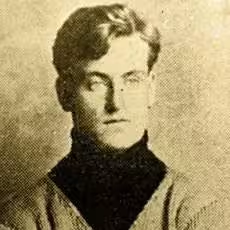
What does it take to turn a struggling program into an offensive juggernaut overnight? For George “Doc” Fenton, it was a mix of elusive speed, a pioneering arm, and a legendary appetite for adventure. Before the SEC was even a dream, Fenton was the “El Rubio Vaselino” of the bayou—a slippery signal-caller who led the Tigers across the Gulf of Mexico to play the first international bowl game in history. From the recruiting battle fueled by “nickel beers” to a scoring pace that remains mind-boggling over a century later, Doc Fenton’s story is the wildest chapter in the early history of LSU football.
Football Bio
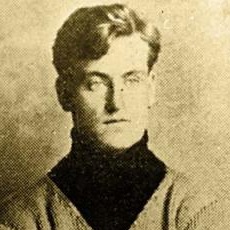
April 30, 1887 – Scranton, Pennsylvania – Doc Fenton, the great signal caller of Mansfield Normal School from 1904 to 1906 and LSU from 1907 to 1909, was born.
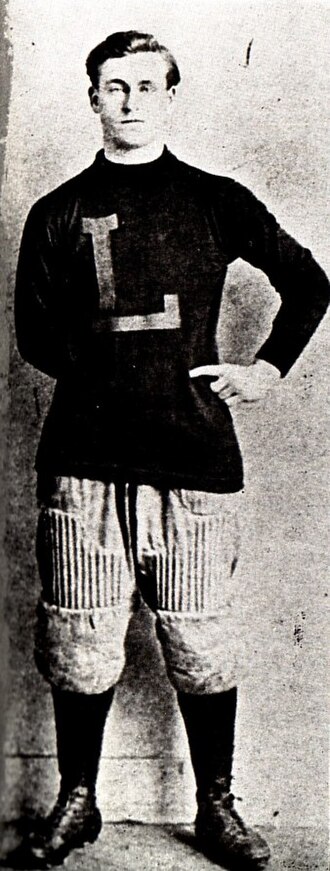
Dan Hardesty – The Louisiana Tiger: LSU Football (1975) pg. 37.
Photo of George Ellwood Fenton, “a.k.a.” w:Doc Fenton in LSU Football Uniform in 1908.
Doc had been playing rugby up in Canada when, at the urging of a fellow Pennsylvanian, he enrolled at Mansfield and played football. At Mansfield in 1906, he was the starting quarterback. To put that in perspective, this was the first season that the forward pass was legal in college football. Fenton had the urge to move to the warmer climate of the South, and according to the website AndtheValleyShook.com, he started having conversations with head coach Fred Furman of Mississippi A&M. However, once the new coach at LSU caught wind of this, Edgar Wingard, who is described as a “notorious hellraiser.”
Wingard had implemented a fast-paced offense that relied on deception, speed, and the newly invented forward pass. Coach W. also evidently had some skills as an early twentieth-century gridiron recruiter, too, as he talked Doc into a recruiting visit to Baton Rouge, and then sealed the deal with the promise of nickel beers and a reminder of Starkville’s, the Home of Mississippi A&M, blue laws that prevented alcohol. That was enough for Fenton, who signed with LSU and immediately transformed the team into an offensive juggernaut.
He enrolled at Louisiana State, and the Tigers, who had scored just 34 points in six games in 1906, scored 28 points in its season opener in 1907 with Doc on the field. After some midseason struggles, the Tigers finished up their campaign with a 48-0 blowout win over Baylor and an invitation to play the University of Havana in the Bacardi Bowl, becoming the first American college team to play on foreign soil. Shortly before the Bowl game, the promoter feared it would be financially ruinous and tried to back out, threatening to cancel. However, the locals sold tickets to Cuban High Society members and to American GIs stationed on the island, and the game went off as planned, with the local Havana team hosting the Tigers.
Shortly before kick off, Fenton noticed the giant 300-pound-plus Havana player tipping back what was described as a “fair share of wine.” Doc instructed a teammate to hit him in the stomach on the game’s first play, and according to Fenton, “the big guy spouted wine like an artesian well. We nearly had to swim out of there.” LSU dominated from this point on, and Cuban fans lauded Fenton as “El Rubio Vaselino,” the “Vaselined Redhead” for his amazing play and slippery moves in the open field. On that Christmas Day, 1907, LSU defeated Havana University in Havana, Cuba, 56-0, as Fenton started the lopsided victory by scoring the game’s first touchdown.
The initial Bacardi Bowl game was such a success that Cuban officials attempted to schedule a second game before the players returned home. According to Marshall Gandy, the players received $25 to play a second game a few days later, and some players were loaned to the Cuban side to even up the rosters. LSU won that game as well, but now, technically, every single player on LSU’s roster is a professional. That would come back to haunt the program later on. As a member of the Tigers, Fenton also kicked field goals as well as extra points and scored 107 points in 1907.
In 1908, he played two games at the end, then became a quarterback for the rest of his career. He scored 132 points in 1908 and 59 points in 1909. For his three years at LSU, he totaled 298 points. This included 36 touchdowns. His longest field goal was 45 yards. The College Football Hall of Fame proudly placed a display honoring Doc Fenton in its legendary museum in 1971.
Conclusion
Doc Fenton was a man ahead of his time, mastering the forward pass in its infancy and using a rugby-born agility to leave defenders grasping at air. His three-year total of 298 points remains a staggering statistic of the “Point-a-Minute” era, and his leadership led LSU to its first truly legendary season in 1908. While the “professionalism” scandal involving the Bacardi Bowl payments eventually clouded the official records, nothing could erase the impact Fenton had on the culture of Southern football. Inducted into the College Football Hall of Fame in 1971, Doc remains the quintessential Tiger—a fearless, slippery, and high-scoring pioneer of the bayou.
Accolades and Football Accomplishments
- College Football Hall of Fame: Inducted in 1971.
- LSU Athletics Hall of Fame: Charter Member.
- Bacardi Bowl Champion: Scored the first touchdown in the first international bowl game (1907).
- National Scoring Leader: Led the nation in scoring with 132 points in 1908.
- Career Scoring: Totaled 298 points and 36 touchdowns in just three seasons.
- Undefeated Season: Anchored the legendary 10-0 Tigers team of 1908.
- Versatile Specialist: Served as the team’s primary quarterback, kicker, and punter.
- Pioneer of the Pass: One of the first quarterbacks in history to utilize the legal forward pass starting in 1906.
- Longest Field Goal: Recorded a 45-yard drop-kick field goal.