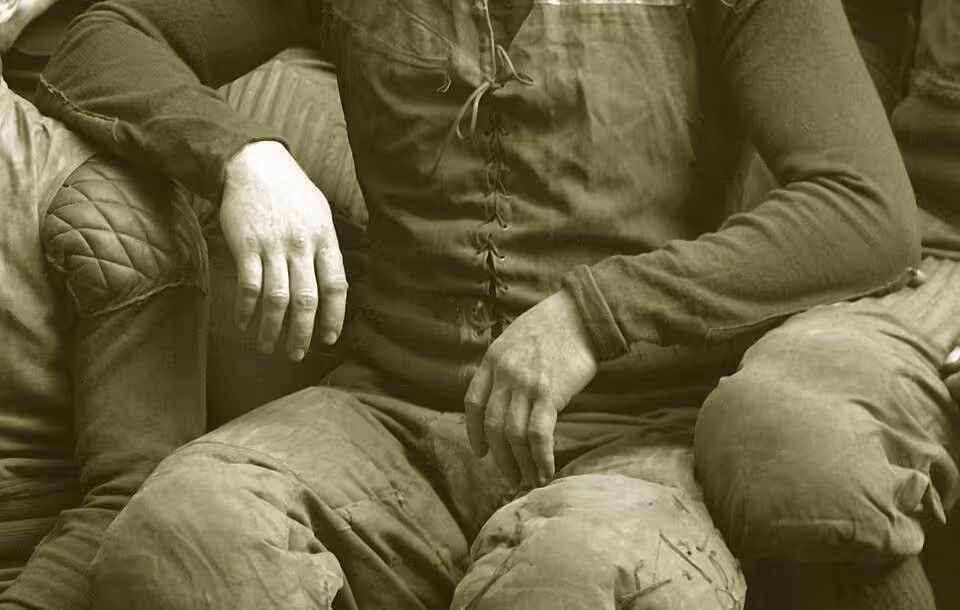
Willie Heston pulverized early gridiron defenses, anchoring Michigan’s legendary “Point-a-Minute” teams and cementing his legacy as one of the game’s first true rushing powerhouses.
Football Bio
September 9, 1878 – Willie Heston, the legendary Michigan Wolverine running back, was born. Willie came from a farming family in Illinois. When he was a little older, his family moved to Oregon.
Willie decided he wanted to be a schoolteacher, so he enrolled at San Jose State in 1898 and played a couple of years of football at the San Jose State Normal School. His objective was to earn a degree and become a teacher. It was discovered, though, that Willie Heston was a very fast man, as he ran the 100-yard dash in 10 seconds flat.
And he had good size for the era, at 5’8″ tall, and he weighed 190 pounds. The school’s football coach at the time was Jesse Woods, who introduced the young man to the gridiron and promptly played him as halfback, seeing his natural talent on display. At that point, Willie had never been exposed to playing football.
Coach Woods’ gut feeling was right on the money: Heston was a great runner who scored more touchdowns than any other player on the team. The next season, in 1899, Willie Heston became the team captain, and the team went undefeated and earned the right to play Chico State Normal School in the league championship game. That game ended in a 6-6 draw, and both teams agreed to settle it with a rematch three weeks later. [National Football Foundation]
For some unknown reason, Woods did not coach the San Jose squad for the second championship game against Chico State. It was Stanford’s coach, Field H. Yost, who stepped in to lead Heston and his teammates, as Stanford had just released him, because the Pacific League barred him from being their coach since he did not graduate from the school, which was a rule in the league at that time. Just a few weeks of practice, Yost guided the San Jose State team to a 46-0 blowout of Chico State in the rematch to capture the title.
In 1901, Heston graduated, received his teaching degree, and accepted a job at a school in Oregon. Around the same time, Yost sent Willie a letter saying he had accepted the head coaching job at the University of Michigan and inviting his former player of just one game to join him there. At first, Willie declined the invitation, and it is unknown what caused the change of heart, but he soon thereafter accepted Field H. Yost’s invitation.
Willie Heston then set out to study law at Michigan while playing for the Wolverines football team. Heston and Yost made Michigan one of the greatest teams in college history. The Wolverines squads from 1901 through 1904 became known as the point-a-minute teams because their average point totals were close to scoring a point every minute they played.
Remember this: the forward pass was not legal in football until 1906, and Willie was the team’s workhorse. As is evident, in a 1903 game against the University of Chicago’s Maroons, where the Wolverines had a total of 267 yards rushing and Heston was responsible for 237 of them, Heston’s four years at Michigan had a record of 43 wins, zero losses, and one tie.
They outscored their opponents in an extremely one-sided way, 2,326 points to 40. They won the national championship in 1901 and again in 1902 as Michigan won its very first Rose Bowl (Then called the “Tournament East-West football game”) for the crown. In fact, that is considered the first Rose Bowl game ever.
Football Fact Flashback: When Willie Heston and the Wolverines traveled to Pasadena on New Year’s Day 1902, the matchup wasn’t officially called the Rose Bowl yet—it was the “Tournament East-West football game.” Michigan demolished Stanford 49-0 in a performance so dominant that the tournament organizers abandoned football in favor of chariot races for the next 14 years before returning to the gridiron in 1916. Heston himself racked up 170 rushing yards on 18 carries in the historic shutout.
Coach Yost called Willie Heston the best player he had ever seen, and Willie was voted as the halfback of the all-time team for the first 50 years of football by the Football Writers of America. The College Football Hall of Fame selected Willie Heston to enter the hall in the 1954 induction ceremony.
Professional football was in its infancy, but a couple of teams wanted Willie Heston. As the story goes, two teams in particular approached Willie and wanted to pay him to play for their respective teams: the Akron East Ends and the Massillon Tigers. The shrewd Heston created a bidding war between the two teams for his services, and even sent a telegram to each stating that the other had offered him $500 to play one game on Thanksgiving Day in 1904.
The two clubs figured out what was going on, and each refused to do further business with him. Heston became one of the first writers in professional football’s first holdout. Willie then coached at Drake University for the 1905 season.
A year later, he was coerced to play again in 1906 after signing a contract with the Canton Bulldogs, reportedly for $600 per game plus expenses. As fate would have it, in his very first pro game, he broke his leg against those same Massillon Tigers he sent the telegram to, and the injury was bad enough to end his playing career.
Willie Heston left an indelible mark on the origins of American football. He transformed the running back position through sheer speed and power, setting an early standard for greatness that college football programs spent decades trying to replicate.
Accolades and Football Accomplishments
- Inducted into the College Football Hall of Fame in 1954.
- Two-time Consensus First-Team All-American (1903, 1904).
- Key driver of Michigan’s “Point-a-Minute” teams that compiled a 43-0-1 record over his four seasons.
- Won National Championships with the Wolverines in 1901, 1902, 1903, and 1904.
- Victorious in the inaugural 1902 Rose Bowl, defeating Stanford 49-0.
- Scored 72 career touchdowns at Michigan, a record that stood for decades.
- Named to the all-time team for the first 50 years of football by the Football Writers Association of America.
- Just Give Us a Second – Michigan’s 2nd Chance Win Spoils Western Michigan Upset Bid 2026
- Harry Newman: Michigan Halfback & Hall of Fame Legend
- Albert Benbrook: Michigan’s 2x All-American Guard
- Jim Mandich: Michigan Legend and NFL Star Tight End
- Reggie McKenzie: Hall of Fame Guard and Bills Legend
- Ernie Vick: The Michigan Center Who Earned the Praise of Legends
- Dan Dierdorf: College & Pro Football Hall of Fame Lineman
- Alvin Wistert: College Football’s Oldest All-American
- Ron Kramer: Michigan Football Legend & Packers Star
- Johnny Maulbetsch: Michigan’s Featherweight Fullback
- Elroy Crazylegs Hirsch: Football’s Great Deep Threat
- Desmond Howard: The Electric Playmaker Who Conquered Michigan and the Super Bowl
- Bob Westfall: The Unstoppable Engine of Michigan’s Golden Era Backfield
- Germany Schulz: The Michigan Giant Who Invented the Linebacker
- Harry Kipke: The Punting Prodigy Who Mastered Michigan Football
- Benny Friedman: The Quarterback Who Taught the NFL to Fly
- Bill Morley: The Aggressive Architect of Columbia’s Early Dominance
- Michigan’s Greatest: The Legendary Career of Bennie Oosterbaan
- The First of the Legendary Number 11s: The Francis Wistert Story
- February 20 Football Fix
- Dave Brown: The Safety Who Defined Michigan’s “Shutout” Era
- The Original Game of the Century: How Chicago’s Safety Ended Michigan’s 56-Game Streak
- Football History of November 27
- The Instant Classic: Ohio State’s Double-OT Thriller Against Michigan
- ❄️ The Whiteout War: How Michigan Won the 1950 “Snow Bowl” Without a Single First Down
- The Ten-Point Takedown: How the 1971 Wolverines Secured Perfection
- The Wolverine Who Inspired a Legend: Rob Lytle’s Unbreakable Michigan Spirit
- Tom Curtis’ Interception Record-Setting Career
- The Iron Man of the Trenches: Tom Mack, the Rams’ Indestructible Guard
- Steve Hutchinson, A Decade of Dominance
- Ron Johnson: Michigan Rushing Leader
- The Iron Man of Michigan: Merv Pregulman, Wartime Hero and Two-Way Star
- The Offside Kid: Bill Hewitt, The Fearless Two-Way Pioneer Who Refused a Helmet
- Woodson’s Masterpiece: How the Michigan Legend Won the Heisman and a National Title
- Michigan Wolverines Inducted in the College Football Hall of Fame
- Football History of October 5
- Pete Elliott
- Tom Harmon
- Appalachian State Shocks Michigan
- The Miracle in Michigan: A Game for the Ages
- Benny Friedman
- Anthony Carter: Michigan Standout