The 1932 American football season was a historic turning point for both the collegiate and professional ranks. Occurring during the depths of the Great Depression, the season was defined by gridiron dominance in college football and an administrative crisis in the NFL that fundamentally changed how the professional game is played.
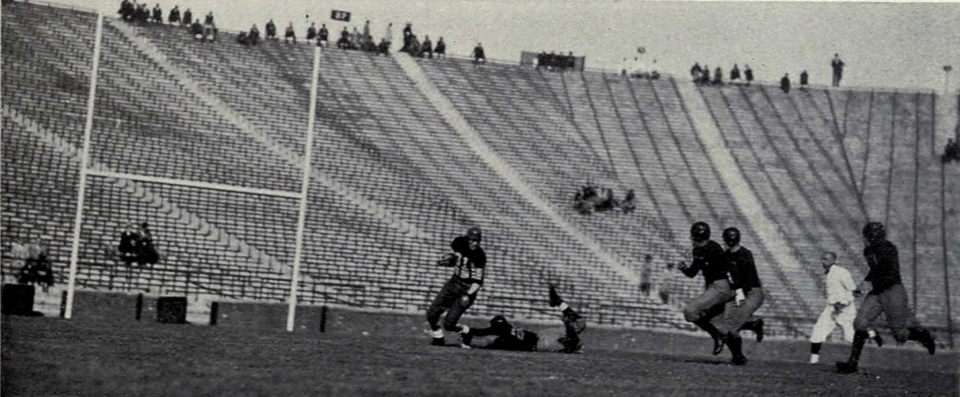
1932 College Football: Divided Sovereignty
Before the advent of the Associated Press (AP) poll in 1936, national champions were chosen by various mathematical and formulaic systems. The 1932 season produced two primary, undefeated claimants to the national title:
- The Michigan Wolverines (8–0): Coached by Harry Kipke, Michigan went undefeated and untied, outscoring their opponents 123 to 13. They were officially awarded the Knute Rockne Memorial Trophy as national champions under the mathematically driven Dickinson System. Because the “Big Ten” (then the Big Nine) prohibited postseason bowl games, the Wolverines could not play in the Rose Bowl.
- The USC Trojans (10–0): Led by legendary coach Howard Jones, the Trojans put together one of the most dominant seasons in college football history. They shut out eight of their ten opponents, outscoring the opposition 201 to 13. USC capped off their perfect run by crushing Pittsburgh 35–0 in the 1933 Rose Bowl. They were selected as national champions by the vast majority of other historical systems (such as Helms and Williamson).
- Colgate University (9–0): The Red Raiders finished the season undefeated, untied, and unscored upon (outscoring opponents 264 to 0), earning a niche stake in the national title conversation.
1932 Professional Football: The First NFL Playoff Game
The 1932 NFL season changed professional football forever. The league had shrunk to just eight teams due to the Great Depression, and the championship was strictly determined by regular-season winning percentage, with tie games completely excluded from the calculation.
- The Deadlock: The Chicago Bears (6–1–6) and the Portsmouth Spartans (6–1–4)—who later became the Detroit Lions—both finished the regular season with an identical .857 winning percentage. Under the rules of the time, the numerous ties did not count, creating a first-place deadlock.
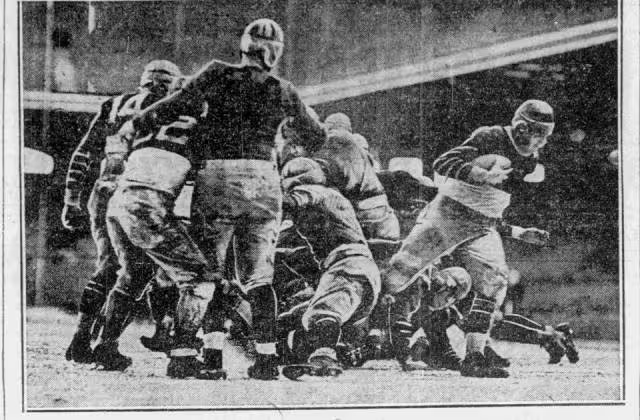
- The Indoor Playoff: To resolve the tie, the league organized a single-game playoff on December 18, 1932. Due to a ferocious blizzard and sub-zero temperatures, the game was moved away from Wrigley Field and played indoors at Chicago Stadium.
- The Modifications: Because the indoor arena could only fit a modified, 80-yard dirt surface covered in tanbark and mulch, unique rules had to be introduced. The sidelines were flush against the walls, requiring the ball to be brought back to the center of the field after every play (the birth of modern hash marks). Additionally, the goal posts were moved from the endline to the goal line to fit the space.
- The Result: The Bears defeated the Spartans 9–0, behind a controversial touchdown pass from Bronko Nagurski to Red Grange (Spartans players argued Nagurski had not backed up the required five yards before passing).
The Legacy of 1932
The immense public interest in the 1932 Bears-Spartans indoor game prompted the NFL to make sweeping structural updates in 1933. The league officially split into two divisions, established a permanent annual NFL Championship Game, and permanently moved the goal posts to the goal line to encourage scoring.
A Deep Dive into 1932 Football History and Highlights
- January 1, 1932 – The USC Trojans of Coach Howard Jones won another Rose Bowl handily, 21-12, over the Tulane Green Wave.
- October 2, 1932 – The Washington Football team has its very first franchise NFL game under the guise of the Boston Braves. They played the Brooklyn Dodgers at Braves Field in Boston, but lost by a couple of scores, 14-0.
- October 11, 1932 – George Preston Marshall acquired the Boston Braves NFL franchise along with two partners, according to his bio on the ProFootballHof.com
- November 12, 1932 – Tennessee (7–0–0) and Vanderbilt (6–0–1), played to a scoreless tie in Nashville.
- November 19, 1932 – Charleston, West Virginia – According to a newspaper clipping found in the Ohio State University archives from a paper called the “Lantern,” a West Liberty State Teachers College football player named Joe Kershalla scored 71 points in a college football game against Cedarville College.
- November 26, 1932 – At Yankee Stadium, Notre Dame beat Army 21–0.
- December 3, 1932: The Hamilton Tigers secured their fifth Championship, beating the Regina Roughriders 25-6 in the 20th Grey Cup at AAA Grounds in Hamilton.
- December 8, 1932 – Knoxville, Tennessee – 13 members of the Southern Intercollegiate Athletic Association and the Southern Conference, located west and south of the Appalachian Mountains, were formerly reorganized into the Southeastern Conference. According to the post on secsports.com, the member schools at that time were Alabama, Auburn, Georgia, Florida, Kentucky, Tennessee, Georgia Tech, LSU, Ole Miss, Mississippi State, Sewanee, Tulane, and Vanderbilt.
- December 18, 1932 – Chicago, Illinois – The NFL decided that a final game to determine a champion would be played in a special game at Wrigley Field in Chicago on December 18, 1932. This first postseason game in NFL history was won by the Chicago Bears 9-0 over the Portsmouth Spartans on a controversial play.