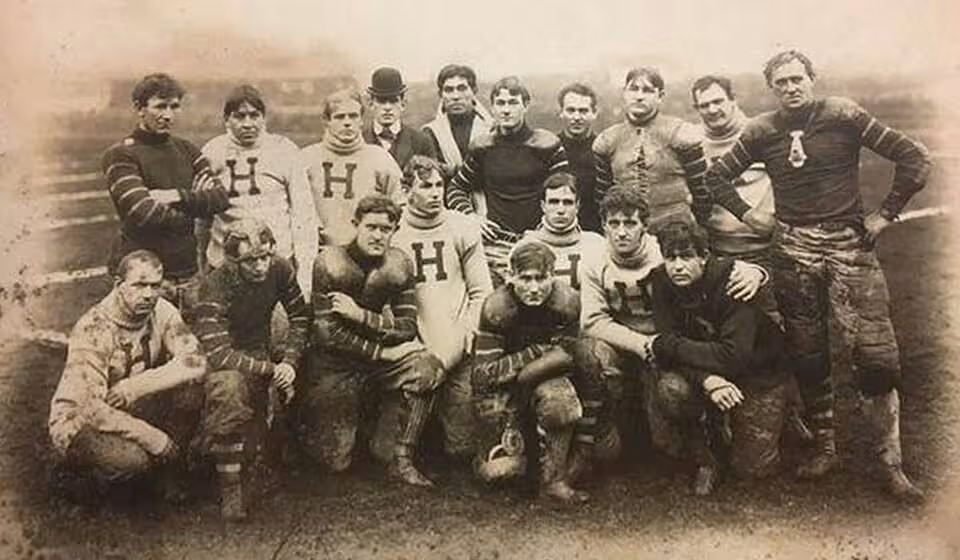
The 1900 football season was dominated by another strong Yale team, which was unanimously retroactively named the champion by most experts.
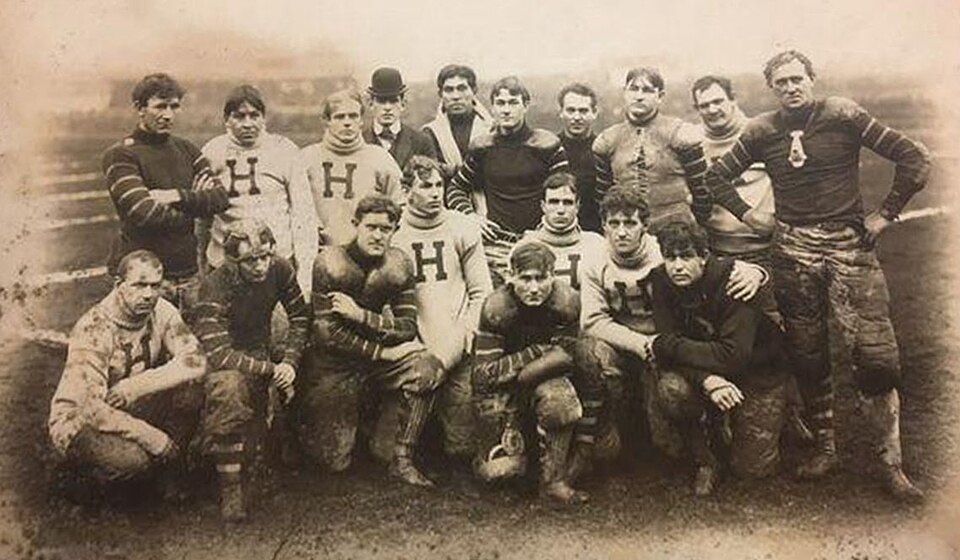
The calm before the storm?
The football rule makers were fairly content in 1900, and 1901 brought little in the way of new revisions to the game’s rules. Only a few changes occurred during this period. One was a very important definition that would serve as the basis for declaring a score. A touchdown was defined as being made when “any part of the ball is on, above, or across the goal-line.”
Other revisions at the time abolished obsolete plays, such as a “throw-in” similar to a modern basketball or soccer play, to start play when a ball went out of bounds. The Rules Committee hadn’t seen this type of play since the early 1880s, following the scrimmage’s institution, yet they kept it in the rulebook. This illustrates the committee’s complacency during this era—a period they used to settle minor housekeeping issues that “bigger fish to fry” had previously crowded out.
Football still had enemies, though, who used this calm period to gather ammunition to try once again to eliminate the sport.
The plot to get rid of football
There was still a part of the public that wanted the sport abolished because of the closeness of participants, which led to rough play. The years since 1896 have seen a drastic decrease in player injuries, but nonetheless. The football reformers also came to life, and some wanted to use the situation to change football back to the wide-open style of play it once had.
At the same time, a professor at the University of Illinois was quietly keeping a precise record of football injury statistics. When the rumor of the experiment spread to the public, both supporters and opponents of the current style of play eagerly awaited the results of Dr. Edwin G. Dexter’s stats. Ultimately, the results strongly favored those supporting the current style, and the reformist and abolitionist hopes were dashed for the time being.
The Rules Committee had a victory in this matter, but they still recognized they had to introduce some aspect of wide-open play into the current game to pacify reformists from future uprisings. Their answer was to change the rules to allow the player who directly received the snap to advance the ball forward. Up to this point, the ball could only be advanced by the second or more player who touched it after the snap. They were still cautious, though, as the forward run of the QB could only occur if he crossed the line of scrimmage five or more yards away from the point where the ball was actually snapped from.
This change led to an answer to a question that is very difficult to find. Why is football referred to as the “gridiron”? Go ahead and search online for the answer, and I’ll bet your results will be mostly inconclusive. The real answer to this question can be answered in our next segment of this ongoing journey through football history. Right here on PigskinDispatch.com, your place for the good news about football.
A Deep Dive into 1900 Football History and Highlights
- November 3, 1900 – University Park, Ithaca, New York – Two undefeated heavyweights of the early gridiron era squared off in a week seven showdown as the Cornell Big Red would travel to play the Princeton Tigers. Entering the game, according to an article on the cornellbigred.com website, Princeton had never lost at home with an excellent 121-0-1 record there. Cornell featured All-American fullback Ray Starbuck while Princeton countered with their leading man, captain H. W. Pell. Cornell made history as they handed the Tigers their first loss at home, 12-0, on a rainy afternoon. The Big Red’s Raymond Starbuck and Henry Purcell each scored touchdowns, and Starbuck booted a pair of extra-point kicks to lead Cornell past the Tigers. It was the first time in 31 seasons of Princeton football that they had ever suffered a loss in their own house! Truly a remarkable feat!
- November 17, 1900 – Riverside Park, Montgomery, Alabama – The 5th Iron Bowl Classic was played at a neutral site in Montgomery. It was a big day for the Tigers as Auburn dispatched the Alabama squad 53-5.
We are able to provide this in-depth look into history from so long ago through careful research. Using someone who was contemporary to the period is the best source. So, a very special shout-out to our main source of reference for this article: Parke H. Davis, in his 1911 book, Football-The American Intercollegiate Game.