Settling the Score in Football
Pigskin Dispatch’s Part 6 in the Series on American Football History
The early history of football is a very interesting story. The game is a series of evolutions that make it more interesting and safer for its participants. The changes to make the game safer had repercussions throughout the other rules to the point where it was sometimes almost a totally different athletic event.
Part 3 of this series on football history alluded to some of the changes, but as we continue this nostalgic trip, we can go further to fully appreciate football’s transformation.
A Deep Dive into 1883 Football History and Highlights
In 1883, the kicking game began to play a major role in the strategy of early football. Running plays were difficult and tedious, making the field goal the more popular means of scoring. Rule makers would meet almost annually to review the rules and consider innovations to the game.
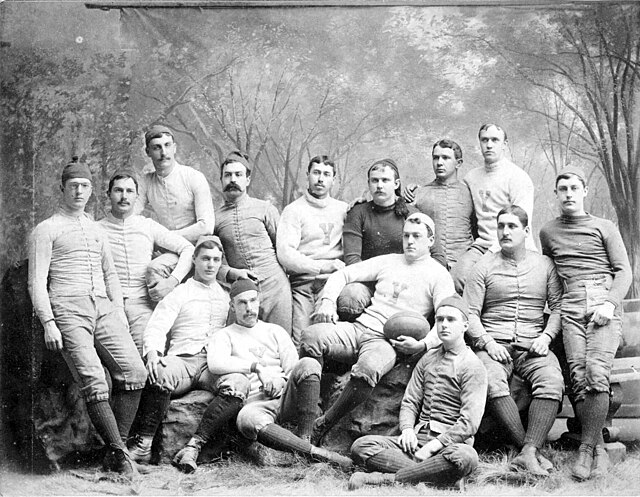
- October 17, 1883: That year’s meeting, titled a convention, was held at the Fifth Avenue Hotel in New York City on October 17. The colleges that played football at the time, which were basically the schools that make up the Ivy League today, each sent a representative to the rules conventions. The representatives in 1883 included: Messrs Darling and Griffith from Columbia, F.L. Clark from Harvard, Alex Moffet and D.M. Look from Princeton, Yale’s Walter Camp (who was the secretary of the convention), and Ray Tompkins, also of Yale, who served as chairman.
One change from that convention was the introduction of a new scoring system.
Safety…………………………1 point
Touchdown……………………2 points
Goal following Touchdown…..4 points
Goal from the field……………5 points
To better understand the point differential, the definition of a touchdown at this time must be examined.
- October 17, 1883, a touchdown was defined as “when a player, putting his hand upon the ball on the ground in touch or in goal, stops it so it remains dead or fairly so.” So a touchdown really wasn’t quite the same as what we think of it today. The point system, which began in the 1870s, was a radical change to Rugby scoring, which at the time was computed by goals, much like soccer, rather than by points scored.
A sidebar rule that modified the original 1876 rule on officials was also instituted in 1883. The original rule titled Number 59 in 1876 read, “There shall be two judges, one for each side, and also a referee, to whom disputed points shall be referred, and whose decision shall be final.” In 1876, this was a significant change, as under the Rugby Union Code, captains acted as officials in games. The 1883 modification added that the two judges and a referee must be alumni of the participating schools. This is quite different from our current codes of impartiality.
Another major rule change at this convention required disqualification of a player who was deliberately offside three times in a single game. The original rule disqualified a player after being offside once. Can you imagine that rule in the modern era? There would be few players left to play on the offensive line before the game ends. It makes our five-yard penalty today seem meaningless for the same infraction. We have to remember, though, that there were only warnings and disqualifications at this time to punish rule violators. Yardage enforcements were nonexistent.
After this convention, another meeting was held on December 5 of the same year. At this later meeting, some new rules were established: any player who delayed the game and was warned a third time would be disqualified from the contest. In addition, the value of a touchdown would be bumped up to four points, and a safety to two points.
Officials were given more responsibility and authority at this convention. One rule was added stating that “The referee shall take out time for all unnecessary delays.” This is the first time an official’s time out was instituted. The term “take out time” eventually became “take time out,” as we call it today. It was a year earlier, in 1882, when the referee was given the authority to call a game when, in his opinion, darkness prevented it from continuing fairly.
- October 17, 1883, the rules were first officially written. Walter Camp was tasked with copyrighting and printing them for the association’s schools.
For a better look at how the game was scored before these rules, take a listen to this discussion we had with Football Archaeologist Tim Brown a few years ago.
Football was beginning to change course from rugby. As this shift occurred, the neutral force of officials was being developed to create a level playing field and add fairness to the game. In the coming years, this trend continued at various conventions and meetings—a development we’ll examine in Part 7 of our football history walk, titled “Football Convention 1884.” Stay tuned for more, right here on PigskinDispatch.com, your place for the good news about football.
We are able to provide this in-depth look into history from so long ago through careful research. Using someone who was contemporary to the period is the best source. So, a very special shout-out to our main source of reference for this article: Parke H. Davis, in his 1911 book, Football-The American Intercollegiate Game.