A New Authoritative Organizational Body and Leader for Football
Pigskin Dispatch’s Part 5 in the Series on American Football History
A Princeton influence on the game
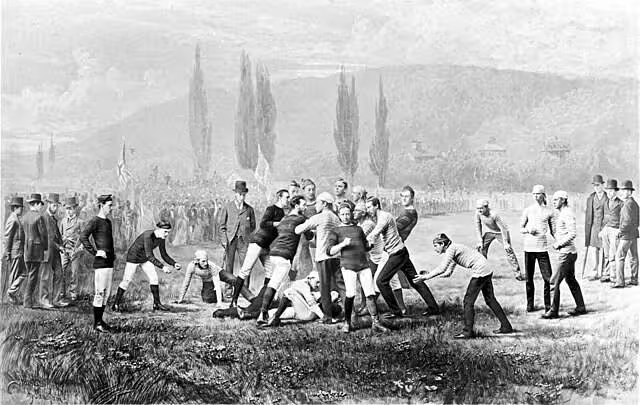
It would be a travesty if this blog failed to mention that in the 1820’s, a group of students at Princeton began playing what was then known as ‘ballown’. This game used an oval-shaped, bladder-filled ball, and the rules changed over time. At first, players used their fists to advance the ball, and then their feet. This game consisted mainly of one goal: to advance the ball past the opposing team.
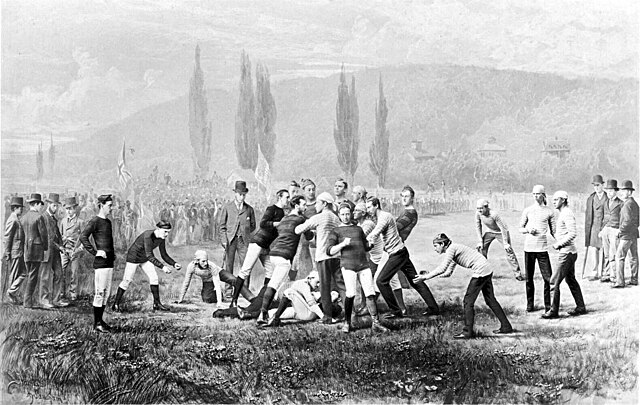
Building on these foundational games, differences in football rules began to emerge, particularly with the IFA and Harvard rules colliding.
In 1875, Harvard again challenged Yale to a game, this time agreeing to play a combination of soccer and rugby rules, much like McGill had in 1874. Yale agreed to these rules, but they included the use of a round ball rather than the oval one Harvard normally used. Harvard won this game of agreements versus rival Yale in front of 2000 fans. The spectators and players from both schools loved the game and decided to make it an annual event.
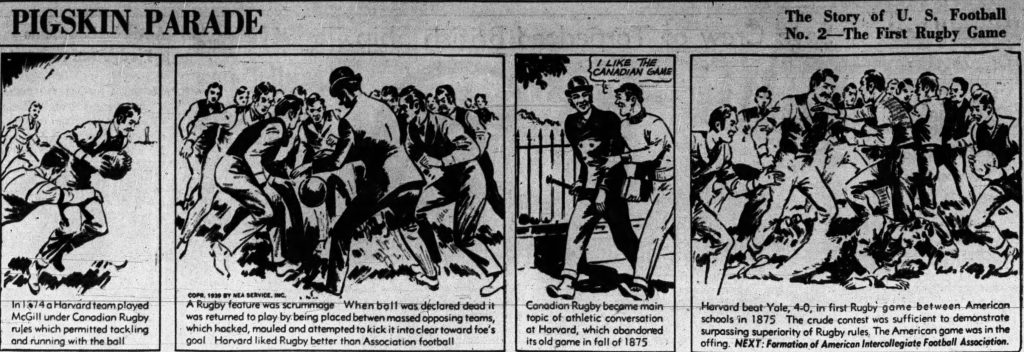
For more on the Pigskin Parade comics, join us here.
A Deep Dive into 1876 Football History and Highlights
- September 1, 1876 – During the next few years, though, a new figure entered the Yale football scene, yes, you guessed it, Walter Chauncey Camp. Camp arrived at the New Haven campus in 1876 and enjoyed the game between the Yale and Harvard clubs. Camp so loved the sport that he joined the Yale team in 1877 and essentially became its first head coach, as the title of Captain then served as the role. Camp not only coached the team but also played. He played on the varsity teams of Yale from 1877 to 1882, serving as Captain in 1878, 1879, and again in 1881. Camp’s leadership gave Yale 25 wins, one loss, and 6 ties over his playing career. He was a sure tackler, a great kicker, and an elusive runner.
- November 11, 1876 – The University of Pennsylvania had its first football game. The Penn Quakers faced the Princeton Tigers, ending in a 6-0 Princeton win.
Walter Camp, though as great a player as he might have been, is not famous for his feats as a football athlete, but is the main innovator who changed rugby into American football. It started in 1882, after his playing career ended and his term on the IFA rule committee began.
The details of Camp as an innovator will appear in the next installment of this football history exposé, Part 6: “Settling the Score in Football,” right here on PigskinDispatch.com—your source for the good news about football.
Our friend Timothy Brown of Football Archaeology goes into more detail on this era in his 2022 Tidbit, The 1876 Harvard-Yale Game.
- November 23, 1876 – Many experts, including Timothy Brown, regard this as the start of American Football. Yale’s legendary player/coach, Walter Camp, represented Yale at a meeting of top Eastern Schools at the Massasoit House in Springfield, Massachusetts, which helped establish a printed set of rules, very similar to the European Rugby Code, and the group formed the Intercollegiate Football Association.
Football Archaeology has a great in-depth series of posts on the 1876 Rules found here.
We are able to provide this in-depth look into history from so long ago through careful research. Using someone who was contemporary to the period is the best source. So, a very special shout-out to our main source of reference for this article: Parke H. Davis, in his 1911 book, Football-The American Intercollegiate Game.