Pigskin Dispatch’s Part 4 in the Series on American Football History
Having explored football’s Ancient European roots, let’s recap before moving forward.
When we last visited this series, a new game called rugby was shipped from England to America. Rugby was a brutal game, and many schools in England decided not to play it and instead chose association football, or soccer. The soccer name obviously stayed here in the States, but in Great Britain and much of the world, soccer is called football.
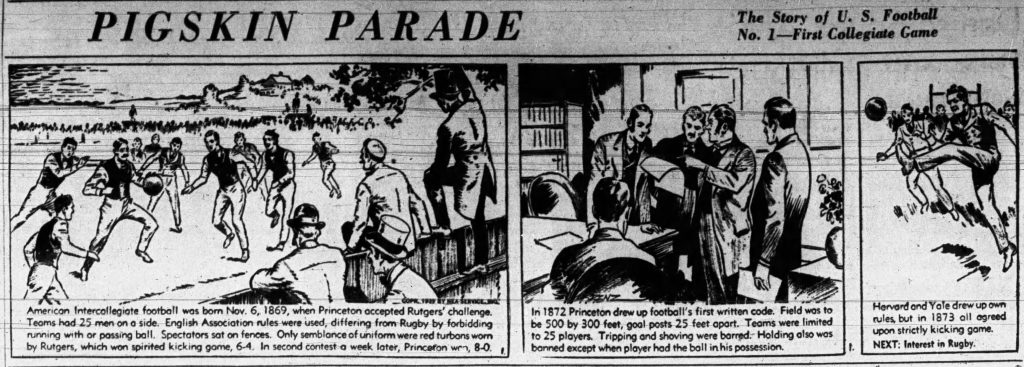
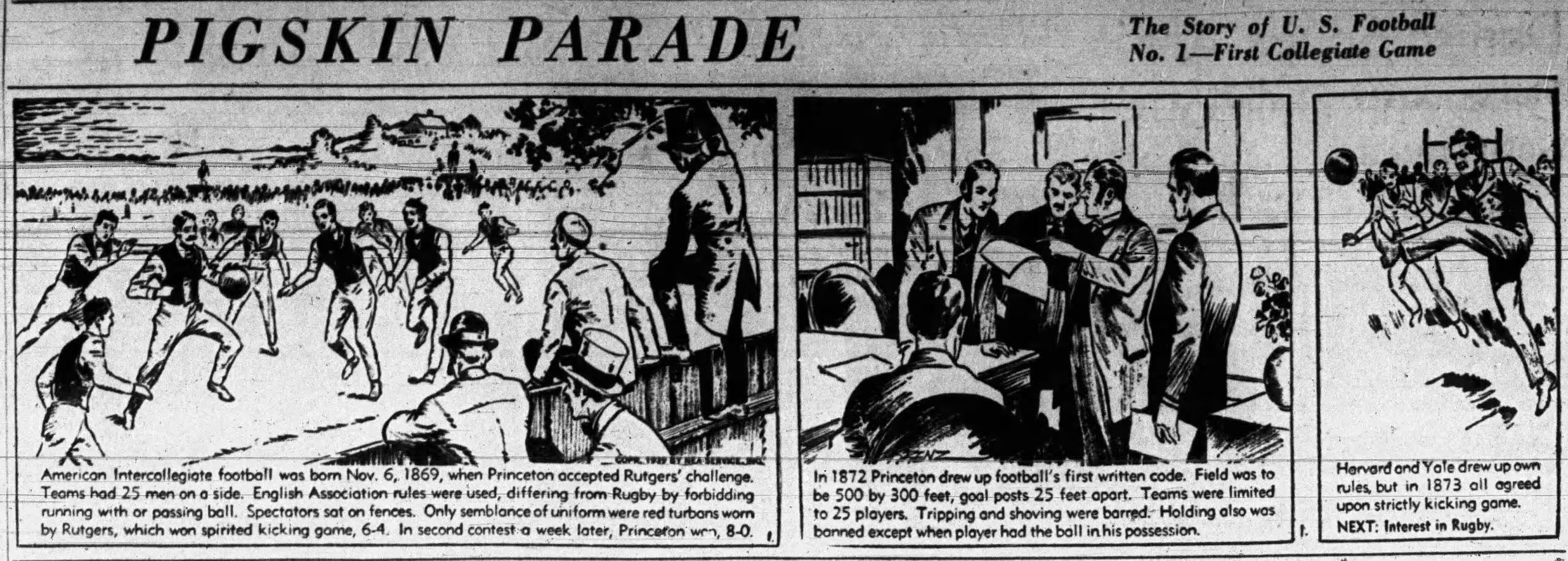
For more on the Pigskin Parade comics, join us here.
America transforms the game.
Rugby, though, seems to have become popular early in America. By 1860, the game was abolished in many American schools due to its rough nature. It was revived in 1862 by Gerritt Smith Hiller, who organized a group of Yale students to play again, using rules that were a reasonably close imitation of soccer. Still, the game was often more an excuse to beat up freshmen in a hazing activity than anything else.
The game stuck around and became popular at the eastern colleges, though, and on November 6, 1869, an inter-collegiate game was played between Princeton and Rutgers. The game played this day was very similar to rugby, with 20 players on the field for each team.
In 1871, Harvard University began playing a variation of the game called “the Boston Game,” which differed from the others by allowing a player to pick up the ball and run if he was chased.
Football 1873
In the fall of 1873, Yale invited representatives from Harvard, Rutgers, Columbia, and Princeton to a convention in New York City to draft rules for an intercollegiate football association. ( a precursor to the NCAA) Harvard declined to attend because the other schools had no intention of honoring any of the rules of the Boston game. The four remaining schools established the Intercollegiate Football Association (IFA) and set the maximum number of players per team at 15.
Harvard players still had a strong desire to play other schools, so in 1874, Harvard challenged Yale to a game under the Boston rules. Yale declined the challenge due to rule differences; under IFA rules, the game it played was more similar to soccer. Harvard’s team captain, Henry Grant, was still not discouraged. He was anxious for his football team to compete and had heard that a similar game was played just over the Canadian border at McGill University. Consequently, Grant got in touch with the captain of the McGill team, David Roger, and invited them to play two games in Cambridge, Massachusetts, on May 13 and 14, 1874.
Harvard, until this time, was still playing the Boston game, and the rules also resembled soccer more than today’s game of American football. The Boston rules differed from the IFA version, though, because in the IFA, a player could never pick up the ball and run with it. Boston rules allowed him to pick it up and tuck it only when he was being chased by an opponent. Harvard players were in for a surprise when the McGill squad came to Cambridge a few days early and practiced in front of them. The McGill players kicked the ball and subsequently ran with it under their arms. Harvard’s Grant pointed out politely that this violated a basic rule of American football. The McGill captain replied that it did not violate any rule of the Canadian game. When the Harvard captain asked the McGill leader, “What game do you play?” David Roger replied, “Rugby.” They then agreed to play the forthcoming games under half-Canadian, half-American rules. Harvard normally played with 15 players to a side, but McGill could only bring 11 to the contests, so both sides used an 11-on-11 format.
The Harvard University newspaper printed the following excerpt the next day: “The McGill University Football Club will meet the Harvard Football Club on Wednesday and Thursday, May 13th and 14th. The game will probably be called at 3 o’clock. Admittance 50 cents. The proceeds will be donated to the entertainment of our visitors from Montreal.”
The May 13 contest began under Canadian colleges’ rules and was scheduled for the second half to use Boston rules. The Harvard players enjoyed the Montreal version so much that they asked their opponents to play the remainder of the game according to the rules McGill had brought. Harvard won the first game 3-0. The following day’s game ended in a scoreless tie. Harvard went on to adopt many elements from the game their Canadian friends had shown them, including tackling, downs, and field goals.
These changes to Harvard’s football rules were setting the table for something much bigger and better, though. When we resume in part 6 of this series, we will introduce the true mastermind and founder of American football, Walter Camp, and his gang over at the Yale campus in “A New Authoritative Organizational Body and Leader for Football.” Right here on PigskinDispatch.com, your place for the good news about football.
We provide this in-depth historical look through careful research. The best sources are people from the period. Our main reference for this article is Parke H. Davis’s 1911 book, Football—The American Intercollegiate Game.