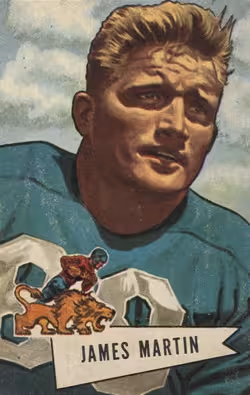
How does a 22-year-old Marine veteran go from scouting sea mines in the Pacific to becoming an undefeated legend at Notre Dame? Jim Martin didn’t just play football; he conquered it through sheer versatility and grit. Known as “Jungle Jim” for his heroic service in World War II, Martin stepped onto campus as a freshman and never looked back, anchoring a Fighting Irish squad that didn’t lose a single game during his four-year tenure. Whether he was catching passes as an end, moving to tackle to save the line, or kicking game-winning field goals in the NFL, Martin was the ultimate “position-flexible” weapon who defined a golden era of American gridiron history.
Football Bio
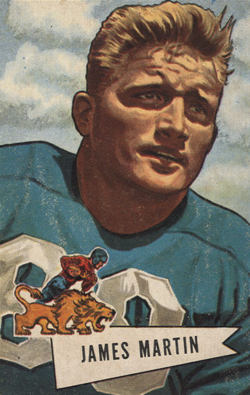
April 8, 1924 – Cleveland, Ohio – Notre Dame’s position flexible end and tackle Jim Martin was born. Jim started college a bit later than most, after serving in the military during the War, so, as a 22-year-old stepping on campus as a frosh, he hit the ground running on the gridiron, starting all four seasons and even becoming a team co-captain with Leon Hart in his senior season.
During that time with Martin on the team, the Fighting Irish never suffered a defeat, amassing a 36-0-2 record, according to the National Football Foundation. He was an end in his first three years. Notre Dame faced a shortage at tackle going into 1949, and Martin volunteered to change positions. He played tackle in 1949 and was on the AP, INS, and NEA All-America teams.
The well-rounded athlete also participated in boxing and swimming at the school, earning the 1950 George Gipp Award as Notre Dame’s outstanding athlete. Jim Martin was inducted into the College Football Hall of Fame in 1995 after the National Football Foundation tallied its votes.
Jim served in the US Marines during WWII as part of an amphibious assault team. Jim played 14 years in the National Football League with Cleveland in 1950, Detroit in 1951-61, Baltimore in 1963, and Washington in 1964. Spending the 1962 season as an assistant coach at Denver. He starred as a linebacker and place kicker. For his pro career, he had 56 field goals, including 15 in the 1961 season with Detroit. He later served as a football coach in the NFL, WFL, and the college ranks.
Conclusion
Jim Martin’s legacy is one of unparalleled durability and selflessness. By volunteering to move from end to tackle at Notre Dame, he ensured a national title for the Irish; by transitioning from a defensive end to a Pro Bowl kicker and linebacker in the NFL, he helped build the Detroit Lions dynasty of the 1950s. A rare four-time NFL champion and three-time college national champion, Martin’s 166-game professional career was a testament to the “Marine mindset” he brought to the stadium every Sunday. From his induction into the College Football Hall of Fame to his decades as a respected coach, “Jungle Jim” remains one of the most versatile and decorated figures to ever grace the game.
Accolades and Football Accomplishments
- College Football Hall of Fame: Inducted in 1995.
- 3× NCAA National Champion: 1946, 1947, 1949 (Notre Dame).
- 4× NFL Champion: 1950 (Browns), 1952, 1953, 1957 (Lions).
- Consensus First-Team All-American: 1949 (Tackle).
- NFL Pro Bowl Selection: 1961.
- NFL Comeback Player of the Year: 1963 (Associated Press).
- George Gipp Award: 1950 (Top athlete at Notre Dame).
- Heavyweight Boxing Champion: Won Notre Dame’s intramural title in 1949.
- NFL Record Holder: First player to kick two field goals over 50 yards in a single game (1960).
- Military Decorations: Awarded the Bronze Star for his reconnaissance service in the Pacific (WWII).
- Detroit Lions All-Time Scoring Leader: Held the franchise record for field goals upon his departure.

Well written – a birthday honor piece!
Thank you, I appreciate the kind comment. Are you a relative of Jim?