In an era where the passing game was still a secondary thought, Malcolm Kutner proved that a vertical threat could change the entire geometry of the field. A three-sport star with “off the charts” leaping ability, Kutner was a nightmare for 1940s defensive backs who simply couldn’t match his track-star speed or 6’2” frame. From the dusty fields of the Southwest Conference to leading the Chicago Cardinals to an NFL World Championship, the man they called “Mal” redefined the expectations for the modern wide receiver. Step inside the career of the Longhorn legend who went from Navy Pre-Flight service to becoming the NFL’s Most Valuable Player.
Football Bio
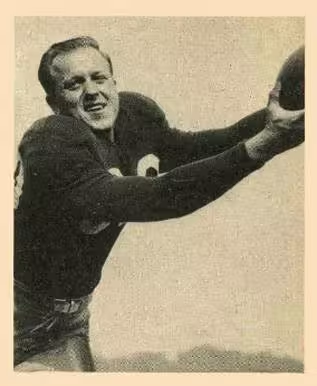
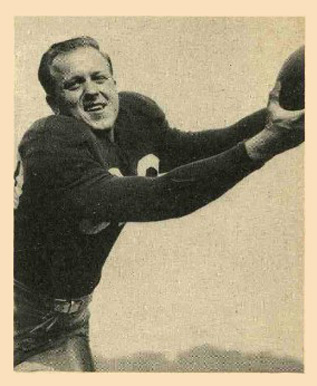
March 27, 1921 – Dallas, Texas – Malcolm Kutner, the tough University of Texas end from 1939 to 1941, was born.
The NFF says that, as a college athlete, Kutner had it all going on. He was big at 6’2”, weighing in at 190 pounds, and was very mobile, as shown by his starring in not only football, but basketball and track as well. His leaping ability was off the charts, making for an extremely big catch radius for QB’s to launch passes to. Once he caught the ball, he was often off to the races because most DBs could not compare with his great foot speed. Kutner led the Longhorns in receiving as a junior, hauling in 16 aerials for 237 yards while helping the Burnt Orange and White to an 8-2-0 record in 1940.
The following year, Kutner was named All-Southwest Conference and All-America as the `Horns finished 8-1-1. Malcolm Kutner was inducted into the College Football Hall of Fame in 1974, after the National Football Foundation tallied its votes. Malcolm served his country during World War II and even got a chance to play ball with the Navy Pre-Flight School. He picked up in the pro ranks just where he left off in college before the war, earning Rookie of the Year honors with the Chicago Cardinals in 1946. The next year, Kutner led the Cardinals to the World Championship and, in 1948, was the NFL’s Most Valuable Player.
Conclusion
Malcolm Kutner’s journey from Dallas to the Hall of Fame is a blueprint for the “complete” athlete. His rare combination of size, verticality, and elite speed allowed him to dominate the Southwest Conference before serving as a hero both on the battlefield and the gridiron during World War II. By claiming the NFL MVP award in 1948, he proved that an “end” could be the most impactful player on a professional roster. Kutner remains a towering figure in Texas Longhorns history, a reminder of a time when the “burnt orange” first began its ascent to national prominence.
Accolades and Football Accomplishments
- NFL Most Valuable Player: 1948 (Chicago Cardinals).
- NFL World Champion: 1947 (Chicago Cardinals).
- College Football Hall of Fame: Inducted in 1974.
- NFL Rookie of the Year: 1946.
- Consensus First-Team All-American: 1941.
- All-Southwest Conference (SWC): 1941.
- 2× First-team All-Pro: 1947, 1948.
- NFL Receiving Yards Leader: 1947 (944 yards) and 1948 (943 yards).
- NFL Receiving Touchdowns Leader: 1948 (14 TDs).
- NFL 1940s All-Decade Team: Recognized as one of the premier players of the era.
- Texas Longhorns Hall of Honor: Inducted in 1965.