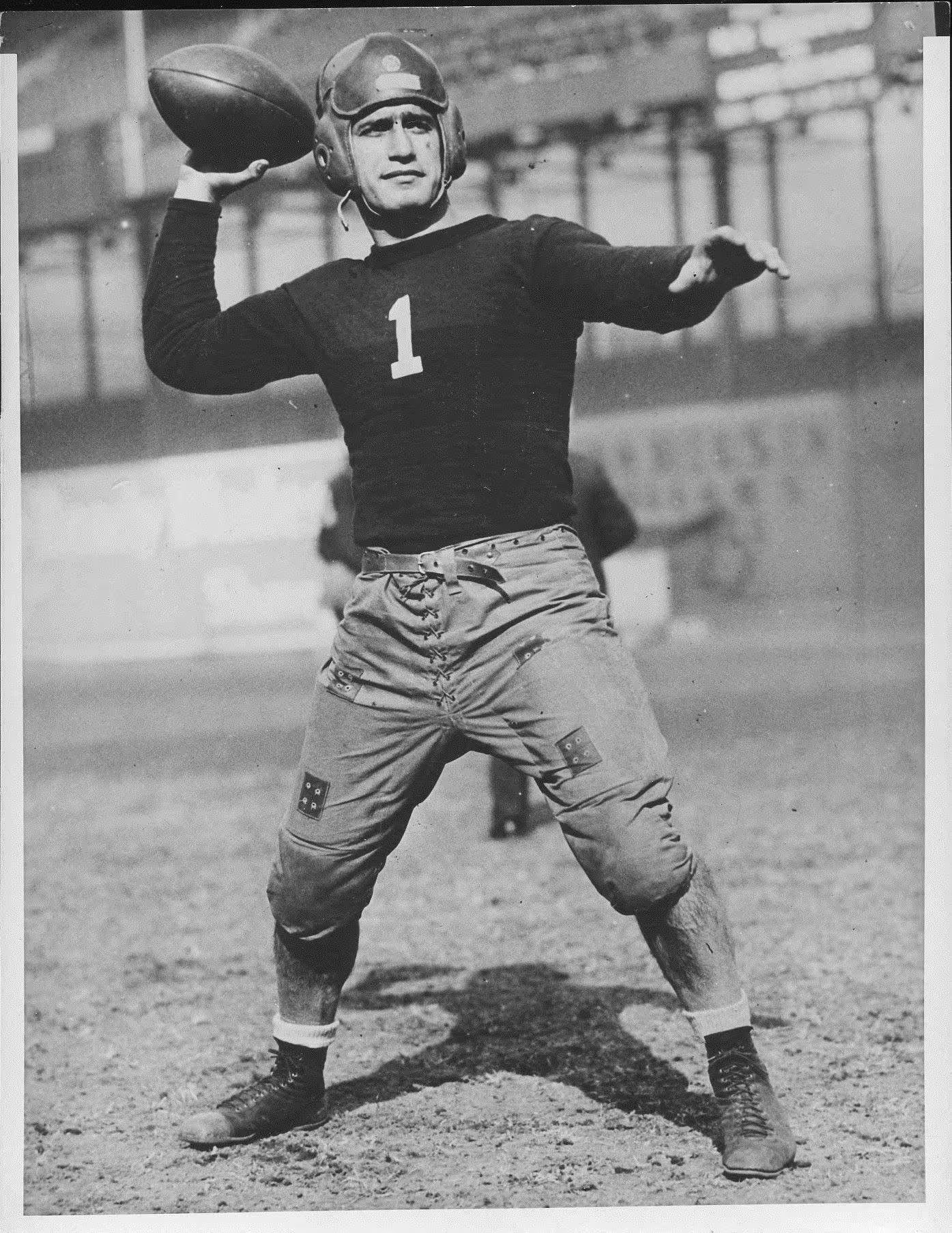
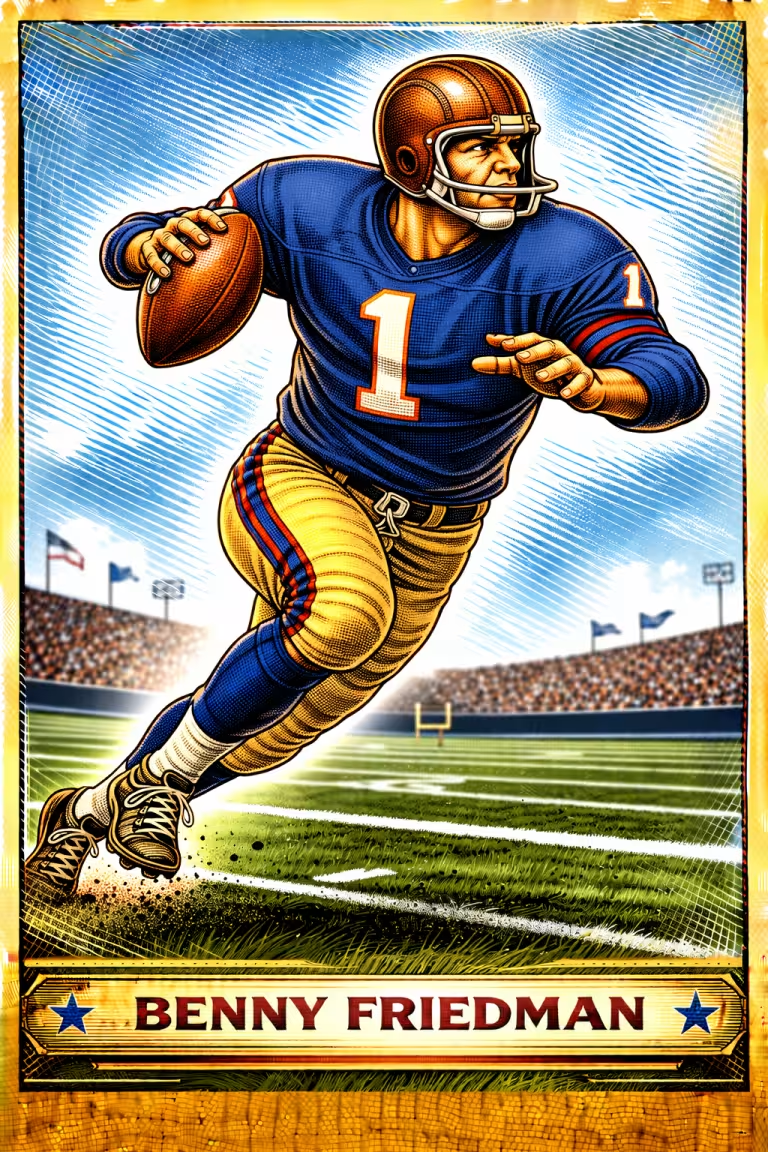
BENNY FRIEDMAN
1929–1931
Before Benny Friedman, the forward pass was a desperate gamble—after him, it became a lethal art form. Standing in the center of a packed Ohio Stadium in 1926, Friedman orchestrated an aerial assault that shocked the Buckeyes and rewrote the tactical manual for Big Ten football. From his “circus-grab” connections with Bennie Oosterbaan to his unprecedented success in the early NFL, Friedman was the first true modern quarterback. He didn’t just play the position; he revolutionized the geometry of the gridiron, proving that a pigskin could be just as dangerous in the air as it was on the ground.
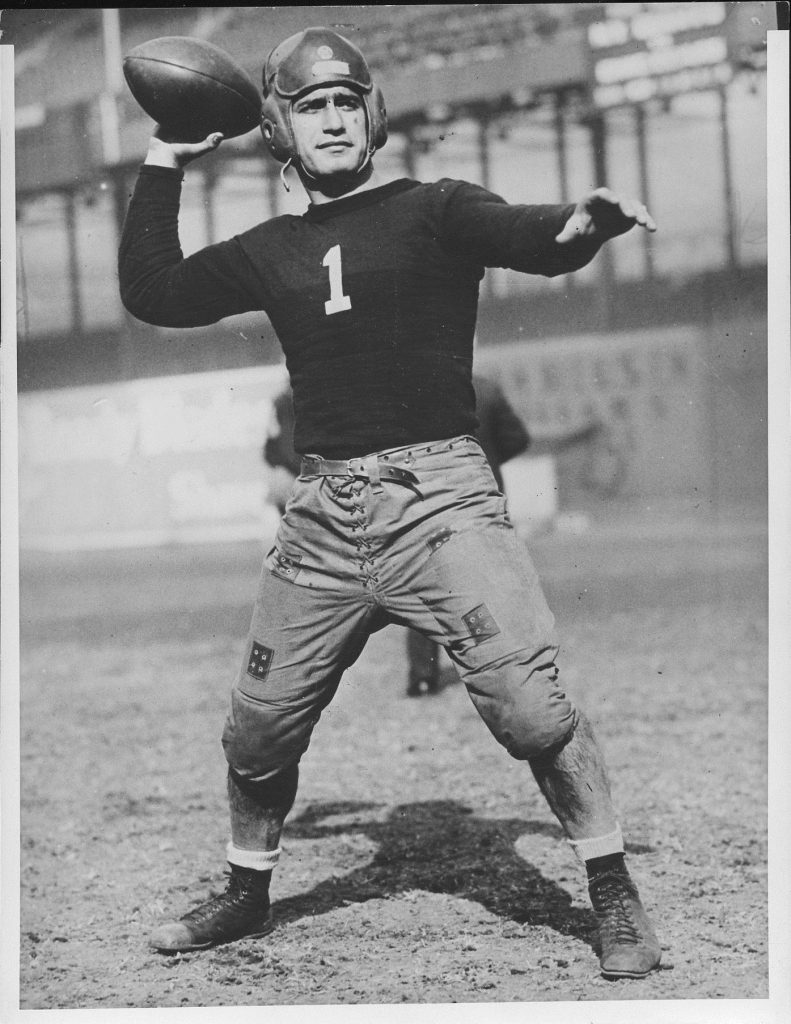
Big Time Play of a Legend
Picture yourself at a 1920s-era Horseshoe Football Stadium in Columbus, Ohio, with 90,000 other onlookers. The game you are witnessing is the heated rivalry between the Ohio State Buckeyes and the University of Michigan Wolverines in an important Big 10 Conference game, as the winner would be contending for the conference championship.
It’s early in the game, a mere 12 minutes have gone by, but the Michigan eleven are trailing Ohio State 10-0. With that in mind, Michigan’s Head Coach Fielding Yost unsheathed his secret weapon, the forward pass, using Friedman, left end Bennie Oosterbaan, and left halfback Louis Gilbert! It was an aerial assault never seen before as Quarterback Friedman shocked the Buckeye defenders with perfect strikes to his teammate, Bennie Oosterbaan, while catching other tosses from Gilbert himself.
It was Friedman scrambling till he got in trouble and then launching the ball in Oosterbaan’s direction, who would sometimes make circus-like grabs. It looked, though, that the drive had stalled; therefore, Gilbert, as a holder, and Friedman, with kicking in mind, dropped back for a field goal attempt. Louis Gilbert dropped onto one knee as though to hold the ball for a place-kick. Instead, he moved out of the way when the ball was snapped back, Friedman caught it, stepped back, and promptly fired a swift, flat pass to Oosterbaan, who was free behind the Ohio goalposts. With Friedman’s extra point kick, the lead was cut to 3.
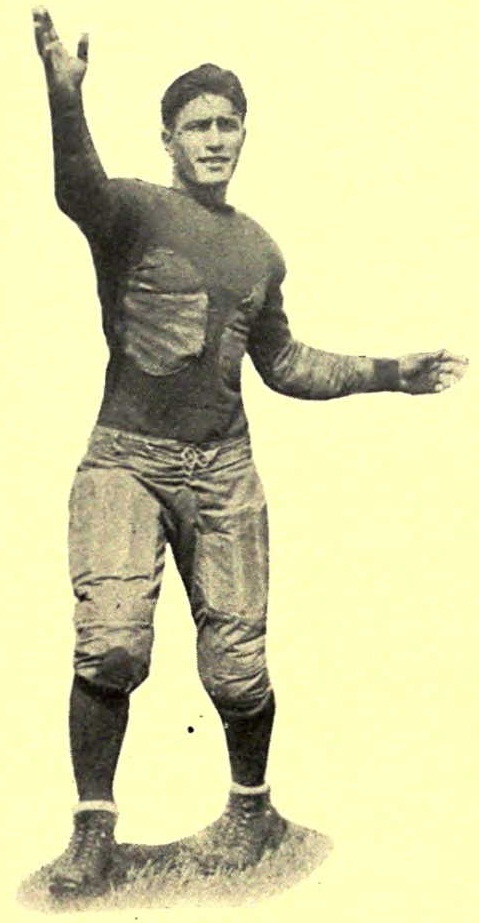
The Buckeyes’ next drive stalled, and they were forced to punt with only a minute left before the half was over. A split-second decision would be pivotal as the first half drew to a close. Gilbert again took his position on one knee, ready to field the snap, but Friedman called it off and took the snap directly so as to drop-kick the ball 43 yards through the uprights. Michigan had tied the score!
The teams came out in the second half, but neither defense would give ground. As a matter of fact, the Blue defense did one better as they recovered a muffed punt deep inside OSU territory. The Buckeyes put up a fight, but on fourth down after shedding a couple of red jersey tackles, Benny Friedman lunged over the goal line. Michigan 17, Ohio State 10.
What happened next would feel like a gut punch. Ohio State moved the ball down the field with short passes, finally punctuated by a Buckeye rush for a score. With the game clock all but expired, there came the all-important point after try, only one point separating the teams. The snap went down, foot hit the ball with the thud of leather on leather. The pigskin rose up in the air on a direct line straight down the middle and sailed between the pipes, but it was two feet under the crossbar. The Wolverines prevailed in a 17-16 thriller in Ohio, then knocked off Minnesota a week later, 7-6, to capture the Big Ten crown. We credit the Bentley.Umich site for posting a next-day report on the 1926 game, from which we could take facts for the story.
Football Bio
Benny Friedman was born on March 18, 1905, in Cleveland, Ohio, and played as a standout quarterback at Michigan from 1924 to 1927, per the National Football Foundation. Benny was inducted into the College Football Hall of Fame in 1951. In 1927, as a rookie with the Cleveland Bulldogs, Benny was selected as an All-NFL player after throwing an almost unheard-of 11 touchdown passes! The Pro Football Hall of Fame says that in the next season with the Detroit Wolverines, he reached All-NFL status, as well as in the two seasons after that in a New York Giants uniform. What a start to a professional career to be on three different teams and be considered the top of your position each year! He ran, kicked, and passed as well as anyone in the League; therefore, the Pro Football Hall of Fame enshrined the great Quarterback Benny Friedman in 2005.
Conclusion
Benny Friedman was a pioneer who played a game that was decades ahead of its time. His ability to pass, kick, and run with equal proficiency made him the ultimate triple-threat, but it was his arm that truly changed the sport. By leading Michigan to Big Ten glory and immediately dominating the professional ranks across three different franchises, he proved that a high-powered passing attack could win championships at any level. Today, every quarterback who steps into a shotgun formation owes a debt to Friedman—the man who first turned the football into a guided missile.
Accolades and Football Accomplishments
- Pro Football Hall of Fame: Inducted in 2005.
- College Football Hall of Fame: Inducted in 1951.
- 4× First-Team All-NFL: (1927, 1928, 1929, 1930).
- NFL Passing Touchdowns Leader: Led the league for four consecutive seasons (1927–1930).
- Unanimous First-Team All-American: 1926.
- Big Ten Champion: Led Michigan to titles in 1925 and 1926.
- Chicago Tribune Silver Football Winner: Awarded to the Big Ten’s MVP in 1926.
- NFL Pioneer: One of the first quarterbacks to use a smaller, “pointier” football to improve passing accuracy.
- The “Giants” Savior: His 1929 transfer to the New York Giants is credited with saving the franchise from financial ruin.