From Ropes to Goosenecks: The Surprising Evolution of Football Goal Posts
If you’ve ever watched a crowd storm the field to topple a goal post after a massive upset, you know these yellow structures are more than just sports equipment—they are symbols of victory. But the goal posts we see today in the NFL and NCAA are a far cry from the "cheesy, beat-up scrap lumber" used in the early days of the gridiron.
Recently, Darin Hayes sat down with Timothy B. Brown of Football Archaeology to tear down the history of these iconic structures. From the cow pastures of the 1800s to the high-tech "slingshots" of today, here is how the goal post evolved.
The discussion stems from Tim's recent Tidbit titled: A History of Goal Posts.
1. The "Badminton" Era: Ropes and Strings
In the very earliest days of American football—derived from rugby and soccer—the setup was incredibly primitive. Instead of the rigid crossbars we see now, teams would often just erect two wooden posts and stretch a string or rope between them, roughly 10 feet off the ground.
As Tim Brown noted, the rules were simple but familiar: "If you kicked the ball under that rope, it was soccer; if you kicked it over, it was rugby."
2. The Danger on the Goal Line
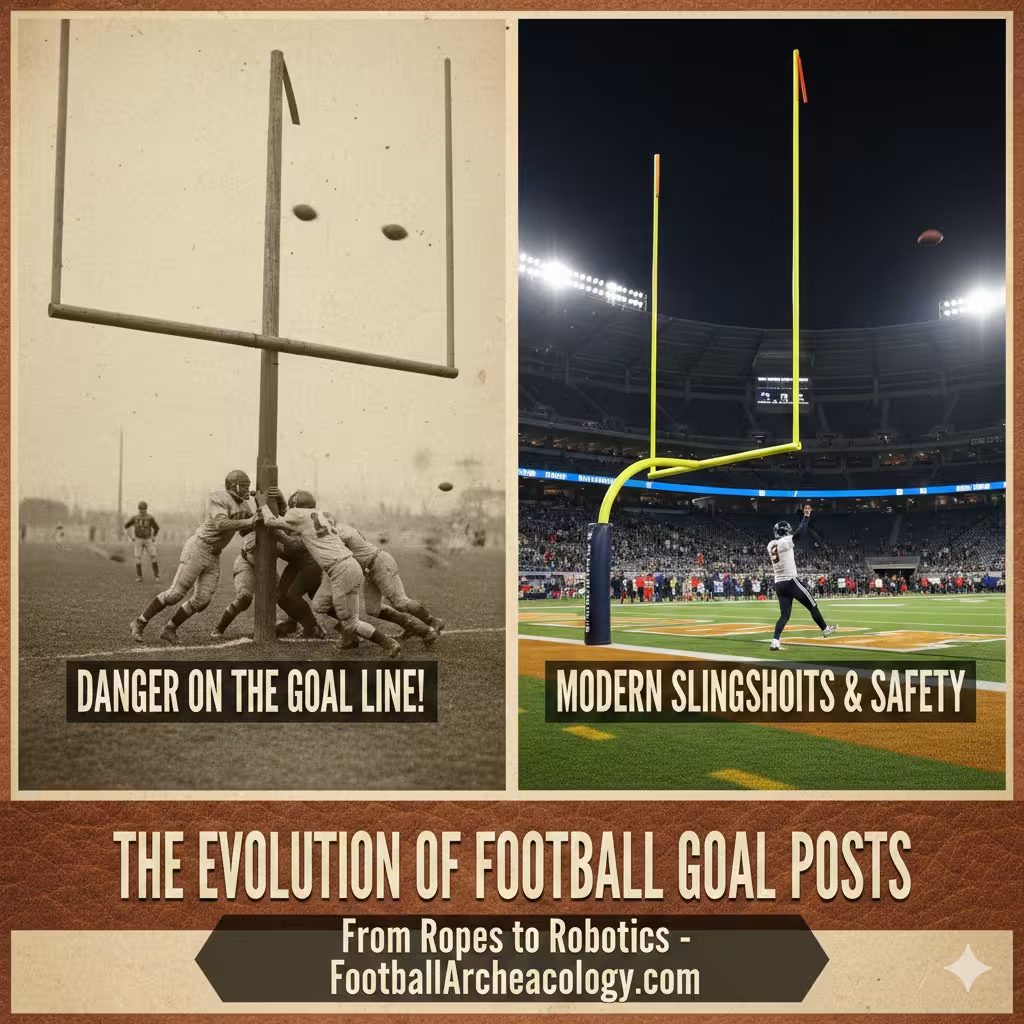
For decades, goal posts were the classic "H-style" and were planted directly on the goal line. While this made sense for scoring, it created a massive safety hazard. Imagine a fullback sprinting for a touchdown, only to be stopped not by a linebacker, but by a 4x4 wooden beam.
- The Harvard-Yale Incident:In 1899, a Harvard player was famously stopped short of a touchdown because Yale defenders literally braced themselves against the goal post to hold the line.
- The Obstacle Course:A few years later, another Harvard runner knocked himself out by running head-first into the post before anyone even tackled him.
3. The "Safety" Goal Post and the $50 Patent
In the early 1900s, an innovator named Edward Manley patented a "safety goal post." His design moved the heavy support posts 3 to 5 yards behind the goal line, using braces to suspend the crossbar over the actual line.
While it was a brilliant idea for player safety, it didn't catch on immediately for one simple reason: Money. Manley charged $50 for every installation—a small fortune in 1900—leading many schools to stick with their dangerous (but free) wooden H-posts.
4. Moving the Posts: Goal Line vs. End Line
The location of the goal post has hopped back and forth throughout history, usually to balance the difficulty of kicking:
- 1927:College football moved the posts to theend line(the back of the end zone) to get them out of the way of runners and provide better angles for kickers.
- 1932:The NFL moved them back to thegoal lineto encourage more scoring and break a record-high streak of tie games.
- 1974:The NFL finally moved them back to theend linefor good. With the rise of soccer-style kickers, field goals had become too easy, and the league wanted to make the game more challenging again.
5. The "Gooseneck" Revolution
The modern, single-post "slingshot" or gooseneck design we see today didn't arrive until 1966. It was dreamt up by Jim Trimble (former coach of the Philadelphia Eagles) while he was playing with a fork at breakfast!
Made of aluminum, these "Tele-Goal" posts were safer, more durable, and looked much more professional than the shop-class creations of yesteryear.
Fun Fact: Before standardized equipment, many high school goal posts were built by the school's shop class. Students would weld the steel and even have the home economics class sew together old mattresses to create the first "padded" posts!
Dive Deeper into Football History
The history of the game is hidden in the details—from the width of the uprights to the sawdust inside a tackling dummy. If you love learning about the "antiquities" of the gridiron, be sure to check out Tim Brown’s work at FootballArchaeology.com.
Join us at the Pigskin Dispatch website to see even more Positive football news!
Don't forget to check out and subscribe to the Pigskin Dispatch YouTube channel for additional content and the regular Football History Minute Shorts.
Miss our football by the day of the year podcasts, well don't, because they can still be found at the Pigskin Dispatch website.
Transcript
You know, we often watch football games that at the end of each field we have these structures that become quite popular, especially at the end of games, because they usually mean points. Well, Timothy B. Brown of FootballArchaeology.com joins us today to tell us about the history of the goal posts. Tim, welcome back to the Pig Pen.
Timothy Brown:Hey there. Good to chat and looking forward to kind of tearing things down as we talk about a post.
Darin Hayes:Tearing things down as you talk about a post. Oh, boy, I haven't seen one of those games in a while where the crowd tears them down, but used to be quite popular in the 70s and 80s, weren't they?
Timothy Brown:Yeah. And even before that, there, there's a lot of.
I mean, we think people tore things down, but man, in like the 20s and 30s, it was like every game people would do that.
Darin Hayes:Yeah. I can't even imagine how much those things must cost nowadays at these stadiums and probably an expensive endeavor if somebody rips them down today.
Timothy Brown:Yeah.
Darin Hayes:So, but okay, you, you recently wrote an article, and that's why we're talking about this, called the History of the Goal Post. And. Well, can you tell us about the history of these fine pieces of art, I would call them at the end of each.
Timothy Brown:Well, yeah, so it's actually like two weeks ago, I think it was, we were talking about goal posts and I said, you know, when they originally made them, like really the first few years, they just erect two posts and then put a string between the posts like 10ft off the ground. Right.
And, and you know, that was kind of the case like earlier on, you know, back in England, you know, when they, when they were playing both soccer and rugby, you know, if you kick the ball under that rope or crossbar for soccer and you kicked it over for rugby. Right. And so that was kind of the original thing going on.
Darin Hayes:Maybe play a game of badminton after, afterwards.
Timothy Brown:Right. Or croquet.
Darin Hayes:Okay.
Timothy Brown:But like, you know, when they, when go post began, they were all the, you know, what I'll just call the H style. Right. Kind of the traditional two post and a crossbar. And they were planted on the goal line, which is why it's called the goal line. Right.
And so, so that went on, you know, for long, long time. And you know, a lot of them were just, especially the, like small towns.
I mean, they just, I did a post one time about them just, just images of just really cheesy beat up like crooked goal posts. I mean, it was just the best they could do with scrap lumber. Right. But so anyways, you know, so they.
The goal posts were on the goal line from the beginning, but they got in the way. You know, and so their stories of.
vard, Yale, because, like, in:You know, they had the ball on the two or something like that, and, you know, ends up running at the goal posts, you know, and the Yale defenders kind of brace themselves against the posts and are able to stop the Harvard runner, and then they end up either losing or tying. And then similar thing happened a few years later, except the Harvard runner. Absolutely. They ran into the goalpost and fell back.
So it wasn't even a defender that stopped him. But. But. So the point is that they got in the way. You know, they. And this is before the forward pass, so. But they just.
obstacle. And so after that,:You know, if you look at old pictures, you'll see these things popping up from time to time. And he patented.
You know, he has a patent on him, but it was basically, he had the two posts like normal, but they were planted like three to four, even five yards behind the goal line. And then. So you'd have a kind of a. You'd have a post, and then.
Then you'd have like, an extension and bracing that would hold up the uprights that were actually over the goal line. Right. So the posts were several yards off the line, but the uprights and the crossbar were over the goal line.
And in his patent, he shows a single, you know, single post design. But I think, you know, they were making them out of wood, and he probably, he. They just couldn't figure out how to.
How to support all that weight on that one post. So anyways, I've never seen an image of one of those early ones, but. So everybody used either the H design or the safety goal post design.
And I think part of the reason why his goal posts, while the safety goal post didn't turn out to be that popular is that he charged 50 bucks for every installation. And so you probably didn't collect on all of them, but, you know, that. That would have kept 50 bucks was, you know, some pretty good money back then.
Darin Hayes:Yeah.
Timothy Brown:So. And then.
s. I found examples from like:And then like, I've read things like, you know, stag saying stag invented them, but, you know, they were out there. And I've got images and I think I've got them in the. In the tidbit images of padded goalposts.
And yet in:Darin Hayes:He didn't use them. Right?
Timothy Brown:sorry, I don't believe that.:So anyways, so then you get into the whole, okay, goal line versus inline. And so it was always on the goal line. And then in college, they were the, you know, and they moved. They moved the goal post to the end line in 27.
And the rationale is kind of somewhat safety oriented, but it was also, you know, back then, you didn't have, you didn't have hash marks. And so, you know, you could have the ball way over near the. The sideline. Right? I mean, you could. That where you.
That's where you could be on fourth down when you're trying to kick a field goal. So part of the rationale for moving it to the end line was to give people better angles to. To kick. Now it would be 10 yards further.
So presumably you, you know, you had, you couldn't. You'd have to be closer to, you know, for the same kind of distance. So anyways, and then like, the NFL basically did the same thing.
llege rules. But then like in:So they moved the goal post to the goal line to try to, you know, encourage scoring. And I'm not sure it did a whole lot, but, you know, because both teams still had more or less equal chances.
Darin Hayes:Well, they had a championship game, was a Sammy Boss. They scored a safety because they threw a pass and it hit the. The goal post and they counted as a safety and Washington lost by two or something.
If I remember correctly, the game with that safety by his pass.
Timothy Brown:Yeah, there were.
Darin Hayes:It did increase scoring that way too, I guess.
Timothy Brown:Yeah, I guess so. I mean, there were some strange rules about, you know, can you. Because I did a story on Doinks, you know, fairly Recently.
And so some of them, you know, sometimes the, the doink was automatically, you know, the play ended. Other times it was still live ball. So, you know, who knows? But then, so then the NFL, they went to the, they moved it to the end line in 74.
And that's largely because, you know, in the 60s, it's really when soccer style kicking took over. I mean, they'd had soccer style before that, but that's when it really became, you know, popular.
And they were just booting the ball from so far out that they said, okay, we got to move this thing, we got to move these things back and make it harder again. But then the other piece of that is like in 66, there's a guy named Jim Trimble, who he had been, I think the Eagles head coach.
Pretty sure he's Eagles head coach, could be before that, but he was the Montreal Alouettes coach. And then he got fired. And so he's chatting with a buddy at breakfast one time talking about a game where like the defense had.
On the Canadian field, you know, they had.
,:d to adopt their goal post in:But NCAA, you can use either, you know, the H style or the, you know, slingshot gooseneck, you know, style of. Or Telegol, which is what. Which was their brand name. So that's kind of the, that's the story of GOPOs.
And I didn't get into the width of them that changed from time to time.
Darin Hayes:But yeah, it's, it's interesting, you know, like at the high school level and below. I don't, I don't. I think schools can still make them.
I, I know like some of them I've been at schools like, where you can tell like their shop made them or, you know, shop class made them, you get these crazy looking and engineered designs and everything. And somewhere I have a collection of them.
You know, I was visiting my mother when she lived down in Dallas, Fort Worth area, and I was Driving by a middle school and I saw this goal post. I'm like going, oh my God, I never saw anything like that. I got, I was taking pictures so I had like a collection of these things.
I got a ton of dig that up sometime. And there's really some really crazy looking ones that, that I've, I worked officiated games on and ones I just had observed.
But yeah, some interesting ideas come out of people's minds on the goal post.
Timothy Brown:Well, the old shop class thing is interesting too because you know, when I can't remember if I published a tidbit about. Or maybe it's still in the works, I don't know, but about like the, the yardage markers on fields. I can't remember if I published that or not.
Anyways, you know the, the little conical. There's, there's been different designs but all the things that. Yeah, actually I did, I published it last week. Anyways.
So like in high schools a lot of the signage and all that kind of stuff were. Shop classes made that stuff, right.
And there were things where like shop kind of home ec and shop classes would make tackling dummies, you know, I mean, they were just trying to save a buck, right?
And so you have the, have the girls sew these, these canvas tackling dummies and then the boys would get sawdust and you know, fill them up and you know, that's what you use for a tackling dummy. So anyway, shop classes have played a big role in, in high school football, right?
Darin Hayes:Yes, they did. So yeah, everybody at the school can get involved in a football game, that's for sure.
Timothy Brown:Yeah. So it's actually pretty cool.
Darin Hayes:Yeah, it is, it is.
make that, you know, back in:Yeah, Goal posts are always interesting thing, you know, and it's unique to football and you, there's a lot of different devices and, and people and rules that are unique to football.
And you dig into them and tell about the people and the events and the history, an evolution of some of these things, just like you did at the goal post today and your tidbits and maybe you could share with folks where they can catch on to some of these tidbits.
Timothy Brown:Yeah, just go to footballarchaeology.com it's a substack you know, site so you can subscribe, you can follow or just bookmark it and, you know, show up in it whenever you want. But if you subscribe, you'll get an email every time that I publish something new.
So then you don't have to search for it, it just arrives in your inbox. But kind of whatever works for you.
Darin Hayes:That's the way to do it, you know, make it nice and easy. And you even have, you know, the paid subscribe thing so you get even more content. And the way to do it, you get all the, all the goodies from Tim.
So make sure you check that out. And check out Tim each Tuesday here as he talks to us about some great antiquity of football. And Tim, we look forward to that again next week.
Timothy Brown:Very good. Look forward to it. Thanks, Terry.
Speaker C:That's all the football history we have today, folks. Join us back tomorrow for more of your football history.
We invite you to check out our website, pigskindispatch.com not only to see the daily football history, but to experience positive football with our many articles on the
Darin Hayes:good people of the game, as well
Speaker C:as our own football comic strip, cleet marks comics.
Pigskindispatch.com is also on social media outlets, Facebook, Twitter, Instagram, and don't forget the Big Skin Dispatch YouTube channel to get all of your positive football news and history.
Darin Hayes:Special thanks to the talents of Mike
Speaker C:and Gene Monroe, as well as Jason Neff for letting us use their music during the podcast.
Speaker D:This podcast is part of the Sports History Network, your headquarters for the yesteryear of your favorite sport. You can learn more at sportshistorynetwork.
Timothy Brown:Com.