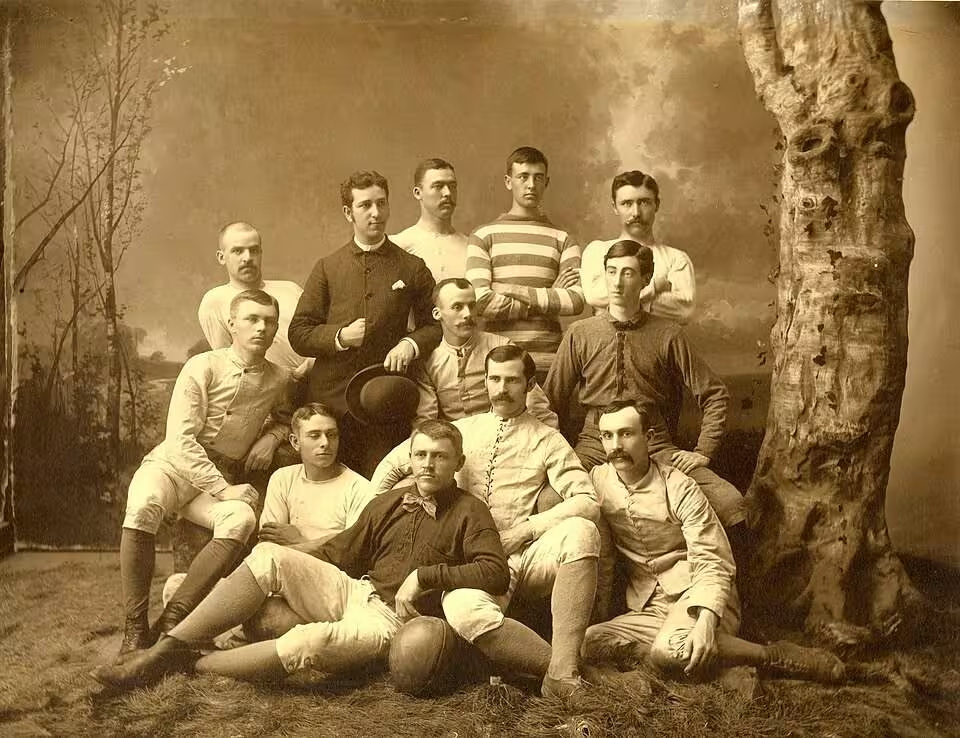
By 1884, American football had outgrown its “experimental” phase and was rapidly becoming a game of total domination. This was the year that witnessed the birth of the first high-scoring blowouts, proving that the new rules—like the line of scrimmage and the system of downs—had created an offensive juggernaut that early defenses simply couldn’t handle.
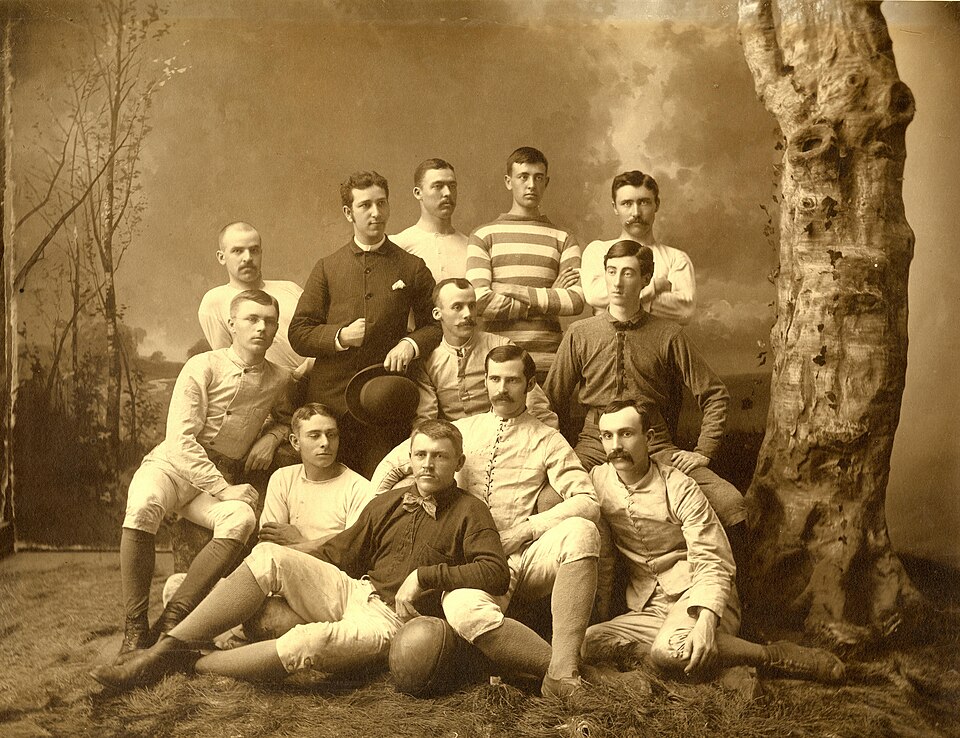
In this exploration of 1884 American football history, we cover:
- The record-shattering 113–0 and 140–0 games that changed the way we view “parity.”
- The arrival of Amos Alonzo Stagg at Yale, a man whose coaching would define the sport for the next 70 years.
- How the American Football Association formed, marking a pivotal moment for organized competition in the United States.
A Deep Dive into 1884 Football History and Highlights
Some events in 1884 served as historical markers in the game.
- October 15, 1884 – The new rules of 1884 concentrated on the kicking game. Fair catches of kicks and punts seemed to be a major priority of this convention, as a few rules were amended to mold fair catch guidelines.
- October 25, 1884 – Yale entered the 1884 season riding a 17-game winning streak and had won multiple National Championships in the past few years. The powerhouse Bulldog squad really flexed their muscles against the Dartmouth team that season. It marked the first game in which over 100 points were scored, as Yale toppled Dartmouth 113-0.
- On November 27, 1884, another rules convention was held at the Fifth Avenue Hotel. This convention was an appeal by Yale and its coach, Walter Camp, to have the decision of referee R.M. Appleton (from Harvard) in the Princeton-Yale game of that year declared a “no-contest,” with the score officially recorded as 0-0. Mr. Appleton’s decision was upheld after a long debate.
Significant Events of 1884
Football develops “Suckers Walk.”
The Fifth Avenue Hotel in New York received a lot of business from early football as it hosted almost all of the early rules conventions. October 15, 1884, saw another football rules contingent group gather in the hotel to discuss and modify more rules of football. The meeting was attended by Walter Camp and E.L. Richards from Yale, G.M. Kimball and A.D. French from Harvard, and C. W. Bird and J. B. Harriman of Princeton. A letter was received from Columbia in which the school withdrew from the association.
Section I of the 1884 rules focused heavily on the kicking game. The convention prioritized fair catches of kicks and punts, amending several rules to refine fair catch guidelines.
Redefining the “Fair”
Until 1884, the rules used the word “fair” to describe how players put the ball in play.
- The “Fair”: This technical term described returning the ball to play from the sidelines after it went out of bounds.
- Downs: Officials classified “fairs” as downs, even though they started differently than standard plays.
- The 1876 Definition: Originally, the rules defined a fair catch as a catch made directly from an opponent’s kick, forward throw, or “knock on,” as well as from a punt-out or punt-on.
- The Heel Mark: This original rule required the catching player to mark the spot by digging his heel into the ground.
Understanding the Mechanics
The early game featured several unique maneuvers that differ from the modern sport:
| Term | Action |
| The Knock | A player in possession deliberately hit the ball, similar to a volleyball serve. |
| Illegal Play | Players could not legally toss or knock the ball forward toward the opponent’s goal. |
| Interception | If a player threw or knocked the ball forward, the opposition could claim a fair catch on the loose ball. |
| Punt-Out | A team performed this punt from behind the opponent’s goal line following a touchdown. |
| Punt-On | A player executed this punt from within the field of play following a previous punt. |
The 1884 modifications to the fair catch were substantial to the game of that period. One modification stated that a fair catch could now be made behind one’s goal line. Another rule regulated contact by an opponent of a player who fair caught a ball. When a player was interfered with after he fair caught a ball the offended team’s captain would have the option to have a free kick or a down where the interference occurred.
This appeal conference marked a need for defining the responsibilities of the referee so. The next convention would be the defining moment when officials would become an integral component to our beloved game.
While the early 1880s were defined by Walter Camp’s rule changes (like the 1882 introduction of “downs”), 1884 was the year those rules were put to the ultimate test in competitive play.
1. The Rise of the Triple-Digit Blowout
This year saw two of the most lopsided victories in the history of the early game. On October 25, Yale defeated Dartmouth 113–0. It was the first time a college team scored over 100 points in a single game while holding their opponent to zero. Not to be outdone, just four days later, Princeton crushed Lafayette 140–0, a score so massive it remains a legend of the “Pioneer Era.”
2. Amos Alonzo Stagg Enters Yale
One of the most influential figures in football history, Amos Alonzo Stagg, enrolled at Yale as a divinity student in 1884. He joined the football team as a player this year, beginning a journey that would eventually lead to him inventing the huddle, the lateral pass, and the tackling dummy.
3. Formation of the American Football Association (AFA)
In the summer of 1884, the American Football Association was founded in Newark, New Jersey. While this organization primarily focused on what we now call soccer (Association Football), it represented the first major attempt to provide a structured governing body for “football” in the U.S. outside of the college system, eventually leading to the first non-college national championship tournament.
4. The “Safety” and Scoring Evolution
By 1884, the scoring system was still being refined to move away from the rugby “try.” The value of a Safety (2 points) and a Touchdown (4 points) had recently been standardized, allowing teams like Yale and Princeton to rack up massive point totals through superior ball control—a direct result of the “snap-back” and “scrimmage” rules established just a few seasons prior.
If you’re looking for more details on the evolution of the rules, this video on How Football Began provides a great breakdown of the transition from rugby to the gridiron system used in 1884.