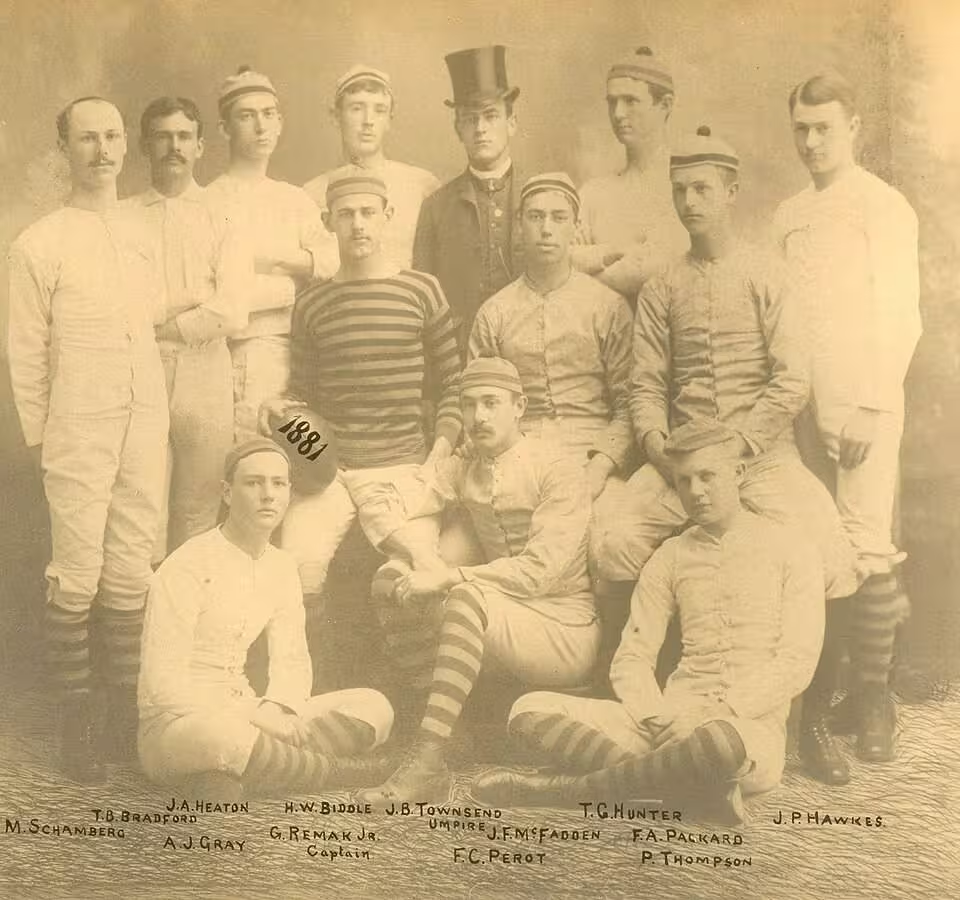
While 1881 might not have the “birth of the sport” branding of 1869, it was the year the gridiron nearly broke. In 1881, American football history hit a crossroads of controversy and innovation that forced the game to evolve or die. From the infamous “block game” tactics that led to the creation of the system of downs to the solidification of the Intercollegiate Football Association (IFA), this year provided the friction necessary for the modern game to ignite.
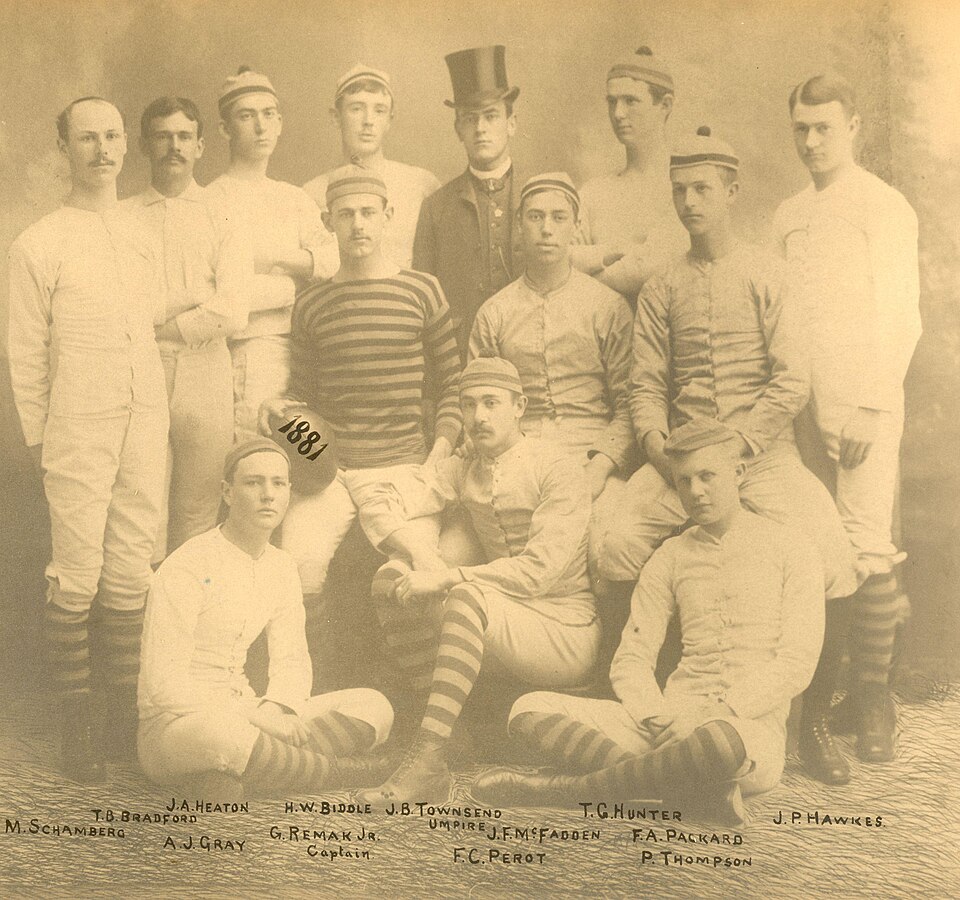
A Deep Dive into 1881 Football History and Highlights
There were 20 colleges participating in the IFA rules of football in the 1881 season, as the sport continued its growth.
Here is a quick look at specific dates of significant gridiron events of 1881.
- October, 1881 – The 1881 convention of the IFA officially standardized the field dimensions at 110 yards by 53.3 yards. The rules also empowered the Referee to eject players.
- October 29, 1881 – The Princeton Tigers traveled to Philadelphia to face the Penn Quakers. The Tigers won the game 7-0, en route to a 7-0-2 overall record, and were retroactively named national champion by the Billingsley Report and as co-national champion by Parke H. Davis.
- October 31, 1881 – A historic game took place when the University of Michigan traveled East to face Harvard. The game was played at the South End Grounds, home of the Boston Braves, a stadium that could accommodate 6800 spectators. Harvard won by a lone touchdown scored, 4-0 (TDs were only worth 4-points in 1881).
- November 2, 1881 – Michigan played game two of their three-day swing into the East, facing Yale. The powerhouse Eli team dashed the Wolverines’ hopes with an 11-0 lopsided victory.
- November 4, 1881 – Michigan took it on the chin for a third straight game against the Eastern powerhouses, this time visiting Princeton, where the Tigers overcame the Wolverines by the score of 13-4.
- November 12, 1881 – Penn State had its first-ever football game, as the Nittany Lions pounded Lewisburg College (PA), 9-0.
- November 19, 1881- Princeton and Harvard played to a scoreless tie at the Polo Grounds in New York City.
- November 24, 1881 – Yale and Princeton played to a scoreless tie at the Polo Grounds in New York City. Years later, the Official NCAA Division I Football Records Book listed Princeton and Yale as having been selected national champions
Significant Events of 1881
Sports historians verify the 1881 season as a “turning point” year. Here are the most significant milestones:
1. The “Block Game” and the Birth of Downs
The most famous event of 1881 was the Princeton vs. Yale championship game. At the time, there was no rule requiring a team to gain yardage to keep the ball.
- The Tactic: Princeton held the ball for the entire first half without trying to score, simply to prevent Yale from having a chance. Yale did the exact same thing in the second half.
- The Result: The game ended in a 0-0 tie, described by spectators as “interminable dullness.” This stalemate was so hated that it directly led Walter Camp to propose the system of downs (3 tries to gain 5 yards) in 1882 to ensure the ball changed hands.
2. The Standardization of the Field
The 1881 convention of the IFA officially standardized the field dimensions at 110 yards by 53.3 yards. This is remarkably close to the modern dimensions used today (120 yards including end zones).
3. Rule Changes for Safety and Flow
- The “Warning” Rule: Referees were officially given the power to warn players for “unnecessary roughness” or “slugging.” After two warnings, a player could be disqualified.
- In-Goal Scoring: Rules were clarified regarding “safeties” versus “touch-backs.” Before 1881, the scoring value of a safety was often disputed; this year helped formalize that a safety was a concession of points (though the point value remained fluid until 1883).
4. The Rise of the “Big Three” Dominance
1881 solidified the dominance of the “Big Three”—Yale, Harvard, and Princeton. Yale finished the season undefeated and unscored upon, cementing their status as the premier powerhouse of the era under the guidance of Walter Camp (who was still involved as an advisor/captain).
1881 Statistical Snapshot
| Category | Detail |
| National Champions | Princeton and Yale |
| Key Innovation | Formalization of the Referee’s power to eject players |
| Field Size | 110 x 53.3 Yards |
| Total Teams | Roughly 10–15 major collegiate programs |
The frustration of the 1881 season was actually a gift; without the boring “block games” of that year, we might never have gotten the high-stakes, yard-gaining drama that defines the sport today.