Imagine a time when throwing an incomplete pass resulted in an immediate 15-yard penalty or turned the ball straight over to the defense. On September 5, 1906, Bradbury Robinson braved those exact, high-stakes rules to throw the very first legal forward pass in American football history—forever transforming a brutal gridiron ground war into an aerial spectacle. From this monumental tactical shift to the milestone birthdays of trailblazers like Jerry Levias and cross-endzone runners like Jim Marshall, September 5th stands as a cornerstone date in the evolution of football.
September 5 American Football History Timeline
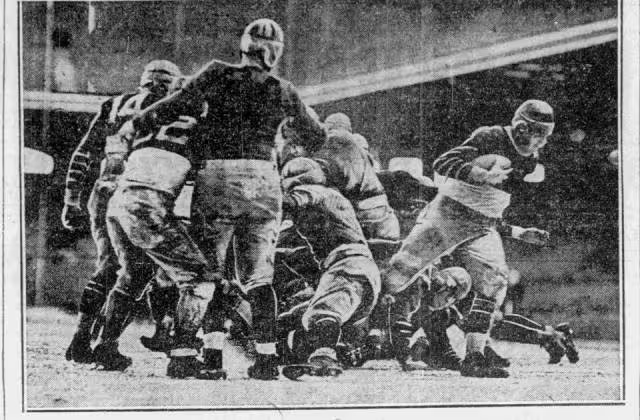
- September 5, 1906 – Traditionally, this has been recognized as the very first forward legal pass in a regular season game that was thrown, the first time in American football history, as St. Louis University’s quarterback, Bradbury Robinson, tosses a touchdown strike to Jack Schneider in a game in Waukesha, Wisconsin, as St. Louis U blanks the hometown Carroll College team, 22-0. Our friend Timothy Brown of FootballArchaeology.com may have found earlier instances that take the shine off Bradbury R.
It was monumental. Think about it this way, the rule to be able to legally throw a forward pass was just created in December of the year prior, but it had some catches to it to make it very difficult to do, because you had the traditional powers of the day, Yale with Walter Camp, you had Army, and you had all the other biggies powers, Princeton, Cornell, they really wanted to run the ball. They wanted to play football the way they played football for the last three decades.
It was people like John Heisman and others who really wanted to push passing in the game, but they couldn’t get the rule passed all the way through. So the rules were very restrictive when this young man from St. Louis University threw his first pass, Mr. Bradbury Robinson, because there were rules like this: if the pass was thrown and it went incomplete on first or second down, the offense would be penalized 15 yards from where the ball was thrown. Can you imagine the risk associated with throwing a pass like that on first or second down? You throw the pass, it gets broken up, hits the ground, oh, 15-yard penalty from where the ball was thrown.
If he’s doing a traditional pass now, seven-step drop, you are maybe 8, 10 yards behind the line of scrimmage; you have a 25-yard deficit going to the next down. Another rule, mentioned in a recent SmithsonianMag.com article, states that in 1906, if the ball hit the ground untouched, the defense would be awarded possession. Yes, it would be worse than a fumble because there wouldn’t be a scramble for it.
A pass is thrown in the air; nobody touches it; the ball is turned over on downs to the defense. Unbelievable. Why would they make rules like that? Well, like I said, those traditional powers, they didn’t want passing the ball.
They felt that it would ruin the game. But after some modifications to those very hindering rules we just discussed, it turned out to be the most exciting game ever created. And it all started with that one first throw forward by Bradbury Robinson, September 5th, 1906.
- September 5, 1988 – At a game in the Canadian Football League, Hamilton player Earl Winfield returns a punt for a 101-yard score. Then he turns around a little bit later and returns a kickoff 100 yards in the same game. And that’s not all. He then later caught a 58-yard pass. Unbelievable by Mr. Winfield in that game.
- September 5, 2002 – Marked the first time that the NFL season started on a Thursday night when the 49ers defeated the New York Giants. There were pre-game concerts and festivities, all meant to bring the season into style and create great fanfare to start the season off right.
- September 5, 2012 – The “Replacement Officials” Debut (2012): On this day in 2012, the NFL kicked off its regular season with replacement officials on the field due to a referee lockout. This led to a chaotic three weeks of games before a deal was reached.
- September 5, 2026 – With no time remaining and down 12-7 to Western Michigan, the Michigan Wolverines were aided by the official’s review of adding one second to the clock after a desperation 47-yard pass by UM QB Bryce Underwood sailed out of the end zone. Underwood made the next play on the reprieve, finding J.J. Buchanon in a crowd for a 13-12 walk-off TD pass.
September 5 Football Hall of Fame Birthdays
Happy Birthday to these gridiron trailblazers! As we look at September 5, we celebrate four remarkable Hall of Fame careers that highlight clutch kicking, pre-Heisman prestige, an incredibly durable 18-year ironman, and a true pioneer of Southern football integration.
Here is the list in order of birth:
- Dave Campbell [1873]A dominant end for Harvard University at the turn of the 20th century, Campbell was a three-time consensus All-American from 1899 to 1901. He capped off his legendary collegiate career by captaining an undefeated 1901 Crimson squad and was rightfully enshrined in the College Football Hall of Fame in 1958.
- Harry Newman [1909]A star quarterback and halfback for Michigan, Newman led the Wolverines to an undefeated national title season in 1932 while claiming the Douglas Fairbanks Trophy as the nation’s top player. He went on to lead the NFL in passing yards and touchdowns as a rookie for the New York Giants before becoming a player-owner for the AFL’s Brooklyn/Rochester Tigers.
- Billy Kilmer [1939]An incredibly versatile athlete, Kilmer transitioned from an All-American single-wing halfback at UCLA into a gritty, 18-year NFL quarterback for the 49ers, Saints, and Redskins. Famously linked to Jim Marshall’s infamous 1964 “wrong-way” run after a 49ers fumble, the College Football Hall of Famer eventually led Washington to an appearance in Super Bowl VII.
- Jerry Levias [1946]A dynamic wide receiver out of SMU, Levias was a historic trailblazer who broke barriers as the first African American scholarship athlete in the Southwest Conference. The 2003 College Football Hall of Fame inductee overcame immense structural adversity to earn All-America honors before putting together a highly productive pro career in the AFL and NFL with the Houston Oilers and San Diego Chargers.
Conclusion
The milestones of September 5th illustrate just how much the gridiron relies on both strategic bravery and individual courage. The risky, game-altering pass thrown by Bradbury Robinson in 1906 opened the floodgates for modern offenses, while pioneers like Jerry Levias broke historic racial barriers to elevate the sport on and off the field. Combined with the unforgettable tales of icons like Billy Kilmer and Harry Newman, this date serves as a perfect reflection of football’s journey: a game that rewards risk-takers, honors trailblazers, and keeps fans endlessly captivated.