May 21 is a landmark date in football history, marked by Michigan State rejoining the Big Ten, Ricky Williams’ record runs, Johnny Majors’ versatility, and Glenn Ressler’s Maxwell Award. From changes in conference history to individual achievements, the day showcases pivotal moments that shaped the sport. Celebrate the legends and key decisions that influenced football from the trenches to the Heisman podium.
Uploaded and shared by Susan Natalie Freeman via Wikimedia Commons.
May 21 American Football History Timeline
- May 21, 1949 – On this day, the Michigan State Spartans rejoined the Big Nine Conference, turning it once again into the Big 10. This event marked a significant moment in college football history and set the stage for future developments in the conference.
The Newspapers.com Football History Headline of the day is from the Republican and Herald from Pottsville, Pennsylvania, when they printed off;
“Mich. State Returns to West Conference!”
This was in reference to the Spartans rejoining the Big Nine Conference to make it the Big 10 again. The Spartans were eligible to compete in their new Conference in every sport except football in the 1950-51 season. Football would have to wait until the 1953 season to have a standing in the Big 10 Conference because the gridiron schedules had already been finalized for the nine-member teams for the next three seasons in December 1948.
May 21 Football Hall of Fame Birthdays
Happy Birthday to these legendary figures! Since today is May 21, we celebrate an incredible lineup of versatile icons, historic award-winners, and record-shattering backs who earned their places in the College Football Hall of Fame.
Here is your list in order of birth:
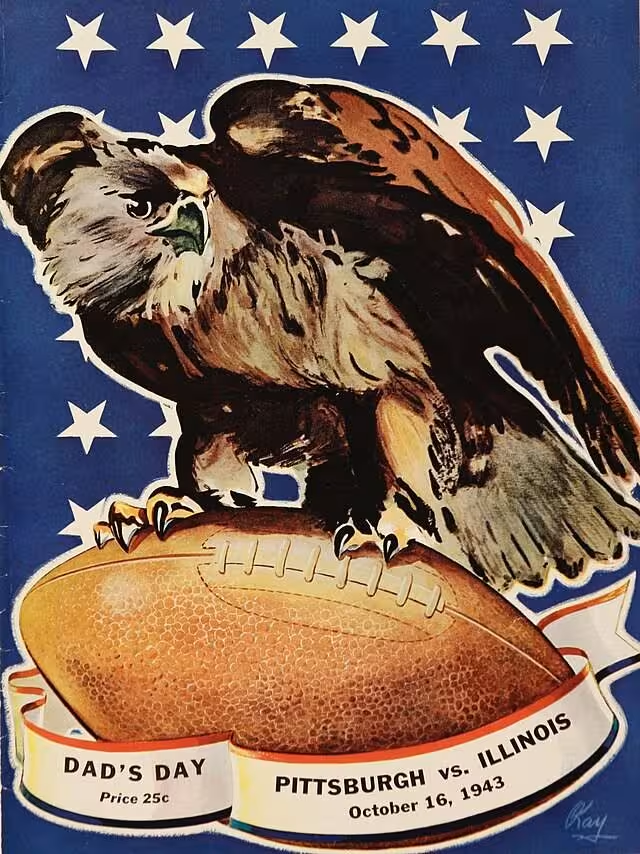
- Johnny Majors [1935] A true multi-threat single-wing halfback, Majors was a unanimous All-American and the 1956 Heisman Trophy runner-up after leading Tennessee to an undefeated regular season. He solidified his status as a gridiron icon by returning to coach his alma mater for 16 winning seasons after famously coaching the Pittsburgh Panthers to a national title in 1976.
- James Saxton Jr. [1940] Nicknamed “The Rabbit” for his blistering speed, Saxton became the first running back in Texas Longhorns history to earn All-America honors. The 1961 Heisman Trophy third-place finisher was renowned for his game-breaking long runs and famously iced the 1962 Cotton Bowl with a school-record 73-yard quick kick.
- Glenn Ressler [1943] A ferocious two-way lineman for Penn State, Ressler dominated as a center on offense and a middle guard on defense, winning the Maxwell Award in 1964 as the nation’s top player. His defining collegiate moment came in 1963 when he racked up 15 unassisted tackles to spark a 26-0 upset over top-ranked Ohio State.
- Johnny Roland [1943] Displaying elite versatility at Missouri, Roland ranked among the nation’s top offensive weapons as a sophomore running back before successfully transitioning to an All-American defensive back by his senior year. After having his No. 23 jersey retired by the Tigers, he enjoyed an eight-year NFL career and a lengthy tenure as a respected pro and college assistant coach.
- Jim Ritcher [1958] A dominant force for NC State, Ritcher made college football history in 1979 by becoming the very first center to win the prestigious Outland Trophy as the nation’s best interior lineman. The two-time All-American went on to enjoy a remarkably durable 16-year NFL career, anchoring the offensive line for the Buffalo Bills during their four consecutive Super Bowl appearances.
- Ricky Williams [1977] One of the most devastating power backs in college football history, Williams swept the Maxwell, Walter Camp, and Heisman Trophy awards in 1998 after shattering the NCAA career rushing record with 6,279 yards. He parlayed his legendary Texas career into an 11-season NFL tenure, highlighted by an All-Pro rushing title with the Miami Dolphins in 2002.
Conclusion
The legacy of May 21 spans generations of elite talent and pivotal institutional shifts. We see a direct line from the “Rabbit-like” speed of James Saxton Jr. and the two-way dominance of Johnny Roland to the modern-era greatness of Ricky Williams. These figures, alongside trench warriors like Jim Ritcher and Glenn Ressler, remind us that football is won through a blend of individual spark and structural stability. As Michigan State’s 1949 return to the Big Ten proved, the right move—much like the right athlete—can define a conference for decades to come.