Influences on Camp’s Transformation of a Game
As discussed in the last episode of PigskinDispatch.com’s blog series on football history, “A New Authoritative Organizational Body and Leader for Football”, Walter Chauncey Camp entered the football scene as a great player and winning leader of Yale.
The allure of the McGill-Harvard match-up in May 1874 had a profound influence on Camp, even though there appears to be no direct evidence linking him to these games. Nevertheless, Camp promoted rule changes in the IFA to introduce certain characteristics observed in that two-game series into games under IFA rules. The first was that the number of players per side would be reduced from 15 to 11 (remember, McGill only had 11 available to play Harvard in 1874). A second development, proposed by Camp and the rules committee in 1882, was to institute a system of downs. The original rules on downs allowed an offense three attempts to advance the ball five yards; in 1906, the distance was changed to ten yards. The fourth down was added in 1912.
Walter Camp also introduced a standard-sized playing field to the game in his early years on the IFA rules committee. All fields were to be 110 yards long under the new rules; previously, the yardage varied for almost every event. In 1888, Camp’s recommendation made it legal to tackle below the waist. The IFA was disbanded in 1894 and replaced by an unnamed rules committee headed by Walter Camp and other representatives of the predominant Eastern schools.
Brutality Threatens to Outlaw the Game
The game of that time was very rough and brutal. In the 1890s, many schools banned the game on their campuses. There had been 18 deaths and another 180 players who had suffered very serious injuries due to the “brutal mass plays” that were common under the rules. The game was in jeopardy of being killed off by concerned citizens and college presidents. Their concern was real, as statistics at the time showed that football was among the most dangerous recreational activities.
President Teddy Roosevelt became involved in the campaign to help preserve football. The POTUS knew that the game needed safety reform and a champion to make it happen. In 1905, before the game disappeared, the country’s Commander-in-Chief called for reform of the rules. Again, Walter Camp was the man who stepped up to save the day.
Football is saved for Future Generations.
The 1904 discussion on the early history of football shows that the gridiron game in its infancy was much more brutal than it is today. Even the ancient games of competitive athletic predecessors that laid the groundwork for the rules of football had severe rough aspects that had been connected to serious injury or even death of players.
The new wave of the game, developed in the United States in the late 1800’s, was extremely “rough and tumble.” If you remember, in an earlier edition of this series, it was noted that the game became so brutal that it was being banned across the country by many institutions of higher learning. Yes, it came to the point where the game needed to change, and it also needed someone to save it.
The Federal Government Intervenes in Football
The offensive formation of choice in the early 1900’s was the “Flying Wedge.” The Flying Wedge formation was a mass grouping of offensive players in which teammates were linked together in a high-speed, collective-momentum play. The blockers would actually grasp a teammate to form a nearly impenetrable wall around the ball carrier. This great human wall would move down the field in unison towards an opponent’s goal line, and it was difficult to defend against. Many players even wore specialized Flying Wedge belts with handles, so teammates could simply grasp their neighbor’s handle and create a chain-link fence of flesh.
The Flying Wedge led defenses to mass-tackle the wedge blockers, and, basically, it turned into a giant pile of humanity where very serious injuries occurred with regularity. Can you imagine having 21 other human beings piled on top of you? It also turned scrimmage play into all-out street brawls as defenders tried to break through the strong-armed linked protection. Remember that players at this time wore virtually no protective equipment. All body parts were subject to brutal exposure. The serious injury potential needed to be avoided to save this fine game, as it was quickly being banned across the country, leading to a wave of public scrutiny.
In 1904, football was facing growing criticism after that season, when 18 young men died, and 149 were injured. Previous attempts to change the rules to make the game less violent had gone nowhere. President Theodore Roosevelt was a football fan who believed that, with appropriate rule changes, the game could be preserved. On October 9, 1905, he summoned representatives from Harvard, Yale, and Princeton to the White House. The topic of discussion was making football less dangerous and, ultimately, saving the sport, which the public was denouncing as being brutal and inappropriate for young men.
POTUS Takes Action to Save Football from Itself
Roosevelt summoned college athletics leaders to Washington, D.C. for two such conferences at the White House to encourage safety reform. In early December 1905, Chancellor Henry M. MacCracken of New York University convened a meeting of 13 college leaders to initiate changes in football playing rules. At a subsequent meeting on December 28 in New York City, the Intercollegiate Athletic Association of the United States (IAAUS) was founded by 62 members.
A Deep Dive into 1905 Football History and Highlights
- October 9, 1905 – President Theodore Roosevelt summoned representatives from Harvard, Yale, and Princeton to the White House to discuss ways to tame the game of football to prevent public outcry.
- November 30, 1905 – The Thanksgiving Day game and undefeated Michigan Wolverines team, who had not been scored upon all season, faced the Chicago Maroons. After a defensive battle, the Maroons scored late on a safety to win 2-0, breaking Michigan’s 56-game winning streak.
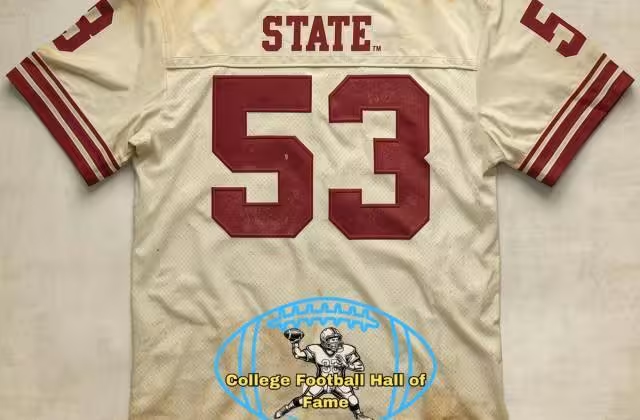
- November 30, 1905 – This answers the question: When did American football teams first start wearing numbers on jerseys? Football Archaeology finds that the Thanksgiving Day game in 1905 between Drake and Iowa State may be the first time that American football players wore numbers on their jerseys.
- December 1905 – Chancellor Henry M. MacCracken of New York University convened a meeting of 13 college leaders to initiate changes in football playing rules.
- December 2, 1905 – The Army-Navy game ended in a 6-6 tie on a muddy Franklin Field in Philadelphia.
- December 24, 1905 – A large group representing twenty-eight colleges met at the request of Chancellor Henry M. McCracken in New York City. People such as H. L. Williams, the Director of Athletics at Minnesota, and F. H. Curtiss from Texas traveled great distances to attend this historic meeting! This December meeting did little on the subject of actual rule changes, but it was a great success in organizing the world of football. This conference of colleges soon assumed the name of the National Intercollegiate Football Conference, but later changed its name to the Intercollegiate Athletic Association of the United States.
- December 28, 1905 – In New York City, the Intercollegiate Athletic Association of the United States (IAAUS) was officially founded by 62 members.