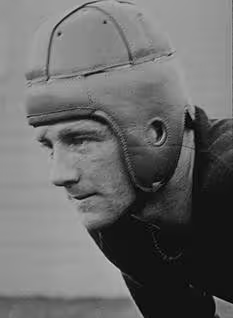
How does a 162-pound fullback become the defensive nightmare that secured Notre Dame’s first national title? Elmer Layden may have been the heaviest of the legendary “Four Horsemen,” but his “straight-line dive” and lightning-fast instincts made him a giant on the gridiron. While the world focused on the Irish offense, it was Layden’s two massive pick-sixes in the 1925 Rose Bowl that broke the back of Stanford and cemented Knute Rockne’s 1924 squad as one of the greatest of all time. From the backfield to the NFL Commissioner’s office, this is the story of the man who turned defense into a championship art form.
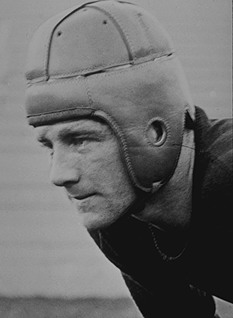
Football Bio
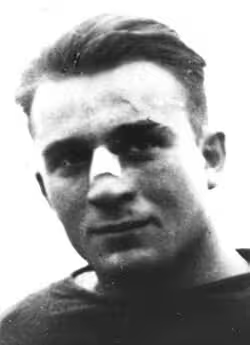
May 4, 1903 – Davenport, Iowa – The famous Notre Dame fullback of 1922 to 1924, Elmer Layden, was born.
The National Football Foundation has a really good bio on Layden that says that he was one of the famed Fighting Irish Four Horsemen. He was the heaviest of the four at 162 pounds, yet he was nicknamed “thin man.” New Year’s Day, 1925, at the Rose Bowl, and the final curtain call for Notre Dame’s famed Four Horsemen. Their opponent was the Stanford Cardinal team, which had prepared for the Irish offensive firepower, which had been headline news across the nation. Instead, it was the defensive prowess of Elmer Layden that buried Stanford.
The Los Angeles Times had an article the next day that stated: “BREAKS DECIDE ROSE BOWL FRAY, Cards outscore Notre Dame in all but points.” The article says that the Stanford defense prevented the Irish from even registering a first down in the second half! Layden scored first on a three-yard run before turning a pair of pick-sixes of 78 and 60 yards!
Knute Rockne could afford to play a bit more conservatively in the back half of the game when your defense is churning out points like that with splash plays. Elmer had tallied three of four Irish touchdowns to provide a final triumph in a perfect 10-game season, which brought Notre Dame its first undisputed national championship.
Layden’s unique running style at fullback was equally uncanny. “He developed a straight-line dive that made him one of the most unusual fullbacks in football”, stated coach Knute Rockne. The Irish posted a combined record of 27-2-1 during Layden’s varsity career. Elmer Layden’s collegiate football records are celebrated in the College Football Hall of Fame after his induction in 1951.
The prolific player later became the head coach at Duquesne and then served as Irish coach from 1934 to 1940, compiling a record of 47-13-3 before leaving to become Commissioner of the National Football League for six seasons.
Conclusion
Elmer Layden’s performance in the 1925 Rose Bowl remains one of the most statistically significant individual outings in postseason history. By scoring through the air and on the ground, he personified the versatility that Knute Rockne demanded of his players. Layden didn’t just play for Notre Dame; he helped define the program’s identity as a national power. His transition into coaching and his eventual tenure as NFL Commissioner only further highlight his brilliance and leadership within the sport. Inducted into the College Football Hall of Fame in 1951, Layden stands as a cornerstone of the Notre Dame legend.
Accolades and Football Accomplishments
- College Football Hall of Fame: Inducted in 1951.
- National Champion: 1924 (Notre Dame’s first undisputed title).
- Consensus First-Team All-American: 1924.
- Rose Bowl MVP (unofficial): Scored three touchdowns, including two interceptions of 78 and 60 yards.
- Member of the “Four Horsemen”: One of the most famous backfields in sports history.
- NFL Commissioner: Served from 1941 to 1946.
- Notre Dame Head Coach: Compiled a 47-13-3 record (1934–1940).
- Varsity Record: Played on teams that went a combined 27-2-1.
- Duquesne Head Coach: Led the Dukes to a victory in the 1934 Festival of Palms Bowl (precursor to the Orange Bowl).