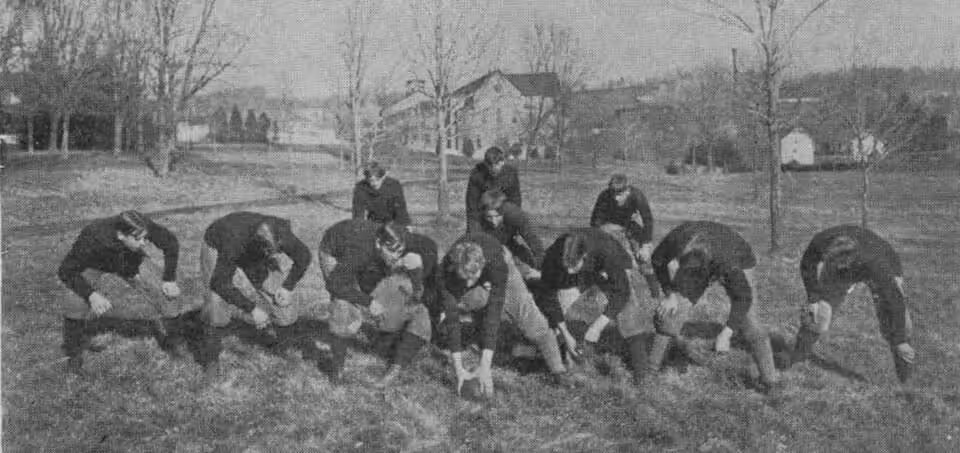
Football in the late 1890’s was in a fairly stable period for the fledgling sport, relatively speaking. It was only a few years prior that the sport came close to its demise, as the collegiate game split into factions over rules. Our last discussion showed how the powers of football came together to arbitrate a compromise, saving the game from uncertain peril.
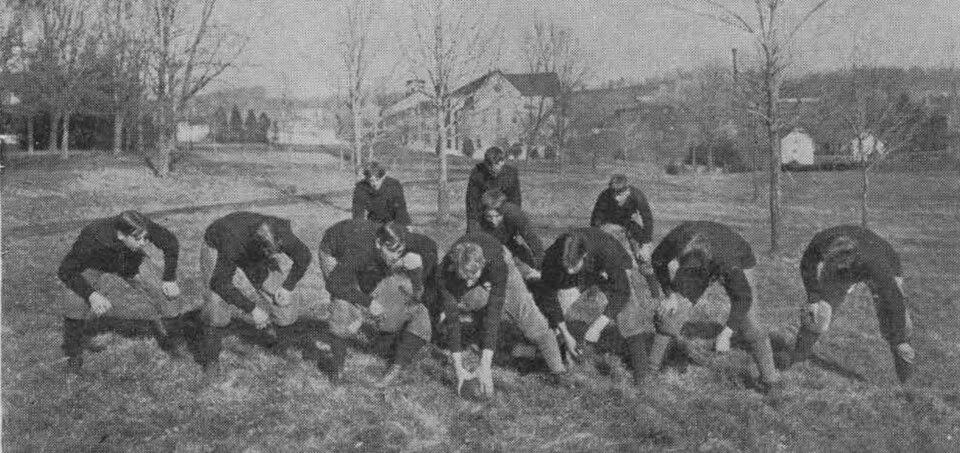
In the next few years, the game could once again experience innovation-driven growth, as football minds focus on strategy rather than the turmoil of football politics.
The football takes shape (literally the ball)
At this time, the ball started to change shape for the first time. The round ball of rugby was falling out of favor in American sports. A prolate spheroid-shaped ball took its place. There were no fixed measurements for the new shape yet. The circumference was only a few inches shorter than the distance around its ends. This design was to enhance the kicking part of the game.
Readers should remember that the forward pass was some years off, so being able to place one hand on the ball to throw was not a consideration for the ball’s designers.
Games lasted 70 minutes (two 35-minute halves). Teams had only three downs to gain 5 yards or lose 20 yards. Tackles were allowed above the knees.
Penalty enforcement evolves
The Rules Committee of football convened on 7 March 1898 and introduced several significant changes to the sport’s rules. One note put a little bit of bite into an official call for players who were a tad too aggressive. A new rule stating that a 15-yard penalty could be imposed on a team that had a player pile on after the Referee signaled the ball was dead was applauded by most players and coaches. This was a great deterrent in preventing the dangerous situation.
Fifteen yards would also be the penalty enforcement for a player throwing down or hitting someone who caught and “heeled” a fair catch. The offended team could also employ a free kick after such a violation and walk off the yardage, or start a play from scrimmage.
In conjunction with the above, a penalty of ten yards would be imposed for the acts of off-sides, holding, unfair use of the hands and arms, and tripping. Likewise, delay-of-game fouls would result in a five-yard penalty against the opposing team.
Stagg Huddles Up Innovations
An old football adage claims all great things in early football come from Yale. Names like Walter Camp, Pudge Hefflinger, George Woodruff, and, of course, Amos Alonzo Stagg, support this idea.
Yes, this is the same Alonzo Stagg who played for Walter Camp’s undefeated Yale team of 1888. He might be better remembered for his coaching career. He coached college teams almost every year from 1892 till 1959. At the age of 98, he retired only due to his wife’s illness. Stagg is not only remembered for his longevity in the game but also for his innovation.
Coach Stagg introduced a staple of football during the 1898 season. This was his first coaching post at the University of Chicago, where he served for 41 years. Chicago hosted the University of Michigan for the last game of the season on Thanksgiving Day, in a rare indoor game at the Chicago Coliseum. Stagg knew that the crowd noise, being indoors, would affect his team’s communication.
Signals for play calling were only recited at the line of scrimmage in those days by the quarterback. Stagg had earlier experiences with playing indoors in 1890 and 1891 at New York’s Madison Square Garden. Before this 1898 game, Stagg instructed his Chicago squad to huddle up before each offensive play to receive the signals. This is the first known instance of a huddle being used for play calling. It would take many more years before teams regularly used huddles during outdoor games, as open-air crowds had to grow large enough to disrupt communication. Another great Stagg innovation was the onside kick. The rule required that the ball must travel at least 10 yards during a kickoff before the kicking team could recover. This was added to the rule book in the early 1890’s. Stagg instructed his kicker to lay the ball on its side, rather than have a teammate hold it with the point touching the ground. This would make the ball travel a shorter distance in an unpredictable pattern, giving the kicking team more time to recover.
Stagg was also the creator of another kicking innovation at this time. He employed the first direct snap to the punter from the center during a game in 1896. Stagg’s punter, Clarence Herschberger, also created something new. He launched punts that spiraled. This often gave his kicks outstanding distance over other punting styles of the time.
A Deep Dive into 1898 Football History and Highlights
- March 7, 1898 – The Football Rules Committee made a couple of tweaks to the rulebook. The 15-yard penalty for piling on was added, and the beginnings of protection for punt returners.
- Summer 1898 – The Morgan Athletic Club was founded in Chicago. The MAC was a team that would eventually become the Chicago Cardinals and, later, the Arizona Cardinals, and was formed, making it the oldest continuous operation in pro football.
- Fall 1898 – University of Chicago star Clarence Herschberger is credited with introducing the first spiral punt in American football.
- October 12, 1898 – Michigan defeated Michigan Agricultural College (Michigan State University) 39–0, marking the start of the long rivalry between the Michigan schools.
- November 24, 1898 – The Michigan Wolverines finished 10-0, winning their first Western Conference championship by defeating Chicago 12–11 at Marshall Field in Chicago, a game that inspired their fight song, “The Victors.”
Conclusion
The 1899 edition of this series will continue exploring football history here on PigskinDispatch.com, providing more insights into the game’s development.
We are able to provide this in-depth look into history from so long ago through careful research. Using someone who was contemporary to the period is the best source. So, a very special shout-out to our main source of reference for this article: Parke H. Davis, in his 1911 book, Football-The American Intercollegiate Game.