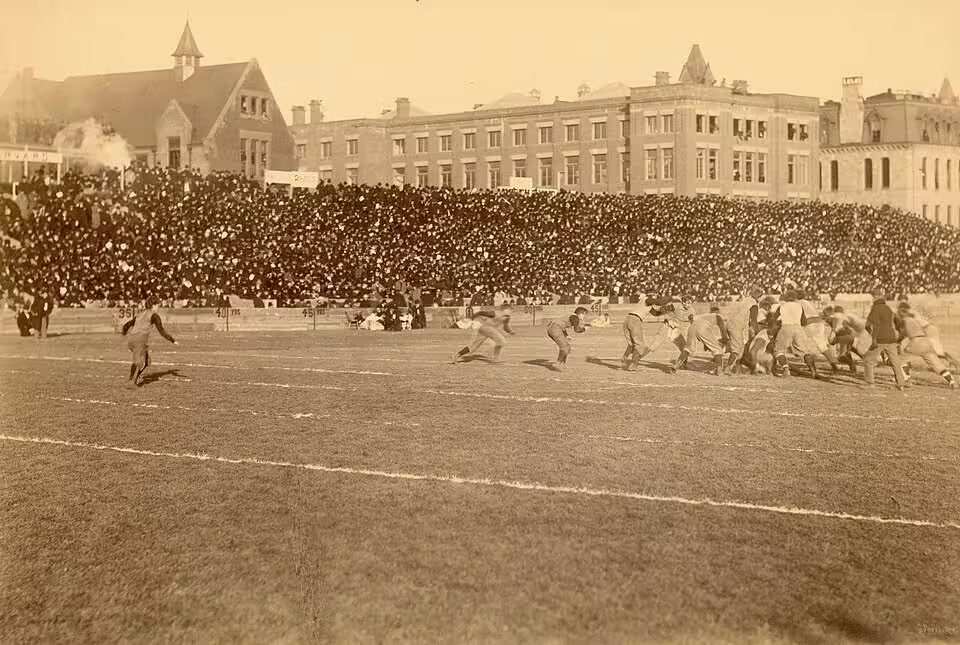
When we last left the history lesson on football in this series, at the conclusion of 1892, we learned that the “Flying Wedge” formation was becoming a dominant strategy for many teams. This Wedge formation was seen as an illness of the game, and many had in mind stopping its use in the early 1890s, and quickly.
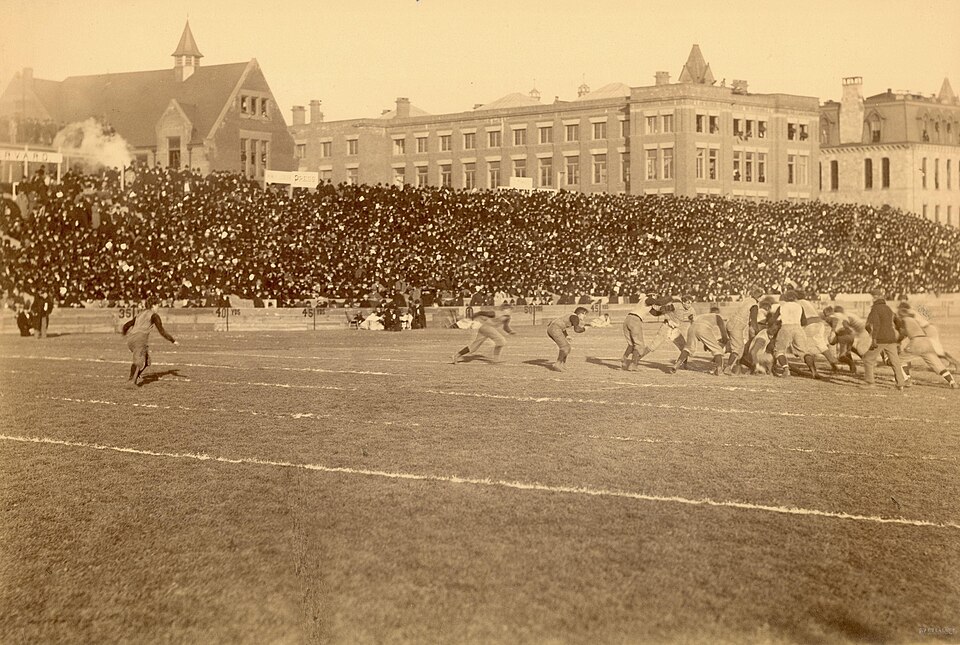
1893 brings more strategic milestones
The advent of new strategies was really gathering steam in early 1893, and it all started with the new coach of Yale. George W. Woodruff had recently become the coach of Yale after leaving rival Pennsylvania. Woodruff, with his new team, revolutionized basic football concepts, leaving rival teams scratching their heads as they came up with new ways to counter them.
Offensively, Woodruff had his Yale forwards (now called linemen) much closer together in their initial lineups. He also taught these players to penetrate the line and push defensive rushers towards the sidelines, rather than towards a central “pocket,” as was the strategy of most blockers of that time. This concept became known as the “mass momentum “plays.
Woodruff instituted other radical ideas for this era, such as picking up a fumble to attempt a long scoring return rather than following the old routine of diving on the ball that opponents practiced. He also created the quarterback-kick, which preceded the onside-kick.
The single most important principle he started, though, was what was known at the time as “flying interference.” This is the concept of defenders moving en masse before the snap to gain an advantage over the offensive blockers, who, even on that day, had to remain pretty much stationary prior to the snap. The bold innovation caused confusion and anxiety among the offensive players and proved to be a very effective strategy that most teams soon adopted.
A Deep Dive into [Year] Football History and Highlights
Here are the highlights of events for the year 1893 in American football history:
- January 1893 – Yale proposed a rule change to restrict player eligibility to undergraduates pursuing a degree at the school.
- August 27, 1893 – The West Point Cadets traveled to the Windy City to play the Chicago Athletic Club in one of the first games under electric lights at the Chicago World’s Fair in the Agricultural building. The exhibition featured some early stars for Chicago AC, such as Pudge Heffelfinger. Football Archaeology.com has a great write-up on the game.
- September 30, 1893 – Philip King of Princeton introduced a new scheme against Lafayette, which was used by most teams from the mid-1890’s until well into the twentieth century. The idea was to line up an end and a back directly behind an offensive tackle.
- November 25, 1893 – Harvard surprised Yale in their annual rivalry game by wearing smooth leather one-piece suits that made them slippery and harder to tackle. This prompted changes to the rules on uniforms.
- November 25, 1893 – Harvard’s legendary Coach Lorin F. Deland unleashed his new “Push-Play,” in which a runner would be lifted by teammates and thrown over the rush line.
- December 2, 1893: Many claim the leather helmet first appeared in football on this date. Admiral Joseph Mason Reeve, fearing “instant insanity” from another head injury, commissioned an Annapolis shoemaker to fashion a protective moleskin hat with earflaps. Reeve wore this first version during the annual Army-Navy game.
DeLand of Harvard had a few things for Yale.
Harvard had a football genius of its own, Lorin F. DeLand, who masterminded innovations to the game. First, DeLand faced Harvard, its surprise rival, on November 25, 1893. The entire Harvard squad wore smooth leather one-piece suits. These suits made them slippery and harder to tackle. This was not a new concept. Years earlier, an unnamed football strategist caused rule changes by entering a championship game as a halfback who greased his body from the shoulders down. This prompted a rule change: “No sticky or greasy substance shall be used on the persons or clothing of the players.” DeLand did not violate this rule, since his players simply wore slippery, smooth leather to achieve the same advantage as the illegal grease.
DeLand pulled out another gem for Yale in this game, called the “turtle-back” play. The eleven offensive players formed a solid oval, concentrated against one point of the defensive rush line, usually a tackle, before the ball became live. From the air, it looked almost like a human spiral. When the ball was snapped, the oval would unwind toward a sideline. Inside the oval, the ball carrier was protected by blockers ahead of him in the unwinding human hurricane.
Another play Harvard ran in this game was the “push-play.” The formation began much like the turtle-back, but instead of simply pushing forward, the runner’s teammates would lift him and toss him over the wall of blockers and rushers.
Woodruff has something up his sleeve for Harvard to
The crafty Yale coach would not be outdone on the scheming front. He had a few tricks up his sleeve against Harvard. First, he varied his mass-momentum offense. All his line, except the center and guards, withdrew 15 yards behind the ball. The retracted linemen and backs formed a wedge that moved forward before the snap. The wedge focused on one point of the line and was very effective for poking a hole in the defense.
The most important new strategic innovation that was introduced to the game in 1893 was that of Philip King of Princeton. King was a player for Princeton in 1893, and his idea was used by most teams from the mid-1890’s until well into the twentieth century. The idea was to line up an end and a back directly behind an offensive tackle.
A few weeks later, Harvard tweaked the tandem tackle in their game. The tackle lined up a few yards off the line before the snap. The next season and beyond, the tandem–tackle formation became the choice for most teams on most plays.
The new concepts also present some drawbacks. Unfortunately, we have run out of time in this edition of football history, so please come back and join us when the season of 1894 appears on the pages of PigskinDispatch.com to continue the story.
We are able to provide this in-depth look into history from so long ago through careful research. Using someone who was contemporary to the period is the best source. So, a very special shout-out to our main source of reference for this article: Parke H. Davis, in his 1911 book, Football-The American Intercollegiate Game.