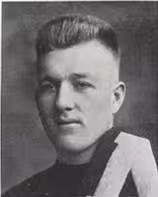
In an era where the forward pass was still an experimental mystery, Clarence Swanson was a visionary. Long before the air-raid offenses of the modern age, Swanson proved that the passing game could be a lethal weapon of mass destruction. By hauling in three touchdowns in a single game in 1921—a record that would stand untouched for half a century—he didn’t just play for the Cornhuskers; he revolutionized their entire offensive identity. Discover the story of the Hall of Fame end who went toe-to-toe with Knute Rockne’s Notre Dame and set a standard of excellence that lasted 50 years.

Football Bio
March 15, 1898, Wakefield, Nebraska, Clarence Swanson, the fantastic end from the University of Nebraska, arrived in the world. Swanson’s story was at its height in the 1921 season when Nebraska entered a game against Colorado State with a record of six and one, according to the NFF.
Clarence had an unbelievable performance, setting a school record by catching three touchdown passes in that game. This record stood for 50 years before the all-American and great Heisman trophy winner, Johnny Rogers, matched it in 1971 in a game against Minnesota. Think about that 1921 to catch three touchdown passes.
Now that’s just phenomenal, because in college football, the forward pass came on strong 15 years earlier. That’s when it became legalized. It wasn’t even coming on strong then.
People were still trying to figure it out. You know, we just had the great author of Amos Alonzo Stagg, Jennifer Taylor Hall, coming on. And she tells a tale that in 1910, Stagg was working on some formations and stuff for the forward pass.
So the forward passes, you know, only a decade old, uh, and it’s still in its infancy in 1921 and, you know, Clarence Swanson catching three touchdown passes in one game. Very remarkable. No wonder it lasted for 50 years.
Anyway, the Huskers demolished the CSU squad 70 to seven on that day, powered by Swanson’s performance. Swanson was an all-American in 1921, and the only team to beat the Cornhuskers was that powerful fighting Irish of Notre Dame, as they narrowly overcame Nebraska seven to nothing. I mean, think about 1921, Newt Rockne is a head coach at Notre Dame.
So that tells you what a powerhouse they were. The National Football Foundation inducted Clarence Swanson into the College Football Hall of Fame in 1973.
Conclusion
Clarence Swanson’s 1921 performance remains one of the most statistically significant feats in the history of the University of Nebraska. In a time when the “aerial attack” was often considered a desperate gamble, Swanson’s ability to find the end zone three times in one afternoon was nothing short of miraculous. His record survived the transition from the leather helmet era to the modern age, only being equaled by the legendary Johnny Rodgers. By mastering the pass in its infancy, Swanson secured his legacy as a pioneer of the “Open Game” and a true titan of the Nebraska gridiron.
Accolades and Football Accomplishments
- College Football Hall of Fame: Inducted in 1973.
- Nebraska School Record: Caught 3 touchdown passes in a single game (Held solo record from 1921–1971).
- First-Team All-American: Selected by Football World in 1921.
- Captain of the Cornhuskers: Led the 1921 Nebraska team to a 7–1 record.
- Defensive Prowess: Part of a unit that held Knute Rockne’s Notre Dame to just 7 points in 1921.
- Nebraska Football Hall of Fame: Charter member, inducted in 1971.
- Longevity Record: His single-game receiving TD record stood for 50 years until matched by Heisman winner Johnny Rodgers.