From the very first “Basket Football” game to the high-tech introduction of instant replay, March 11th is a date when sports boundaries were broken. Imagine a world where football legend Amos Alonzo Stagg was scoring buckets in the first-ever public basketball game, or where the fearsome Bronko Nagurski was reclaiming world wrestling titles in his “offseason.” Whether it’s the birth of Hall of Fame trailblazers like Ellery Huntington Jr. and Rex Mirich or the NFL’s first experimental steps into the world of video review, this day in history proves that the spirit of the gridiron has always extended far beyond the sidelines.
March 11 American Football History Timeline

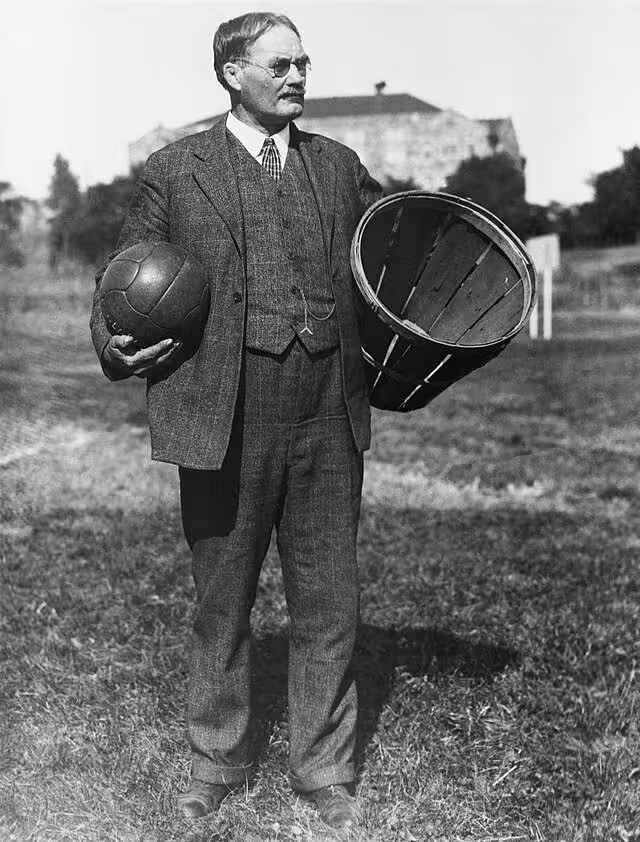
- On March 11, 1892, the first public basketball game was played between the students and the faculty of Springfield College in Massachusetts. Basketball’s inventor, James Naismith, taught at the school, and on the staff was Amos Alonzo Stagg. The headline from the local newspaper, displayed on the forums.realgm.com the next day, reads “Basket Football Game.” The article says over 200 fans watched the contest, in which the students prevailed 5-1. That one bucket by the faculty was made by our football hero, Coach Stagg.
- March 11, 1941, Bronko Nagurski defeated Ray Steele in Minnesota to become the National Wrestling Champion. Steele stripped Nagurski of the Wrestling Title on March 7, 1940, so in this victory, Bronko took the belt back from Steele per the Legacyofwrestling.com. We have learned much about Bronko as a football player from his birthday post on our November 3 blog, but many don’t realize that he was quite successful at wrestling as well. According to the National Wrestling Hall of Fame’s website, Nagurski, as a member of the Chicago Bears in the late 1930’s, approached six-time World Champion Wrestler Lou Thesz about grappling in the football offseason. Bronko attracted large crowds and even gained the World NWA Title on several occasions in the years before World War II. Bronko Nagurski was inducted into the National Wrestling Hall of Fame in 2009, adding to his enshrinements in the College and Pro Football Halls of Fame.
- March 11, 1986, the NFL adopted the instant replay rule, according to an article on Soundandvision.com. The adoption was by no means what we are used to today, as it was experimental and very limited. That first season, there were only 374 total plays, an average of 1.6 per game, with only 10% overturned from what was called on the field. This version was dropped by an owner’s vote in 1992, when a majority of 17 teams opposed continuing the practice. The debate over instant replay continued, and a new system was approved for testing in 1996. In 1999, NFL owners voted 28-3 to reinstate instant replay using the new and improved system, which included coaches’ challenges. The article goes on to say that the NFL’s earliest experiments with instant replay date back to 1976, which led to tests being conducted on a wider scale in 1978, starting with the Hall of Fame game between the Philadelphia Eagles and Miami Dolphins.
March 11 Football Hall of Fame Birthdays
Here are the gridiron legends born on March 11, listed in order of birth:
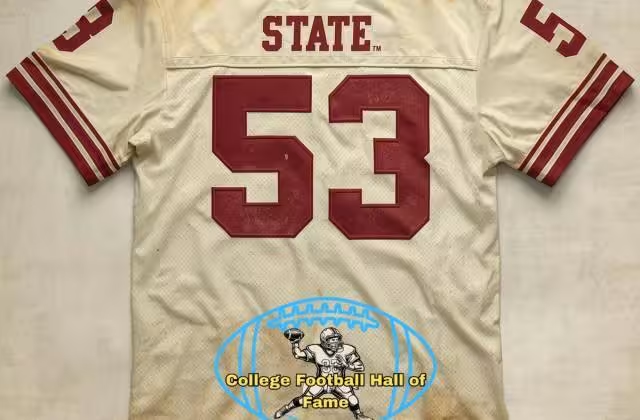
- Ellery Huntington Jr. (1893) As Colgate’s first All-American, Huntington was a tenacious quarterback known for his elusive playing style and a legendary 85-yard kick return against Syracuse. A veteran of both World Wars, he later served as head coach for his alma mater and authored “50 Years of College Football” in 1940.
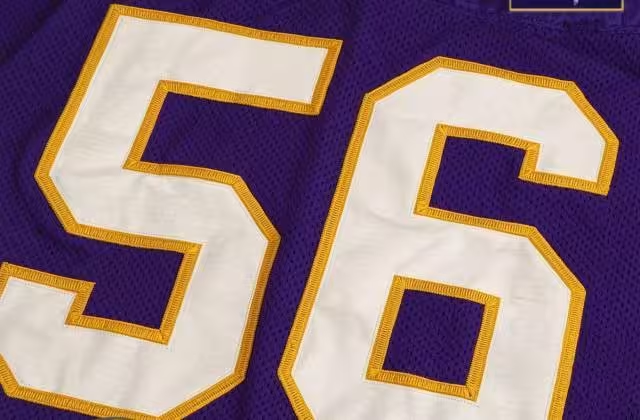
- Rex Mirich (1941) A standout two-way lineman for Northern Arizona, Mirich earned back-to-back All-American honors while anchoring a defense that once held opponents to just 109 yards per game. He enjoyed a seven-season professional career in the AFL and NFL, suited up for the Raiders, Broncos, and Patriots.
Conclusion
March 11th serves as a powerful reminder of how interconnected the world of sports truly is. The day highlights the incredible versatility of athletes like Nagurski and Stagg, who dominated multiple arenas, and marks the birth of the NFL’s modern era through the adoption of instant replay. These milestones—ranging from the dusty courts of Springfield to the defensive trenches of the AFL—showcase the evolution of strategy, technology, and pure physical grit. As we look back on these diverse legacies, we see the foundation of the multifaceted sporting world we enjoy today.
Want more Daily History of the Gridiron? Checkout our March 10 feature page.
Thankyou to all of our sources, including Pro-Football-Reference.com and Newspapers.com.