🏈 The Date Where NFL Destiny Was Forged
Imagine a single calendar date that birthed a Hall of Fame-heavy draft class, a Super Bowl decided by a kicker’s toe, and two of the most agonizing “what-if” moments in sports history. January 17th is a day of extremes on the gridiron—a day where the Baltimore Colts found redemption, the Cleveland Browns met heartbreak at the three-yard line, and the Minnesota Vikings saw a “perfect” season vanish in the Minneapolis air. From the business of revenue sharing to the drama of the “Manster’s” draft era, this is the date when NFL history wasn’t just played; it was forged in the fire of competition.
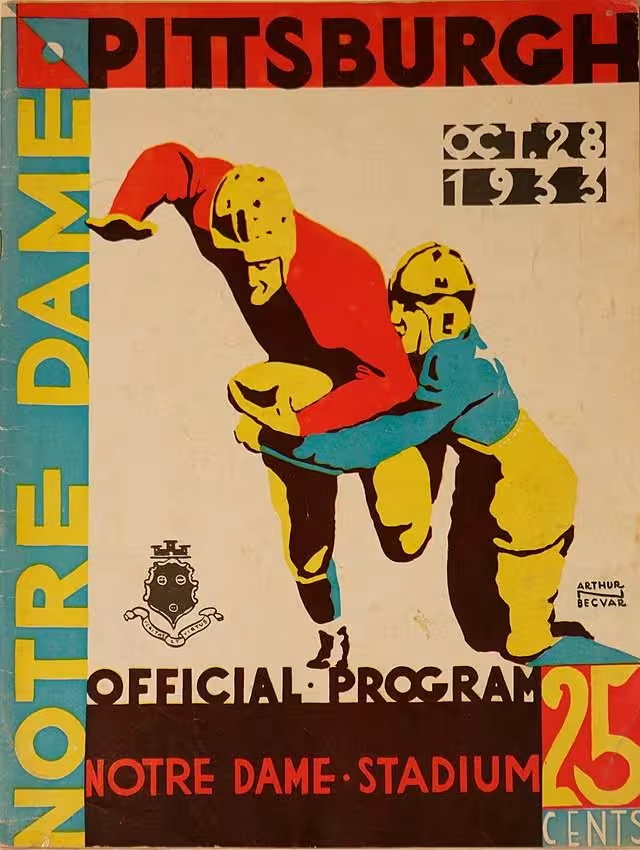
January 17 Football Image of the Day

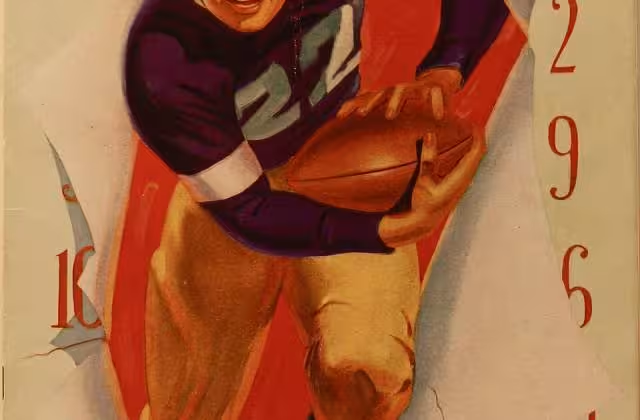
University of Notre Dame, Arthur Becvar illustrated the cover
January 17 American Football History Timeline
- January 17, 1952 – The 1952 NFL Draft took place. The top pick was Bill Wade from Vanderbilt University. The Pro-Football-Reference.com site says that after the Los Angeles Rams drafted Wade with the first pick, two future Hall of Famers were taken next. At number two, the Dallas Texans took linebacker Les Richter. The Chicago Cardinals then selected receiver Ollie Matson with the third overall pick. Other eventual Hall of Famers in this draft were Hugh McElhenny, who went to the 49ers at number 9, and Frank Gifford, who joined the Giants at 11. Gino Marchetti, Bobby Dillon, and Yale Lary were also selected and later earned bronze busts in Canton.
- January 17, 1954 – Los Angeles Memorial Coliseum – The NFL Eastern Conference doubled up the Western Conference, 20-9, in the 4th NFL Pro Bowl. The game’s MVP was Chuck Bednarik, a linebacker for the Philadelphia Eagles.
- January 17, 1960, also brought the 10th NFL Pro Bowl to the Los Angeles Memorial Coliseum. In this game, the Western Conference pulled away from the Eastern Conference for a 38-21 victory. Baltimore Colts defensive lineman Eugene Lipscomb and quarterback Johnny Unitas earned MVP honors for their standout performances.
- January 17, 1970 – In Houston’s Astrodome, the 9th and final AFL All-Star Game saw the Western Division defeat the Eastern Division 26-3, with Los Angeles Charger quarterback John Hadl receiving MVP honors.
- On January 17, 1971, at the Miami Orange Bowl in Florida, Super Bowl V delivered a dramatic finish. The Baltimore Colts and Dallas Cowboys, the top teams in the league, competed for the Lombardi Trophy. With the game tied at 13 late in the fourth quarter and starting quarterback Johnny Unitas sidelined, Colts backup Earl Morall led a late drive deep into Dallas territory. Kicker Jim O’Brien entered the field and, with five seconds remaining, secured victory for the Colts, 16-13. Notably, Chuck Howley, linebacker for the losing Cowboys, earned the MVP award—the only time this has occurred in Super Bowl history. (source)
- January 17, 1977 – At the Seattle Kingdome, the NFL Pro Bowl ended with Steelers corner Mel Blount earning MVP as the AFC beat the NFC, 24-14.
- On January 17, 1988, at Mile High Stadium in Denver, the AFC Championship game featured the Cleveland Browns facing the Denver Broncos. Trailing by five points in the final minutes, the Browns mounted a methodical final drive. However, running back Earnest Byner lost possession at the Denver 3-yard line, resulting in a Broncos recovery with just over a minute remaining.
The Denver Broncos held on to beat the Cleveland Browns, 38-33, in a game defined by “The Fumble.” This moment became one of the most devastating and memorable in NFL playoff history, shaping both franchises’ legacies.
- January 17, 1988 – RFK Stadium in Washington, D.C., hosted the NFC Championship, where the Washington Redskins defeated the Minnesota Vikings 17-10.
- January 17, 1993 – Joe Robbie Stadium in Miami was the site of the AFC Championship as the Buffalo Bills surpassed the Miami Dolphins, 29-10.
- January 17, 1993 – At Candlestick Park in San Francisco, the Dallas Cowboys topped the San Francisco 49ers 30-20 in the NFC Championship game.
- January 17, 1995 – On this date, the Los Angeles Rams announced their move to St. Louis.
- January 17, 1999 – Mile High Stadium in Denver saw the Broncos beat the New York Jets 23-10 in the AFC Championship game.
- On January 17, 1999, at the Metrodome in Minneapolis, the Atlanta Falcons faced the Minnesota Vikings in the NFC Championship game. The Vikings, 15-1 in the regular season and heavy favorites, led 27-20 with 2:18 remaining. Kicker Gary Anderson, perfect on the season with 35 field goals and 59 extra points, missed a field goal that would have extended the lead. The Falcons capitalized, tying the game and eventually winning in overtime with a field goal. The loss ended one of the Vikings’ best seasons and entered NFL lore as “The Miss,” with a final score of Atlanta Falcons 30, Minnesota Vikings 27. (source)
- On January 17, 2001, NFL owners met in Dallas and voted to increase shared revenue across the league. All 32 teams agreed to pool the visiting team’s share of gate receipts for all regular and preseason games, starting with the 2002 season. According to a 2004 study by Brown, Nagel, McEvoy, and Rascher, this revenue plan assisted with new stadium construction and renovations in cities such as Denver, Detroit, Tampa Bay, Seattle, and Pittsburgh. Others, including Dallas, New York, Los Angeles, and Las Vegas, developed large new venues, while Chicago’s Soldier Field and Green Bay’s Lambeau Field benefited from major renovations. (source)
- January 17, 2026 – The 2025 AFC Divisional round playoff between the Denver Broncos and the visiting Buffalo Bills was a memorable OT thriller. Buffalo QB Josh Allen had four turnovers, including a controversial interception by JaQuan McMillian in Overtime to give the Bills yet another heartbreak in recent playoff games.
January 17 Football Hall of Fame Birthdays
- J. C. Caroline
- Buddy Dial
Conclusion: The Thin Line Between Glory and Heartbreak
Whether it was the Los Angeles Rams announcing a move or NFL owners revolutionizing the league’s economy, January 17th has always been a catalyst for change. Yet, for fans, it never loses its human side. Chuck Howley’s bittersweet MVP trophy, Earnest Byner’s devastating fumble, and Gary Anderson’s single costly miss all loom large. These moments remind us that in the NFL, the difference between a Hall of Fame career and a lifetime of “what-could-have-been” is often measured by inches and seconds.