January 11 holds a key place in football history as a date when several impactful moments, from administrative decisions to memorable games and Hall of Fame birthdays, have shaped the NFL’s direction. Events such as the appointment of Commissioner Bert Bell, John Elway‘s iconic “The Drive,” and the Eagles’ dramatic “4th and 26” exemplify how this date has repeatedly influenced the league’s evolution.
January 11 Football Image of the Day

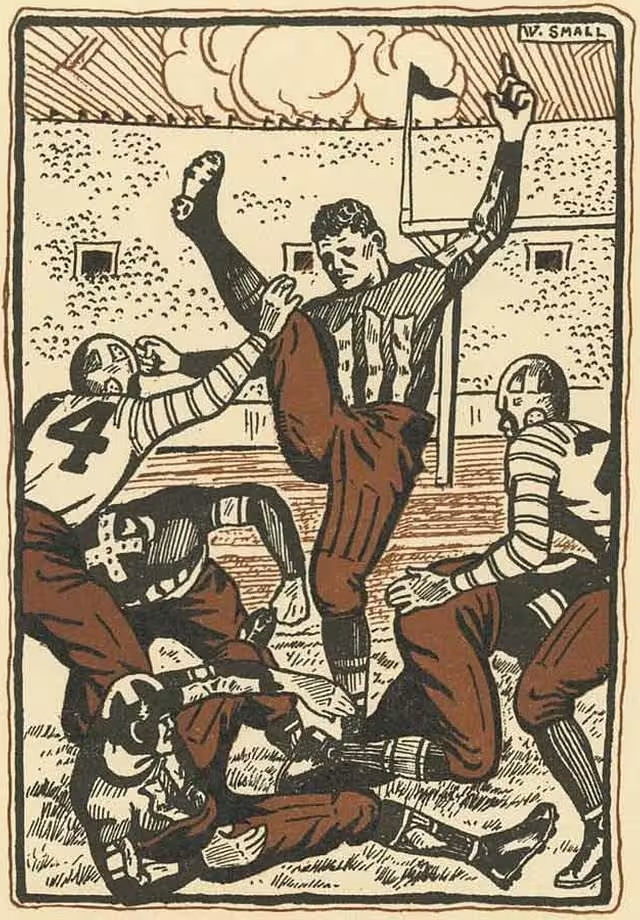
The Oregana – 1926 yearbook of the University of Oregon
The author is W. Small via Wikimedia Commons
Does this scene capture the essence of college football in the 1920s? Leather helmets were optional through much of the decade, and the all-important punting game is depicted in this brilliant piece that uses only 3 colors, but lets our imaginations run wild. Friction stripes on jerseys, horizontal stripes all the way down to the wrists on the jersey sleeves, and socks to the knickers, what a great piece of Americana!
January 11 American Football History Timeline
- January 11, 1895, Purdue University President James Henry Smart invited the presidents of six other universities to Chicago to regulate intercollegiate athletics. During the meeting, the group prioritized student-athlete eligibility and mandated that athletes maintain full-time status in good standing. The representatives officially founded the conference at a second meeting on February 8, 1896. Although Lake Forest College missed this session, the University of Michigan joined in its place. These seven attendees became the founding members of the organization known as the Western Conference.
- On January 11, 1946, the NFL announced that Bert Bell had been named the league’s second Commissioner. The Pro Football Researchers Association, in their 1996 Volume 18 edition of the Coffin Corner Magazine, shared a story from the Pro Football Hall of Fame detailing this transition. Elmer Layden, the first Commissioner, ended his tenure when Brooklyn owner Dan Topping withdrew his team to join the All-America Football Conference (AAFC). Owners chose not to renew Layden’s contract, concerned he was too soft to prevent departures. The AAFC, emerging strongly after World War II, presented serious competition with its resources and talent. The NFL owners then unanimously selected Bert Bell, owner of the Pittsburgh Steelers, as League Commissioner. Previously, the NFL had presidents: Jim Thorpe in 1920, followed by Joe Carr for 19 years, then Carl Storck for 2 years. In 1941, Layden became the first Commissioner as the league transitioned from the President title. Bert Bell quickly addressed a gambling scandal, refused truces with the AAFC, instituted the two-minute warning, and secured a TV deal. Bell’s resolve led to the AAFC folding, allowing the NFL to absorb its three strongest teams and enhancing the NFL’s position against college football.
- January 11, 1959 – Los Angeles Memorial Coliseum – The 9th NFL Pro Bowl was played as the Eastern Conference got the better of the Western Conference in a final score of 28-21. According to the American Football Database website, New York Giants halfback Frank Gifford and Doug Atkins, the Defensive End from the Chicago Bears, were the game’s Most Valuable Players.
- January 11, 1970 – Tulane Stadium, New Orleans, Louisiana – Super Bowl IV had the Minnesota Vikings taking on the Kansas City Chiefs for the right to win the Lombardi Trophy, according to Pro-Football-Reference.com. The Chiefs jumped out to a 16-0 halftime lead based on three Jan Stenerud field goals and a rushing TD by Running Back Mike Garrett. The teams exchanged touchdowns in the third quarter on a Vikings Dave Osborn plunge, and KC Len Dawson pass connection to Otis Taylor for a 46-yard touchdown. The Chiefs captured the NFL title by knocking off the Minnesota Vikings, 23-7. The game’s Most Valuable Player was Quarterback Len Dawson.
- The January 11, 1981, AFC Championship was played at San Diego’s Jack Murphy Stadium. The AFC West dominated the NFL’s American Conference when the Chargers hosted the Oakland Raiders. The Oakland Raiders defeated the San Diego Chargers, 34-27.
- January 11, 1981 – Veterans Stadium, Philadelphia – The NFC Championship, Philadelphia Eagles beat Dallas Cowboys, 20-7.
- January 11, 1987: The New York Giants beat Washington 17-0 in the NFC Championship before a record crowd at Giants Stadium.
- January 11, 1987 – Cleveland Municipal Stadium – AFC Championship will forever go down in the annals of sports history as “the Drive.” According to SBNation.com, Cleveland fans were on an emotional high as the Browns scored a touchdown with less than 6 minutes remaining in the fourth quarter on a 48-yard pass from Bernie Kosar to receiver Brian Brennan, who, with a spin move, escaped would-be tacklers to find the endzone. Things looked even better for the Browns as Denver bobbled the ensuing kickoff and found themselves with possession at their own two-yard line. The Broncos had not mustered a drive of any length all day against a stingy Cleveland defense, and that just added fever pitch to the home crowd. But the cool, calm, and collected John Elway had other things in mind. Elway and company drove the entire 98 yards of the field, including some third-and-long conversions, to tie the game and silence the crowd. The Broncos took the game to overtime, where a Rich Karlis Field Goal defeated the Cleveland Browns’ Super Bowl plans 23-20.
"THE DRIVE"
— Kevin Gallagher (@KevG163) January 11, 2026
First-&-98
Trailing the #Browns by seven late in regulation, #Broncos quarterback John Elway orchestrates an epic 15-play, 98-yard drive — capped by a touchdown pass to Mark Jackson — to force overtime in the 1986 AFC Championship#BroncosCountry
January 11, 1987 pic.twitter.com/eutU8OCe78
- January 11, 1995 – The Canadian Football League tried some experimental U.S. expansion by announcing Alabama’s Birmingham Barracudas were granted a CFL franchise. Birmingham lasted only one season, though, per Onthisday.com, as the States did not support the Canadian style of play.
- On January 11, 1998, the AFC Championship Game featured Bill Cowher’s Steelers facing a Denver Broncos team led by wily veteran John Elway. Terrell Davis started the scoring with an 8-yard scamper, according to Pro-Football-Reference.com. Pittsburgh countered with a TD by their big back, Jerome Bettis. The Steelers defense shut down Elway and company in the second half and made it interesting down the stretch, but could not overcome 3 Kordell Stewart interceptions, as the Denver Broncos went on to beat Pittsburgh 24-21 to advance to the big game. (source)
- January 11, 1998 – 3Com Park, San Francisco – The NFC Championship game was won by the Green Bay Packers, who outlasted the San Francisco 49ers, 23-10, to advance to the Super Bowl, per Onthisday.com.
- January 11, 1999 – Marty Schottenheimer resigned as head coach of the Kansas City Chiefs after 10 seasons. Schottenheimer had great success as an NFL head coach not only with the Chiefs but also with the Cleveland Browns a decade earlier. CBSNews.com tells how Marty’s teams played well in the regular season, but his failures in the playoffs led to many disappointments for Chiefs and Browns fans. It’s a shame that he is remembered for his failures rather than for the tremendous success his teams achieved. His 145 victories ranked him 10th in NFL history at the time.
- On January 11, 2004, the Philadelphia Eagles faced a crucial “4th and 26” while trailing the Green Bay Packers by three in the NFC Divisional Playoff. ESPN.com reports that, with 1:12 remaining, Donovan McNabb threw a 28-yard pass to Freddie Mitchell to keep the drive alive. The Eagles tied the game on a David Akers field goal, forcing overtime. The Packers had a chance in overtime until Brett Favre threw an interception to Brian Dawkins, setting up the Eagles’ game-winning field goal by Akers for a 20-17 victory. McNabb set a postseason record by rushing for 107 yards as a quarterback.
- January 11, 2011, had a doozy of a College National Championship game. A Heisman Trophy winner, Cam Newton, led the Auburn Tigers team that faced off against the prolific Oregon Ducks of Coach Chip Kelly, who ran more offensive plays per game than most.
- January 11, 2016 – University of Phoenix Stadium – The second College Football Playoff National Championship game featured the top teams in college football, with the Crimson Tide of Alabama challenging the Clemson Tigers. The College Football Playoff website covers the game’s storyline well. Clemson’s signal caller, the phenomenal Deshaun Watson, set a Championship game record with 478 total yards, but the Tide countered with offensive production from Derrick Henry, who trudged for 158 yards on the ground, and O.J. Howard caught 208 yards of passes on just 5 receptions with two scores. It was a game for the ages as #2 Alabama outlasted #1 Clemson, 45-40. The Tide’s O.J. Howard was the Offensive Player of the Game, while Bama’s Eddie Jackson was the Defensive Player of the Game.
January 11 Football Hall of Fame Birthdays
Conclusion
The tapestry of football history woven on January 11th is extraordinary. It reminds us that this single date encompasses foundational administrative shifts, such as the decisive appointment of Bert Bell—who defined the modern commissioner role—and breathtaking athletic drama, like John Elway’s 98-yard march and the improbable “4th and 26” conversion. Whether celebrating the careers of Hall of Famers like Paddy Driscoll and Dave Dickenson, recalling the intensity of championship clashes, or remembering Super Bowl IV, January 11th is truly a date when the NFL’s past was both shaped and celebrated.