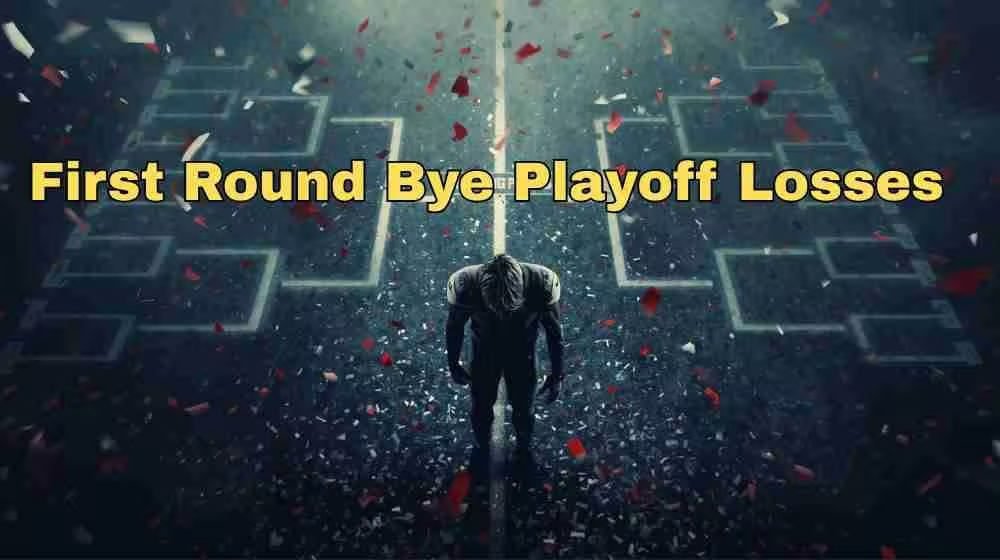
The current discourse centers on the notable outcomes of the second round of the College Football Playoffs for the 2025-2026 season, particularly emphasizing the alarming trend regarding teams that receive first-round byes. It has been observed that, in a strikingly similar pattern to the previous year, a majority of these teams have succumbed to defeat in their subsequent matchups, raising pertinent questions about the efficacy of the bye week as a strategic advantage. Specifically, we find that seven out of eight teams granted byes over the past two years have been eliminated in their first games of the playoffs, suggesting a potential correlation between extended periods of inactivity and diminished competitive performance. This episode delves into the ramifications of such trends, drawing a comparative analysis with the National Football League, where teams with byes have historically fared significantly better. We shall explore the implications of these findings and consider prospective adjustments that could be implemented to enhance the preparedness of teams entering the playoffs.
Join us at the Pigskin Dispatch website to see even more Positive football news!
Don't forget to check out and subscribe to the Pigskin Dispatch YouTube channel for additional content and the regular Football History Minute Shorts.
Miss our football by the day of the year podcasts, well don't, because they can still be found at the Pigskin Dispatch website.
The recent culmination of the second round of the College Football Playoffs for the 2025-2026 season has elicited a plethora of intriguing statistics and narratives worthy of examination. This discussion centers on the performance of teams that received first-round byes, particularly in light of the historical context surrounding such advantages. In the past two seasons under the newly instituted 12-team playoff format, a troubling trend has emerged: teams afforded the luxury of a bye have consistently faltered in their subsequent matchups, leading to a significant 7 out of 8 losses among those granted this respite. The implications of this trend provoke critical questions regarding the readiness and competitive edge of teams following extended periods of inactivity. Additionally, the episode delves into a particularly unusual play from the Reliaquest Bowl, wherein a punter's infractions underscored the complexities and nuances of college football rules, illustrating the fine line between strategic innovation and adherence to regulation. Through these discussions, we aim to illuminate the multifaceted nature of college football dynamics, particularly as they relate to playoff performance and the evolving strategies employed by teams.
Transcript
We have some very interesting facts and figures that are coming out here that we're going to discuss and compare them to the National Football League, especially on teams that have byes.
Speaker A:We have this award coming up in just a moment.
Speaker B:This is the Pigskin Daily History Dispatch, a podcast that covers the anniversaries of American football events throughout history.
Speaker B:Your host Darren Hayes is podcast from America's North Shore to bring you the memories of the gridiron one day at a time.
Speaker A:Hello my football friends.
Speaker A:This is Darren Hayes of Pigskind dispatch.com welcome once again to the Pig Pen for this special edition of the Pigskin Dispatch podcast.
Speaker A:yoffs round number two of the:Speaker A:After two years of having four teams with buys a 12 team format in a college football playoffs.
Speaker A:Some alarming news for teams that have buys.
Speaker A:We'll get to that in just a moment.
Speaker A:But there's a very interesting play that happened in a non college football play.
Speaker A:The Reliaquest bowl which was played the other day between Vanderbilt and Iowa had a very interesting play right before the first half.
Speaker A:Vanderbilt was trying to get back into the game.
Speaker A:They ended up squandering some opportunities.
Speaker A:They had a 4th and 15 from their own 15 yard line and their punter took the snap and went almost what looked like it was going to be a fake or at least a rugby scrum punt.
Speaker A:He started running towards the line of scrimmage and then kick the ball.
Speaker A:Really had a really nice boot that would have flipped the field quite nicely to and a half because there was less than a minute left.
Speaker A:I think there's 45 seconds left when he kicked the ball or when at least the snap for the the punt was taken.
Speaker A:But there was a flag on the field and here the punter had gone past the line of scrimmage when he punted and he was flagged for it, which I don't think I've ever seen in all my career of officiating or spectating football.
Speaker A:I've never seen a punter cross the line for an illegal kick until this game.
Speaker A:And it happened at a crucial moment and the penalty which I was a little bit surprised to I didn't process the whole play.
Speaker A:I figured it would be, you know, maybe half the distance and a re kick or something.
Speaker A:I didn't really process the whole thing but the college rule was you'd have a five yard penalty the team from the preceding spot, which means from the 15 yard line where the blast ball was snapped, it's a turnover on downs.
Speaker A:And Iowa got the ball at the 10 yard line and proceeded with Granowski their quarterback to throw a 10 yard strike to the right corner of the pylon and scored.
Speaker A:It's a quick touchdown.
Speaker A:Got another seven points added to their padding of their lead going into halftime and Cruz to a victory in the Reliaquest Bowl.
Speaker A:But very interesting play and you don't see that very often but illegal kick, you know, going past that line of scrimmage.
Speaker A:So be careful.
Speaker A:Teams and punters at all levels that are doing the rugby scrum punt or faking or feigning to fake a punt and running towards the line of scrimmage, make sure you boot that ball before you get there because it's not quite like illegal forward pass, it's not penalized the same.
Speaker A:And Vanderbilt learned very quickly, quickly how painful that penalty can be in that circumstance.
Speaker A:So that's just an oddity that came out of the college football playoffs.
Speaker A:But another one is teams that have first round buys.
Speaker A:So let's just review the college football playoff of the last two years, the first two years of the 12 team format.
Speaker A:So you have 12 teams, you have the top four seeds get a buy in the first round, the other seeds, the next four highest seeds will be seeds five through eight get a home game in the first round and the seeds nine through 12 have to play those respective teams on their home field.
Speaker A:Well, last year all of the teams that had buys lost all four games.
Speaker A:You know, it was just an unbelievable circumstance and everybody said wow, is it maybe is that too long to go without playing a football game?
Speaker A:These first round buys, could that be the problem?
Speaker A:You know, we had Arizona State ended up losing to Texas.
Speaker A:Ohio State beat Oregon who had a buy.
Speaker A:Boise State lost to the Notre Dame, sorry to Penn State and Georgia lost to Notre Dame.04 were the teams with buys.
Speaker A:ollege football playoffs, the:Speaker A:We had three, three of the four teams that had a bye week lose the game.
Speaker A:The exception was Indiana who handily won their game defeating Alabama.
Speaker A:But you know, Oregon beat Texas Techs who had to buy.
Speaker A:Ole Miss came back and beat Georgia and a thrilling game or Georgia had that first round by and Miami surprised Ohio State.
Speaker A:And so people say, you know, teams can't go this long without playing a game.
Speaker A:So that makes seven of eight teams with buys in the last two years have lost their first round thing and, and you know, got kicked out of the tournament because of that, but, you know, losing, you're out kind of thing.
Speaker A:But Miami is a perfect example of a team that did not play in their conference championship.
Speaker A:They were not in the ACC championship for the weird rule that the ACC had, we talked about that on a previous episode.
Speaker A:But they went 20 some days without playing a game, ended up winning two games in a row, one on the road against Texas A and M in their first round game.
Speaker A:So it can be done and maybe it's not too long, but maybe the preparedness of it maybe should be looked at.
Speaker A:That's an interesting thing to examine.
Speaker A:So let's look at this comparatively.
Speaker A:I guess the only thing that's closest to this in the game of football would be maybe the National Football League who has had first round buys for probably the last 30 some years of the top seed.
Speaker A:From:Speaker A:So it's, it's been sort of staggered around here for some time.
Speaker A:But now you know, you have first two seeds are getting buys again here.
Speaker A:But so roughly in the last 25 years and these are not exact numbers, they're just numbers I tried to add up real quick here to do but just to give some perspective on this.
Speaker A:So in the last 25 years we've had approximately 88 games of teams that had a first round buy in the playoffs, that played in the divisional round the next week.
Speaker A:A home game in NFL circumstances, unlike the college game where they play on neutral sites.
Speaker A:But there's only been 38 times in the 88 that a team with the buy lost the game.
Speaker A:They were thus the home team.
Speaker A:So it's a little bit in favor of the home team that had the buy and the National Football League.
Speaker A:Nothing like the 1 in 8 or 1 in 7 record of the the team of the buy in the college football playoffs the first two years.
Speaker A:So will this trend change and what will teams do in the coming years to if the same format is held to, you know, prevent against us should, you know, maybe they should be getting a scrimmage game.
Speaker A:You know, who knows what they're going to be doing to do this, having that two week layoff.
Speaker A:And maybe that's not the case.
Speaker A:Maybe the teams are just that competitive and maybe the rankings are poorly done that you just don't know who the better team is until you get on the field and play the game.
Speaker A:So fascinating study to look at and something we'll have to watch in the future.
Speaker A:But just a couple things for college football playoffs I thought maybe it would be historically relevant to talk about here on the Pigskin Dispatch Football History Podcast.
Speaker A:So hope you enjoyed this.
Speaker A:As we talk about every podcast, I hope you're enjoying your new year and and we have some great stuff coming up next week, so make sure you join us, including our visit with Timothy B.
Speaker A:Brown of Football Archeology going into our College Football Jersey Number series, we'll be talking about the number three going to our big Bold predictions with Ed Cleese for the Wild Card weekend coming up and looking at Results from Week 18 in national football League and more fun in college and pro football history.
Speaker A:Till next time everybody.
Speaker A:Have a great gridiron day.
Speaker A:That's all the football history we have today folks.
Speaker A:Join us back tomorrow for more of your football history.
Speaker A:We invite you to check out our website pigskindispatch.com not only to see the daily football history, but to experience positive football with our many articles on the good people of the game as well as our own football comic strip clete marks comics.
Speaker A:Pigskindispatch.com is also on social media outlets, Facebook, Twitter, Instagram and don't forget the PigSkindiSpatch YouTube channel to get all of your positive football news and history.
Speaker A:Special thanks to the talents of Mike and Gene Monroe, as well as Jason Neff for letting us use their music during our podcast.
Speaker A:This podcast is part of the Sports History Network, your headquarters for the yesteryear of your favorite sport.
Speaker A:You can learn more@sportshistorynetwork.com.